Showing posts with label Pochard-Red-Crested. Show all posts

Sunday, 25 September 2016

Spurn Week 14

Spurn 19.09.2016
After possibly the most frustrating week of my life away from Spurn for my mums birthday, today I made the proud return. Yeah, I may have missed a host of rare birds (Including a mega) but now I was back to set things right.
I intended to go down to Seawatching but ended up in Canal Scrape looking for jack snipe. It was not present but whilst there Jonnie heard a Yellow-browed warbler and after a bit of a chase we nailed it in the Sycamores in canal hedge. Two years since my last of this very dainty species, so very nice to catch up with one again.
-Common Snipe
-Yellow Browed Warbler

I spent the rest of the morning walking round the triangle. A Richards pipit was reported but attempts to refind it were unsuccessful. On the canal were a very showy Common Snipe and a fairly showy Water Rail, showing especially well for how skulking they usually are.
It was whilst walking back that I probably had the best of the morning. Along the canal I passed a few birders looking for a barred warbler. It was clearly a tour group of some kind. After I had just passed them the group leader shouted ‘large bunting coming, looks like and Ortolan’. The bird was extremely vocal and then landed right in front of us on the edge of the saltmarsh. It sat out in the open for all of a minuet before flying over us and into a field not to be seen again. Whilst I got pleasing views through bins, between radioing it out and trying to get my camera out of my bag, I had ended up not seeing it for very long at all. A pity really!
The afternoon was largely spent sleeping. When I awoke we headed down to the Seawatching hide, slowly via the canal and Clubleys field. A Redstart on canal scrape was about the best of it. A couple of Snipe of Clubleys field was also a nice treat. Seawatching was dead. Really dead! Only a handful of birds in total!

Species List:
Triangle: Ortolan Bunting, Yellow-browed Warbler, Mallard, Teal, Wigeon, Brent Goose, Pink-footed Goose, Moorhen, Little Grebe, Water Rail, Willow Warbler, Reed Warbler, Reed Bunting, Meadow Pipit, Tree Pipit, Rock Pipit, Great Tit, Blue Tit, Grey Wagtail, Skylark, Starling, Goldfinch, Chaffinch, Winchat, Stonechat, Wheatear,
Seawatching: Razorbill, Guillemot, Kittiwake, Black-headed Gull, Common Tern, Sandwich Tern, Common Gull, Swallow, Red-throated Diver, Cormorant, Common Scoter

Spurn 20th September
It was another damp morning, much like the previous…
The plan was to head down to Seawatching via the canal. Along the way down the canal we picked up a few bits and pieces, the highlight being a Grasshopper Warbler skulking in the bottom of a Hawthorne bush. It’s the first time I have ever seen this species on the deck and not in flight. Once I got down to the Warren I was pretty pleased to pick up a Yellow-browed Warbler in the sycamores. Not a new bird or anything, as it had been present the previous day, but always a delight to see such smart little birds.
The sea was steady, with a trickle of Divers, Kittiwakes and Skuas all going past. A couple of very close dark phase Arctic Skuas were probably the best of it, especially when they started mobbing the terns that were blogging about. The rest of the triangle had obviously seen something of a clear-out from the previous day. There were still a few Meadow Pipits knocking about, and among them I picked out a Corn Bunting on the fence line.
The main order of the day was moving the tern equipment off the beach and into Kew. On my way up to Beacon Ponds I was treated to my first Jack Snipe of the Autumn which I flushed from sea defences at long bank. Obviously it showed no signs of slowing up once flushed, and fair pinged it towards the listening dish.

Species List:
Triangle: Lesser Whitethroat, Whinchat, Stonechat, Grasshopper Warbler, Reed Warbler, Sedge Warbler, Redstart, Yellow-browed Warbler, Garden Warbler, Corn Bunting, Reed Bunting, Little Grebe, Blackcap, Grey Heron, Marsh Harrier, Blue Tit, Great Tit, Woodpigeon, Feral Pigeon, Carrion Crow, Willow Warbler, Swallow, House Martin,
Seawatching: Red-throated Diver, Great Skua, Arctic Skua, Sandwich Tern, Red-breasted Merganser, Teal, Tufted Duck, Common Tern, Gannet, Kittiwake, Common Gull, Razorbill
Long Bank Area: Common Snipe, Jack Snipe, Greenshank, Lapwing, Wigeon, Mallard, Teal, Woodpigeon, Reed Bunting, Willow Warbler, Swallow, House Martin,

Spurn 21st September
After the easterlies overnight I was obviously hopeful for some new birds having dropped in. Sadly the winds had changed and the walk round the triangle did not produce much different. Obviously though Yellow Browed Warbler is always a treat to see, and once again I picked one up in Cliffe Farm on my walk down to the Canal Zone. And the walk then ended with seeing one in the hand with one trapped and ringed in Churchfield. Such cracking little birds!
-Yellow Browed Warbler
The afternoon was spent doing work on the garage for the preparation for the new roof coming on Friday. During our work in the obs garden we had 2 more Yellow Browed Warblers and a flock of 14 Long-tailed Tits which are something of an irregularity down south of Easington.
We had just finished with the garage and I had just set off my dinner when the radio buzzed into life; Paul had recaught the Blyths Reed Warbler that I had missed on Sunday. Cue absolute pandemonium as all 7 birders sat in the obs kitchen sprung into life. Given my disastrous weekend it was good to settle my score with one of the species I missed.
The light was fading but I still managed a few decent enough shots of the bird in the hand. I’m not gonna lie, I have tried to read up on this species and I still have very little idea what I’m actually looking for beside the ‘banana shape’ which this individual did not even show. Still, something to read up on one quiet evening I suppose.
-Blyths Reed Warbler
The bird was released after being shown to the small crowd that had gathered. Its weight had gone up substantially since its previous trapping on Sunday, which is a sign the bird had obviously made itself at home in the area. It begs the question as to why nobody had seen it over the past few days, as its skulked away through the undergrowth no doubt.  

Species List:
Triangle: Chiffchaff, Willow Warbler, Reed Warbler, Sedge Warbler, Yellow-browed Warbler, Reed Bunting, Meadow Pipit, Pied Wagtail, Tree Pipit, Moorhen, Little Grebe, Linnet, Lesser Whitethroat, Jackdaw, Carrion Crow, Magpie, Mallard, Teal, Shelduck, Herring Gull, Whinchat, Stonechat, Long-tailed Tit, Blue Tit, Great Tit, Turnstone, Sanderling, Dunlin, Redshank,

Spurn 22nd September
Wednesday morning brought a change in the weather, and with it the emphasis changed from bush bashing into vis-migging. So I headed down to the warren in the morning, as per, hoping for a good day’s passage, or something moving on the sea.
As it happened I got neither of those. The previous night there had been a photo sent through the Spurn account of a Siberian stonechat seen the previous day. It was somewhere down the point and as a result the effort given to trying to refind the bird was negligible. As a result, I decided to go down and hopefully recover the bird.
Sadly I did not recover the bird, although it would not surprise me if it were still down there. Birds as a whole were at a bit of a premium. I heard a Yellow-browed Warbler but could not get it out of the bushes. A few Wheatears were still around at various points along the road and a smart Lesser Whitethroat was probably the best of it.
In the afternoon I made the most of the bike that we have at the Obs and made my way up to Kilnsea to count the wildfowl, the down to the canal scrape to see if any snipe had dropped in. The wetlands was good, with 209 Wigeon, 92 Teal plus small clusters of Shoveler and Pintail. The canal did not have the variety as Wetlands but did have a Kingfisher on it, which is always a bonus. I was able to grab a few photos but the light was badly against me.
-Kingfisher
After Canal Scrape I was beginning to cycle back when a radio message came over of a possible Siberian stonechat ‘stejneger’ at the Warren. I know nothing on this topic, but went along to learn. In the end all birders there left none the wiser. The consensus was that the bird would have to be trapped and sampled to be anywhere certain, but it was in the company of 2 other European Stonechat and there was no obvious difference in the field.

Species List:
Triangle: Brent Goose, Whinchat, Stonechat, Wigeon, Merlin, Kestrel, Long-tailed Tit, Lesser Whitethroat, Willow Warbler, Mallard, Dunlin, Herring Gull, Black-headed Gull, Teal, Redstart, Little Egret, Moorhen, Song Thrush, Blackbird, Common Snipe, Kingfisher, Meadow Pipit, Swallow,
Spurn Peninsula: Wheatear, Song Thrush, Turnstone, Knot, Rock Pipit, Willow Warbler, Eider, Whitethroat, Chiffchaff, Goldcrest, Blackcap, Lesser Whitethroat, Great Black-backed Gull, Herring Gull, Black-headed Gull, Little Gull, Cormorant, Brent Goose, Oystercatcher, Curlew, Bar-tailed Godwit, Swallow, House Martin, Meadow Pipit, Dunlin, Sanderling, Ringed Plover, Kestrel, Golden Plover, Grey Plover,
Kilnsea Wetlands: Mediterranean Gull, Wigeon, Greenshank, Lapwing, Ruff, Teal, Knot, Shoveler, Black-headed Gull, Common Gull, Jackdaw, Magpie, Common Snipe, Mallard, Herring Gull, Wigeon, Swallow, Meadow Pipit,

Spurn 23rd September
Today was basically given up to the construction of the new garage roof at the observatory. That being said we did get out birding a little bit. Most of the birding we did get done was on canal scrape, largely looking for and then at the Jack Snipe that finally decided to show somewhat. It showed badly obscured and asleep but I have now finally seen it. Hopefully in the coming days it will decide to show a bit better…
-Jack Snipe
Also on the agenda was chasing down yesterday’s Stonechat but to no avail. To consensus seems to be that it’s just a normal Stonechat anyway, which suits me as I could see no difference in the bird the previous evening. However in being down at the warren I was on hand to admire the Long-tailed Tits that the ringers caught. It was the same flock that had been around for some time and all the birds caught had previously been caught by Paul only a couple of days ago.
-Long-tailed Tit

Species List:
Triangle: Stonechat, Whinchat, Meadow Pipit, Yellow Wagtail, Grey Wagtail, Common Snipe, Jack Snipe, Dunlin, Jackdaw, Great-spotted Woodpecker, Yellow-browed Warbler, Spotted Flycatcher, Willow Warbler, Mallard, Wigeon, Little Egret, Grey Heron, Hobby, Sandwich Tern,

Spurn 24th September
With the garage roof all but done, we were afforded more time to go out birding. Of course the first port of call was Canal Scrape to see if the Jack Snipe was showing at all. It was, and much better than yesterday. With the morning light still very much sub-par I decided my best option  was to phone scope it which did get some results, although not as fantastic as I would have liked. In the end, the bird bobbed away into the reeds until all you could see was its bobbing profile.
-Jack Snipe
Next call was numpties for the Vis-mig. There was a steady flow of a mixture of species, but it was by no means exceptional. A few finches, Hirundines and Meadow Pipits were the main movers. The undoubted highlight was a Merlin that flew past us a couple of times, fairly close too, and then proceeded to chase starlings over Clubleys field.
-Merlin
After a short food break I headed onto Wetlands for a look at the high tide waders. Sadly none came on. A few Waders already present were showing well, as they often do from the hide. I resorted to counting the ducks, but even their numbers had seemingly dropped off.
The afternoon was largely spent running up and down Easington Straight after a possible pacific golden plover but sadly nothing much came of it, and then the task of moving wood into the new woodshed. However, the day reached its peak when late afternoon I sacked off the wood moving and went to have another look at the Jack Snipe, and the Jack Snipe was obliging greatly by sitting right out in the open, showing well. I think it’s best to let the photos do the talking on this one…

Species List:
Triangle: Sand Martin, House Martin, Swallow, Greenfinch, Goldfinch, Linnet, Reed Bunting, Meadow Pipit, Grey Wagtail, Red-throated Diver, Starling, Merlin, Shelduck, Mallard, Black-headed Gull, Tree Sparrow, House Sparrow, Cormorant, Gannet, Jack Snipe, Common Snipe, Wigeon, Moorhen, Little Egret,
Kilnsea Wetlands: Knot, Dunlin, Ringed Plover, Redshank, Greenshank, Little Egret, Pied Wagtail, Meadow Pipit, Wigeon, Teal, Mute Swan, Greylag Goose, Swallow,

Spurn 25.09.2016
After a night in the pub, and with an oncoming cold I was not exactly in a rush to get out of bed in the morning. When I did eventually get up, eventually being 7.30, I headed down to the canal scrape in the hope of seeing the Jack Snipe in good light, but sadly it was not showing. A Water Rail made a brief appearance and a Common Snipe showed very nice.
Most of the day was spent sorting out wood, but had a few breaks to go out birding, namely a return trip to the Jack Snipe which had now come out and was showing well. This was followed by a trip to the Borrow Pits for a reported Red-crested Pochard, which was still there among the mallards, but obviously has to have some questions over its origins. That being said, there are a number of Spurn birders who seem to think that it has indeed got some credentials, so we will see what happens to it…
-Red Crested Pochard
In the evening I checking in on the Jack Snipe again, which continued to show well. The problem was the light was against me trying to improve on the photos which I had already got. I decided not to stay long and then go down to the Seawatching. It was fairly quiet down there, but a nice movement of Mediterranean Gulls, about 25, was something a bit different and made going down worthwhile.
-Jack Snipe

Species List:
Triangle: Water Rail, Jack Snipe, Common Snipe, Yellow Wagtail, Meadow Pipit, Whinchat, Reed Bunting, Red-crested Pochard, Little Grebe, Mallard, Moorhen, Dunlin, Swallow, House Martin, Grey Heron, Woodpigeon, House Sparrow, Kestrel,
Seawatching: Arctic Skua, Common Gull, Mediterranean Gull, Great Black-backed Gull, Black-headed Gull, Gannet, Razorbill, Red-throated Diver, Bar-tailed Godwit, Dunlin, Swallow,

Tuesday, 5 April 2016

Norfolk Day 2

Having done Cley yesterday, today's logical choice was Titchwell. The bus scenario meant I diddnt arrive on site until eleven, but I quickly settled down and began to rack up some year-ticks. Brief glimpses of Cettis Warbler were frustrating and a superb drake Red-crested Pochard remained sadly distant up the reed-beds.
I wandered up to the beach, getting more views of great waders: Redshank, Grey Plover, Black-tailed Godwit and my first Little Ringed Plover of the year. Brent Geese were also showing quite closely to the walkway. Out at sea it was fairly quiet, though there was a smart flock of Common Scoter not far offshore, as well as a couple of Great-crested Grebe in their summer finery.
Walking back down the sea wall I managed to grab a few more things, that were perhaps less expected. First I managed to pick up a smart Merlin hunting over the saltmarsh, though sadly it only passed through as opposed to hunting anything. I was able to grab a shot of it though although the light was not over helpful.
-Merlin
Back down near the visitor center I bumped into a crowd off birders looking into a ditch, and following where they were looking I could see they were looking at a Water Rail feeding right out in the open no more than a couple of meters away from us. It really did not seem bothered about us being there, although it had plenty of cover from fallen vegetation. I managed to get some shots but it was very dark in the shade and the vegetation obscured but I'm still pleased with the results that I got. 
-Water Rail
I was hopeful of picking up brambling on the feeders but there did not seem to be any about. Walking through the willows though I grabbed my first Chiff-chaff of the year. I had heard them since arriving in Norfolk but this was the first one that I had seen, mainly due to the fact that I could not face chasing them round given I was bound to bump into one at some point, as in here...
-Chiff-chaff
Continuing round to Pats Pool I did not pick up a great deal more for the daylist but there was a nice pair of Red-crested Pochard there that were showing a bit better than the birds in the reeds so I attempted to grab a record shot to work with and it seems decent enough for that.
-Red-crested Pochard
It was now about three in the afternoon and I decided to move on from Titchwell. I did manage a Brambling on the way out, in the feeders near the entrance although the views were badly obscured through the trees, still a nice addition to the day and yearlist.
Next on the agenda was the last Golden Pheasant at the Wolferton Triangle. The history of this bird is that this is the only disclosed tick-able Golden Pheasant left of the old population. An old bird, time is probably not on its side. I knew how to get there and what to do, but at this time in the afternoon I did not fancy my chances, especially with stories of having to wait up to 3 hours from first light, which was supposedly the best time of day. I arrive at Wolferton for half 4. Being on foot put me at a massive dis-advantage as the bird could come out at one side of the triangle and I would have no idea if I were on the other side, and it would take time to get round to check. I figured my best strategy was to pick a side, set up and the pray it played ball. I was in luck though. I initially walked the north side with no joy but there was a lot of traffic. Seeing the traffic made me even less confident of seeing it, but I figured if I was on site I at least had a chance.
Walking the south side I heard a call I was not familiar with on the far side of the road to the triangle, and a quick check of Xeno-canto via the phone confirmed that it may in fact be the pheasant I was after. With this possible lead I decided to set up on the south side and scan the road. It was about half an hour since when I turned around from looking up the road to see a flash of gold dissapear into the bushes behind me. It had obviously come out when I was facing the other way and when I turned my movement had spooked it back in. However, it had now not only been seen, but its position and intentions had been given away. It was clearly trying to cross the road to Triangle. Now all I had to do was wait.
It took another 10mins before, emerging from the bushes, he decided to saunter across. It was incredible to see, but it quickly turned to horror when a car decided to come speeding round the corner and reduced possibly a 10 second crossing into a 2 second crossing. The pheasant put on a spurt across the road into the triangle and that was that. With the sudden pressure of the car I had no time to think, and one of the things I failed to do was focus the camera, what a muppet. The bird moved so fast I had no time to judge and by the time I had the focusing right the bird was already gone...
-Golden Pheasant
I was so pleased to have seen it, and after only an hour. I was buzzing. The road was still busy and now with no pin-point on its location I knew the odds were stacked against me for re-finding it. I decided to call it a day at that, but what a result, I did not expect that at all. Result.

Species List:
Titchwell RSPB: Common Buzzard, Woodpigeon, Red-legged Partridge, Black-headed Gull, Siskin, Chaffinch, Blackbird, Blue Tit, Great Tit, Marsh Harrier, Greylag Goose, Brent Goose, Common Teal, Pochard, Coot, Cettis Warbler, Red-crested Pochard, Curlew, Gadwall, Canada Goose, Shelduck, Pied Wagtail, Mallard, Grey Plover, Black-tailed Godwit, Redshank, Little-ringed Plover, Avocet, Shoveler, Moorhen, Red Kite, Sparrowhawk, Lesser Black-backed Gull, Common Scoter, Great-crested Grebe, Oystercatcher, Common Gull, Cormorant, Meadow Pipit, Herring Gull, Swallow, Goldfinch, Sand Martin, Jackdaw, Magpie, Pheasant, Collard Dove, Chiff-chaff, Wigeon, Water Rail, Tufted Duck, Mute Swan, Brambling, Wren, 
Wolferton Triangle: Goldcrest, Siskin, Long-tailed Tit, Common Buzzard, Woodpigeon, Chaffinch, Golden Pheasant, Robin, Blue Tit, Blackbird,

Monday, 27 April 2015

Attenborough Nature Reserve - Finally reaching BOU 250!!!!!

Having had a calamity on Saturday and with no sign of the Hudwit re-appearing I was left at something of a loss with my birding. The heron on Scilly was tempting but it decided to set off on another island hop again, and as a result I considered not worth the risk.
However, another heron, not a mega but certainly a stunning bird had turned up near Nottingham on Sunday, though I was busy then. When it was re-found today I decided to head off after lectures to try and get a look, since it was not going to cost the earth (Less than a trip to Swilly) and would mean checking out another site and hopefully seeing some smashing species. 
The train was right next to the reserve, so I was on the site within 90 mins of setting. As is usual for a twitch, I powered on to where the heron would be. However, I was distracted as soon as I entered the reserve by a couple of ducks on the water as I marched past. I checked myself and went through the bushes for a closer look. They were indeed what I thought they were, Red Crested Pochard males. As is customary with this species, its difficult to know if the individuals you are looking at are tickable or not. However, there was not an excess of toilet ducks, as you would maybe expect. They never showed their legs for rings, but they were very tame. However, they seem pretty legit so I have them down on my yearlist as my 149th species of the year. I also saw them again on the way back when I was able to get some shots of them preening. It was an ideal start to the afternoon.
-Red Crested Pochards
Through the woods there were ample Blackcaps singing as well as a host of other, commoner species. Walking along the path directly to where the heron was I heard a bizarre call, almost like a squawking response to a predator. I was shocked when I found a male blackcap with its feathers all splayed out, it all became clear when a female appeared from the foliage a few seconds later. Its the first time I have seen blackcaps displaying and it was certainly something to behold. I was directly below them, and could have stayed to get some photos, but did not want to disturb them so took a couple of quick shots and left them to it.
-Blackcap
And just round the corner from them was the bird of the moment. The heron in question? Black Crowned Night. I remember seeing them in zoos and being surprised by how small they were. Now, in the field I was surprised by how big it was compared to how I remembered it.
It was badly obscured by the leaves but it was not inactive and moved its head enough so you could see all its features. Its eye was captivating through the scope, so deep and orange. The small crest behind its head was also a pretty funky feature, especially as it was being constantly buffered by the wind. Despite the cover I did get to see the complete bird, just not all at the same time. It was not close but not distant, sat on an island in the middle of the lakes. I got some good shots of it through the scope, showing all the features and what a superb bird it is.
-Black-Crowned Night Heron
After 15 mins of watching and enjoying the bird it suddenly took off and flew round out of sight. I was a bit gutted it had gone, but more that I had not got any photos of it in flight. Either way, it had gone, possibly due to there being more cloud cover making it think it was closer to evening than it was? I dunno.
I mentioned to a couple of guys there that I needed gropper and they gave me some directions to where they knew of some. It was no problem, as around 400 meters further down the path I heard one reeling away. Possibility of my second lifer and biggest bogey bird. I could see a few guys further down the path looking for it but I could tell they were as frustrated as me by the fact it was remaining very skulky.
Then I noticed a heron flying towards me. I dunno why I did not call it immediately as it was clearly too small to be a Grey or a Bittern but needed to check through the bins first and as a result wasted time checking that I could have been using to take photos. It was, of course, the bird of the hour, the Night Heron. I called the guys down the path, as it was going over their heads, before it flew over the trees. We raced round but it had gone over the next line as well, as the hide we needed had been conveniently locked just when it was most required. I did get one shot away, and its not bad.
-Black-Crowned Night Heron
We then returned to the gropper as it started reeling again. We saw its movement but nothing of it, and my quite clearly exceptional record with this species continues...
With the afternoon drawing on there had been an outburst of flying insects. I am not talking about a few midges or anything, these were swarms of bugs all down the paths. It was a little unpleasant so headed to an area of open space nearer the visitor center. On the way I checked the lakes and picked out a couple of Little Ringed Plover and plenty of Common Terns.
At the visitor center there was little resbite from the flies that had got much worse as I had moved. Despite the heron, I think here was where my favourite part of the afternoon occured. There had been Cetti's Warblers singing all day at the reserve but as per I could not get close. However, just off from the center, one was singing adjacent to the path, and I decided to try and track it down. It did not take long, as I soon picked up the bird skulking through the brambles. It was the clearest view of this species I have ever had.
And then, it decided to stop skulking and start to go up a tree feeding all the way. I could not believe it and was trying desperatly to get shots of this bird that was showing itself so well. Then, out in the open off on a branch, I got to see it sing. Its the first time I have ever been able to see the species clearly and singing. The way it chest bubbles as the song explodes out was probably the best thing I saw all day. I did manage some shots, though not of the song, but clearly of the bird, a real beauty.
-Cetti's Warbler
The bird then dropped again. I had decided, before the bird started showing properly, that the flies had reach an unbearable point and that I would go for the next train, which was not long until. As a result I decided to leave the cetti's and head off to the station.
So thats how the afternoon concluded, as fantastically as it had started, putting my on 151 for the year and 250 life list with the addition of Night Heron. A superb bird, with a fantastic supporting cast and a great day out. Pretty sweet all in all.

Species List:
Attenborough NR: Mallard, Canada Goose, Graylag Goose, Gadwall, Pochard, Red Crested Pochard, Tufted Duck, Mute Swan, Grey Heron, Black-Crowned Night Heron, Oystercatcher, Little Ringed Plover, Chaffinch, Great Tit, Dunnock, Black-Headed Gull, Lesser Black-Backed Gull, Blackcap, Cetti's Warbler, Magpie, Carrion Crow, Jackdaw, Common Tern, Coot, Moorhen, Blue Tit, Woodpigeon, Feral Pigeon, Great Crested Grebe, Lapwing, Cormorant, Reed Bunting,

Wednesday, 16 April 2014

Norfolk Holiday Day 4

And so on the last full day in Norfolk I decided to return to Titchwell since it had given so much more than Cley had yesterday. Once more it took me the best part of the morning to get to the site, but once there the weather was lovely and hopefully there would be plenty of morning reports for me to go for. 
I arrived at the site and checked the list. Both the mornings oddities were at Patsy's Reedbed; Pink Footed Goose and Lesser Whitethroat, the latter would be a lifer for me. I therefore headed straight to there. I wandered up to the view point over the pool and immediately spotted the PFG, which was resting among the graylags on the near side of the pool. I watched it for about 10 mins before deciding it would be time to try and locate the Lesser Whitethroat. 
-Pink-Footed Goose
So having picked up a great tick in the PFG, and got my best ever photos of the species I headed on to where the whitethroat was. It had been reported in the hedge behind the the pool, not showing well but calling frequently. As I had been asking for info about the bird at the center one of the birders wandered by who had seen it. He asked if I knew what one sounded like, and said that it sounded like a yellowhammer but without the 'cheese' when I replied no.
And so I stood next to the hedge listening for a yellowhammer with no cheese. And after about a minuet I heard it. I followed its call for some time before I saw it shadowy figure moving through the hedge. That was the pattern for a good 20 mins, following the skulky bird through the hedge without getting a real good view, but frequently hearing its call. 
After the 20mins it had a quiet spell, before having a very loud spell and then deciding to up-sticks and head away from that hedge and a different one away on the far side of the field. I tried to get a record shot as it flew off, but I struggled and my only effort is shown below, the bird being near the bottom right corner. You can see the dark cap if you blow up the photo enough, but photos are not everything, and my record shot is enough, as it pretty much sums up my view of the bird, skulky and difficult to see.
But see it I did, making it my 4th lifer of the holidays, and that was exciting enough when I had only just started the mornings birding.
-Lesser Whitethroat
Since the whitethroat had left I turned to find that the PFG had left to my disappointment. As a result I decided to head off, and just as I was leaving I turned again and what should drop out of the reeds but a Bittern. I could not believe it, as it landed right on the edge of the reeds on the edge of the pool, allowing me a great view of the bird. 
It stayed at the edge for a little while before merging itself into the back of the reeds. I managed a few photos but struggle to find it through the scope. The bins were enough, though they were not necessarily needed for a great view.
-Bittern
As I waited to see if the bittern would come back out the PFG returned with a small group of Graylag's, and landed on the pool. It took a little while but it returned to the bank soon enough and I was able to pick up a few more photos with the light with me this time. So that's 3 pretty awesome bird species and I had not even been onto the main part of the reserve.
-Pink-Footed Goose
I began my walk up the Western Bank to the Parrinder Hides. On the way up along the edge of the woods where the reeds are I heard a very familiar call that I have been hearing all week. It was the stunning and shocking call of a Cettis Warbler. As I turned to see if I could find the source of the call I spotted a small reddish warbler fly out of the reeds and land lower down. I then got to follow the bird as it skulked through the bottom of the reeds before it flew off into the woodland. So that was my second Cettis Warbler of the Holiday, and only my 4th ever.
The hides were quite quiet by the high standards set last time, though there were still great numbers of wildfowl and waders. There were a few Little-Ringed Plover and Avocets, as well the usual suspects. I decided to head up to the coast and see what was around up that end. 
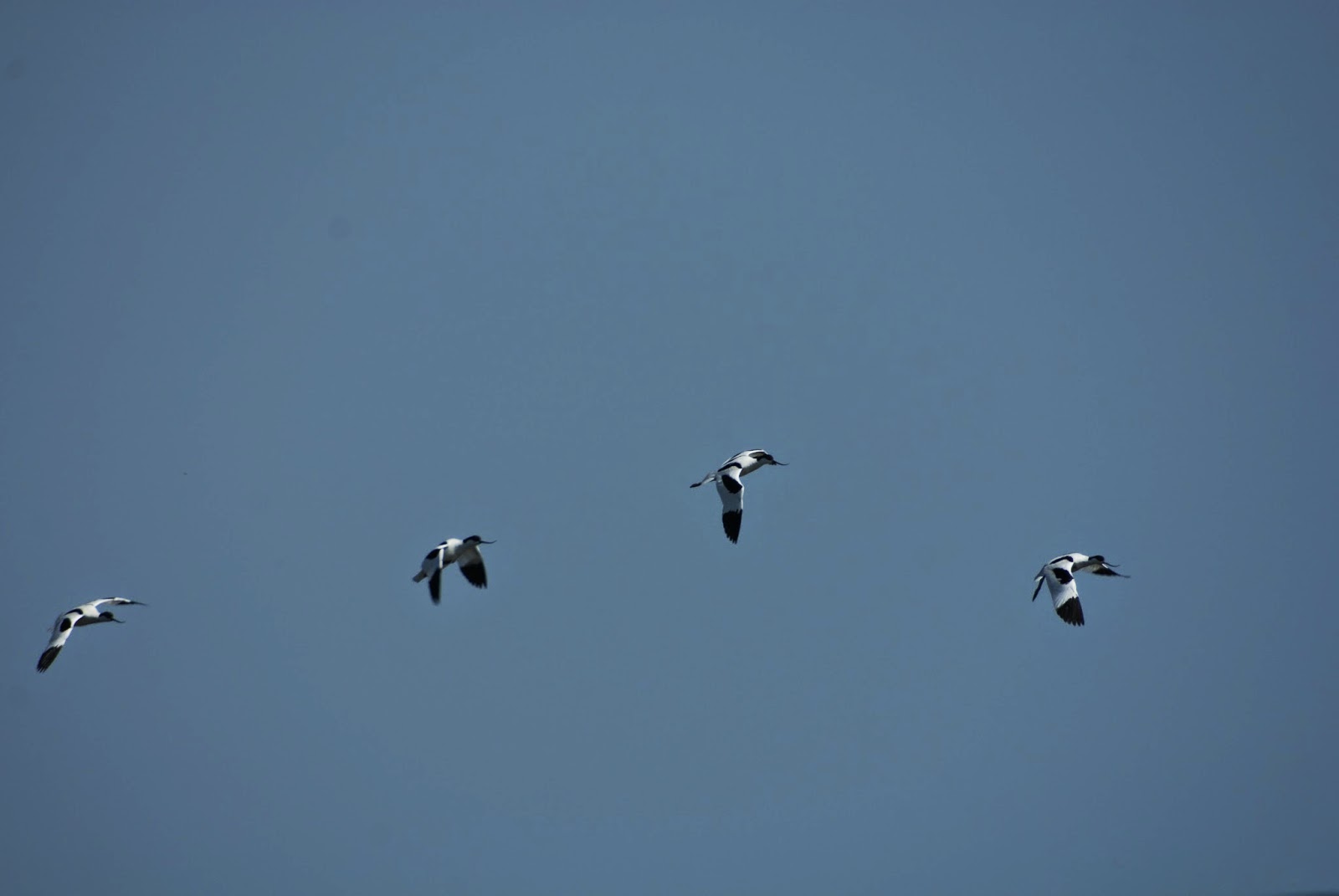
On the way up to the beach I was able to watch some lovely birds along the edge of Volunteer Marsh and Tidal Marsh. There were good numbers of Grey Plover and Brent Geese, but the highlights was a small group of Avocets over the tidal marsh which did a few Loop-de-Loops over the marsh before coming back down and landing on the island. Because they were in flight you can really appreciate the beauty and elegance of these birds.
-Avocet
Up on the coast I arrived just in time to see a flock of scoters with white wings come and land on the ocean quite near the shore. I had a look through the scope, and possibly because the sea was calm, or perhaps because they were closer I was actually able to fully appreciate the birds and even see the yellow on their bills and the white on the wing.
I still could not really count the number of each species in the flock, but I knew there were a large majority Velvet due to the number of white wings that I had seen when they landed. I grabbed some better record shots, which show that quite a few of the birds do indeed have white wings, but that some don't, a mixture flock.


-Common and Velvet Scoters
I was able to watch them for quite a while, though the started to drift out to sea, and then drift towards the western part of the beach until they ended up some was away. At that point I began to look around, see what else was about. Someone had decided to wander right down to the edge of the water, not a birder, someone on the beach, but in doing so they had sent up all the birds from the shoreline, Sanderlings, Dunlin and Bar-Tailed Godwit. The numbers of them can be difficult to tell if they are on the shoreline feeding, but when they were all in the air you can see the number of Sanderlings, far more than I had thought initially.
-Sanderling, Bar-Tailed Godwit and Dunlin
Also the near the waters edge was a small group of Common Scoter, 2 males and 2 females. The males however drifted off while the waders were up, but the females stuck around very close to the shore. I wanted to get close to the bird, since it was so close to the shore, but I decided against it in case I incurred the wrath of any other sea-watchers, though they would probably be watching the larger but drifting flock of other scoters. So in the end the photos were not what they could have been, but I did manage to get some decent photos of it.
-Female Common Scoter
Since the scoters had drifted away I decided to head down to the South Parrinder Hide to see if anything else had shown up through the day while I had not been there. I went in and began to scout around to see what was about. There was the usual stuff, until I took my eye away from the scope and spotted, on the bank right in front of the hide, the Spotted Redshank.
I'm always dubious in calling birds like this in case I am wrong, but exclaimed it more in surprise since I had been looking all over and here it was right in front of me. I got some great views and took plenty of photos, allowing me to fully appreciate the subtly beauty of the bird, as well as get to grips with all the key features: Spots, dark bill and the slight droop on the end of the bill.
Like I said, I got many photos, and who wouldn't with such an usual bird right in front of me looking so fine in the sunshine. Unlike last time, the sun was with me this time so all the spots on the birds back show up well in the photos, clearly showing the bird in all its glory.
-Spotted Redshank
Between my Spotted Shank watching a small family of Mallards swam across the front of the hide. You could tell the dude birders in that moment, as they became infatuated with the ducklings, while the other birders remained watching the Spotted Shank in front of the hide. I took a few quick photos of the Ducklings simply because its the first family I have seen this year, though of course there was the duckling on fly flatts, sadly though that one was dead. 
-Mallard Ducklings
-Spotted Redshank
After a while I decided to return to see if the scoters had come closer to the shore. They had not, the only birds of note being Sandwich Terns that drifted past the shore. However, on the way up I was able to get great views of a stunning Black-Tailed Godwit in summer plumage, on the small strip of water along the edge of the Volunteer Marsh. 
-Black-Tailed Godwit
After that short trip I called in again at the South Hide to see if the Spot shank was still there, but it had left, probably insulted by the number of 'birders' that seemed more keen on the ducklings that the shank. Time was running out for me so I decided to go and see if the Whitethroat had turned up. On the way there I stopped by to grab a few more photos of the Avocets, who even knows when I will next see one...
-Avocet
On the way I passed the Reedbed Pool, and on there was a pair of Red-Crested Pochard. The male and female were drifted from each other, the male drifted behind the reeds as I approached, but the female was sat quite close to the path. I managed a few photos of the bird, another record shot of this species. 
-Red Crested Pochard Female
I checked where the Whitethroat had been but it was not there, and neither was the PFG. In fact, the only thing that made that bit of the walk interesting was the fact that I stumbled across my first damselfly of the year, a fleeting glimpse of a Large Red Damselfly as it flew across the path. 
All in all, a great day, all four lifers of the holiday in one day, if that there was one addition today. And that will probably be the last birding action of the day. The only thing left to do is to give a full breakdown of all the species seen today...

Species List:
Titchwell Marsh: Pied Wagtail, Lesser Whitethroat, Pink-Footed Goose, Graylag Goose, Tufted Duck, Black-Headed Gull, Willow Warbler, Shelduck, Wren, Gadwall, Oystercatcher, Coot, Moorhen, Mallard, Bittern, Marsh Harrier, Woodpigeon, Robin, Cettis Warbler, Shoveler, Pochard, Teal, Avocet, Grey Plover, Redshank, Brent Goose, Herring Gull, Dunlin, Bar-Tailed Godwit, Ruff, Little Ringed Plover, Canada Goose, Lapwing, Lesser Black-Backed Gull, Linnet, Reed Bunting, Little Egret, Common Scoter, Velvet Scoter, Turnstone, Sandwich Tern, Sanderling, Jackdaw, Common Crow, Curlew, Spotted Redshank, Red-Crested Pochard, Chaffinch, Blackbird, Pheasant, Long-Tailed Tit, Swallow, Red-Legged Partridge, Large Red Damselfly, Speckled Wood, Large White, Peacock, Small Tortoiseshell,