Sunday, 27 February 2022

Brazil; Northeast Trip -- Day 2

  We started our day birding the forest of Crasto in the south of Sergipe, which used to be one of the best locations to find the endangered and very range-restricted Fringe-backed Fire-eye. Since those days the track through the forest has been tarmacked and widened, and since then the records have dried up. Still, it is the most accessible location for this bird so we gave it our best shot. Despite all our efforts, the mornings birding failed to produce the bird, although there were lots of other species to enjoy. I had a lifer with Stripe-necked Tody-Tyrant, which showed very nicely, and we found some other nice species such as Blue-crowned Trogon and Southern Scrub Flycatcher.

  By mid-morning, it was clear that we were not going to find the bird we were looking for so headed to an area of restinga and beach to look for waders. What followed was a series of errors that essentially wasted two hours of our lives for nothing, since the beach and mangroves were not accessible, and we had to drive half an hour each way on terrible roads before we discovered this. As the one who designed our itinerary, not my finest moment.

  This latest development left us at something of a loss for the afternoon, but I had a backup plan in case we dipped the Fire-eye in the morning, a remote patch of forest where there seemed to be many records of the species. Accessibility could have been an issue here too but fortunately, we have a large car and it managed to navigate the tricky roads, allowing us to enjoy a few hours birding at the site.

  And enjoy the birding we did. Although it took a few hours, by which point we had all but given up, assigned to dip the species for the third time, we chanced upon a pair of Fringe-backed Fire-eye feeding on the edge of the forest trail. They showed exceptionally well, often singing right next to us, although too concealed for photos. Perhaps the biggest surprise was finding a pair of Pernambuco Foliage-Gleaners here, a species that is not known to occur here and may represent a new population of this very endangered bird. And as we were leaving we had fantastic views of White-winged Cotinga perched next to the road, the first time we have seen one, not through a scope. So all in all it was a nice way to end what at times had felt like a pretty catastrophic day

-Stripe-necked Tody-Tyrant
-Blue-crowned Trogon
-King Vulture
-Pale-bellied Tyrant-Manakin
-Pernambuco Foliage-Gleaner
-Fringe-backed Fire-Eye
-White-winged Cotinga

Species List:
Crasto Forest: Squirrel Cuckoo, Reddish Hermit, Plain-bellied Emerald, Western Cattle Egret, King Vulture, Black Vulture, Lesser Yellow-headed Vulture, Short-tailed Hawk, Zone-tailed Hawk, Blue-crowned Trogon, Ringed Kingfisher, Rufous-tailed Jacamar, Channel-billed Toucan, Orange-winged Amazon, Planalto Slaty Antshrike, Silvery-flanked Antwren, Blue-backed Manakin, Sepia-capped Flycatcher, Stripe-necked Tody-Tyrant, Greyish Mourner, Short-crested Flycatcher, Piratic Flycatcher, Tropical Kingbird, Chivi Vireo, Tropical Gnatcatcher, Moustached Wren, Purple-throated Euphonia, Violaceous Euphonia, Pectoral Sparrow, Palm Tanager, Red-legged Honeycreeper, Bananaquit,
Projeto Jaboticaba: Squirrel Cuckoo, Reddish Hermit, Black Vulture, Blue-crowned Trogon, Rufous-tailed Jacamar, Laughing Falcon, Scaly-headed Parrot, Planalto Slaty Antshrike, Fringe-backed Fire-eye, Lesser Woodcreeper, Pernambuco Foliage-gleaner, Pale-bellied Tyrant-Manakin, Blue-backed Manakin, White-bearded Manakin, White-winged Cotinga, Whiskered Myiobius, Ochre-bellied Flycatcher, Short-crested Flycatcher, Variegated Flycatcher, Rufous-browed Peppershrike, Tropical Gnatcatcher, Moustached Wren, Pale-breasted Thrush, Violaceous Euphonia, Flavescent Warbler, Blue Dacnis, Red-legged Honeycreeper, Buff-throated Saltator, 

Saturday, 26 February 2022

Brazil; Northeast Trip -- Day 1

  Our first destination on our itinerary as we tried to mop up our outstanding targets in the Northeast of Brazil was the Barra da Siribinha in the north of Bahia. However, we had crafted an itinerary that allowed us to spend a few days birding in between, with a few targets on the way.

  The first stop was made was a large lagoon APA Marituba do Peixe, a stunning wetland nestled in a sea of sugar cane plantations that frankly was not much use for anything. There were a few nice birds on the wetland, although most of it was common wetland species. A pair of Black-faced Tanagers was certainly a surprise, given that it's only the second state record on eBird. Nearby we also found a pair of East Brazilian Cachalaca, which was also a cool species to encounter.

  In the afternoon we ventured into a new state for us both; Sergipe. Here we wanted to check an isolated patch of forest to look for Pectoral Antwren. Sadly we failed to find this species, but we had a brilliant time birding this fragment, with excellent views of both Crane Hawk and Zone-tailed Hawk, plus an evening gathering of Orange-winged Amazon parrots to enjoy as well. There was also a new mammal species for us both, with the very rare Coimbra’s Titi monkey having a population here, with us being able to find a few individuals.

-Black-faced Tanager
-Zone-tailed Hawk
-Crane Hawk

Species List:
APA Marituba do Peixe: Pale-vented Pigeon, Ruddy Ground Dove, Guira Cuckoo, Smooth-billed Ani, Swallow-tailed Hummingbird, Purple Gallinule, Southern Lapwing, Wattled Jacana, Great Egret, Black Vulture, Lesser Yellow-headed Vulture, Snail Kite, Green-barred Woodpecker, Crested Caracara, Yellow-headed Caracara, Peach-fronted Parakeet, Yellow-chinned Spinetail, White-headed Marsh Tyrant, Great Kiskadee, Social Flycatcher, Tropical Kingbird, Rufous-browed Peppershrike, White-winged Swallow, House Wren, Black-faced Tanager, Palm Tanager, Blue-black Grassquit,
Santo Amaro das Brotas--Estrada das Antenas: Ruddy Ground Dove, Scaled Dove, Smooth-billed Ani, Squirrel Cuckoo, Black Vulture, Turkey Vulture, Lesser Yellow-headed Vulture, Crane Hawk, Roadside Hawk, Zone-tailed Hawk, Rufous-tailed Jacamar, Crested Caracara, Orange-winged Amazon, Planalto Slaty Antshrike, Silvery-flanked Antwren, Straight-billed Woodcreeper, Ochre-lored Flatbill, White-headed Marsh Tyrant, Great Kiskadee, Boat-billed Flycatcher, Social Flycatcher, Streaked Flycatcher, Tropical Kingbird, Rufous-browed Peppershrike, Tropical Gnatcatcher, House Wren, Moustached Wren, Pale-breasted Thrush, Violaceous Euphonia, Pectoral Sparrow, Hooded Tanager, Sayaca Tanager, Palm Tanager, Blue Dacnis, Red-legged Honeycreeper, Guira Tanager, Blue-black Grassquit, 

Thursday, 24 February 2022

Brazil; Parque Municipal de Maceió

  It is almost time for us to leave the city of Maceio, which we have called home for the last couple of weeks. Its safe to say that we have thoroughly enjoyed our time here, relaxing on the beach, working in the AirBnB apartment and the local birding. We had long planned to visit the urban park here in Maceio, and today was finally the day that we were able to do that thanks to Clarindo and his wife Michelle.

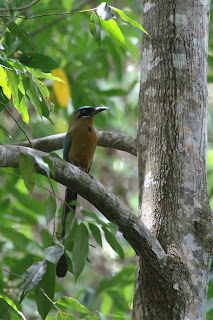
  We arrived at the park early morning and Clarindo immediately found us a pair of East Brazilian Chacalaca, a species I have only seen a couple of times before. We then explored the forests in the park where we had a nice confiding pair of Straight-billed Woodcreepers, followed by some more confiding Rufous-tailed Jacamars and Amazonian Motmots. Less confiding were the small groups of Seven-coloured Tanagers that we found, as they were mobile and difficult to follow. We also enjoyed nice views of Yellow Tyrannulet at the end of the walk, as well as a moulting Little Blue Heron on the park lake.

  The real highlight of the park was not in its birds however, as we were able to find at least seven Brown-throated Three-toed Sloths at various points along our walk. We knew they were abundant in the park, and were one of the main draws for our visit, but to see so many was unprecedented. This is only the second time I have ever seen any Sloth species, and the last time my views were poor, so this was quite the experience. In addition to the sloths we were able to find a couple of South American Coati and on the lake there were a few Broad-snouted Caiman, including one individual that was really quite large.

  After the park we spent the afternoon visiting a few sites around the city. We started with the local police station, where Clarindo knew we had a chance to find the Plain-breasted Emerald. We only had a short wait before we spotted the bird perched on the wires above our heads. Then we moved on to the local fishing marina again, where we found at least four but probably more Ruddy Turnstones. I love seeing wading birds on their wintering grounds, and this is only the second time I have seen this species in Brazil, so I was pretty excited by this.

-East Brazilian Chacalaca
-Straight-billed Woodcreeper
Brown-throated Three-toed Sloth
-Rufous-breasted Hermit
-Rufous-tailed Jacamar
-Broad-snouted Caiman
-Yellow Tyrannulet
-Amazonian Motmot
-Plain-breasted Emerald
-Turnstone


Species List:
Parque Municipal de Maceió: East Brazilian Chachalaca, Feral Pigeon, Ruddy Ground Dove, White-tipped Dove, Smooth-billed Ani, Squirrel Cuckoo, Rufous-breasted Hermit, Swallow-tailed Hummingbird, Versicolored Emerald, Common Gallinule, Purple Gallinule, Great Egret, Little Blue Heron, Striated Heron, Black Vulture, Turkey Vulture, Roadside Hawk, Amazonian Motmot, Ringed Kingfisher, Rufous-tailed Jacamar, Golden-spangled Piculet, Little Woodpecker, Crested Caracara, Yellow-headed Caracara, Southern White-fringed Antwren, Straight-billed Woodcreeper, Blue-backed Manakin, White-bearded Manakin, Red-headed Manakin, Sepia-capped Flycatcher, Common Tody-Flycatcher, Ochre-lored Flatbill, Yellow Tyrannulet, Yellow-bellied Elaenia, Euler's Flycatcher, Masked Water Tyrant, Short-crested Flycatcher, Great Kiskadee, Social Flycatcher, Tropical Kingbird, Chivi Vireo, Tropical Gnatcatcher, House Wren, Moustached Wren, Pale-breasted Thrush, Purple-throated Euphonia, Pectoral Sparrow, Golden-crowned Warbler, Sayaca Tanager, Palm Tanager, Burnished-buff Tanager, Seven-colored Tanager, Blue Dacnis, Red-legged Honeycreeper, Bananaquit, Buff-throated Saltator, Brown-throated Three-toed Sloth, South American Coati, Broad-snouted Caiman, Green Iguana,
Maceio: Feral Pigeon, Ruddy Ground Dove, Smooth-billed Ani, Neotropical Palm Swift, Black-throated Mango, Plain-bellied Emerald, Limpkin, Southern Lapwing, Ruddy Turnstone, Common Tern, Great Egret, Western Cattle Egret, Black Vulture, Roadside Hawk, White Woodpecker, Crested Caracara, Red-shouldered Macaw, Common Tody-Flycatcher, Yellow-bellied Elaenia, Masked Water Tyrant, Cattle Tyrant, Great Kiskadee, Tropical Kingbird, Grey-breasted Martin, White-winged Swallow, Sayaca Tanager, Palm Tanager, Bananaquit

Sunday, 20 February 2022

Brazil; Barra de SĆ£o Miguel

  We had our first day out properly birding since we arrived in Maceio. We headed out with Herminio, his girlfriend and another of his friends who works as a bird guide. Our destination was a large coastal water body surrounded by mangroves to the south of the city. Our guide had arranged with local fishermen to be taken round the mangroves in their small boats, which provided us with our best opportunity to find our main target, the Rufous Crab-Hawk.

  No sooner had we travelled through the mangroves and into the main body of water did we find an adult Crab-Hawk perched up against the sky. For the first time since we arrived in the city it had rained overnight, which meant dull light and overcast skies, not ideal for photos. Still, the bird was stunning to look at from our boat. We also found a juvenile as we carried on round the water, which was a bit closer and showed quite nicely, often vocalizing as well. 

  There were other good birds in the mangroves. Another new species for me was Yellow-crowned Night Heron which we flushed from its roost on the edge of the mangroves. We also had an Osprey, a small number of Orange-winged Parrots and a few Bicoloured Conebill, the latter being another mangrove specialist. After a few hours out on the boat we took some time to explore the woodlands adjacent to the mangroves, and here we also enjoyed some excellent birding. There was another new species for me with Blue-chinned Sapphire, with two individuals kissing flowers next to the path. We also managed to find Pectoral Sparrow and Southern White-fringed Antwren to our day-lists. As we were leaving there was another patch of more mature woodland and here we found our first Amazonian Motmot of our time in the northeast. This is an endemic subspecies that certainly has credentials for being a species in its own right at some point in the future. 

  It was now nearly midday so we made our way back to Maceio, but very slowly calling off at a number of mangrove sites along the way. Our first stop was just a small pool adjacent to our lunchtime restaurant, where there was nothing of note, but our second stop was a nice mangrove river. Although it was busy with recreational disturbance there were still a few birds, including a nice Little Blue Heron and a Limpkin feeding in the mud. We also stopped off at a beach, but it was too busy for birds, although we could see a Green Sea Turtle out beyond the breakers, occasionally surfacing.

  Once we returned to Maceio we did a little birding on the beach and in the adjacent fishing marina. The beach was quite productive as we were able to find two Grey-headed Gulls, which were a lifer for our guide, and only the third record for the state of Alagoas. The fishing marina was also nice, with a small group of Semipalmated Plover. There were also hundreds of terns flying around, but frustratingly all directly into the light and it was impossible to identify the species, leaving us to just enjoy the spectacle. 

-Rufous Crab Hawk
-Yellow-crowned Night-Heron
-Orange-winged Amazon
-Southern White-fringed Antwren
-Amazonian Motmot
-Pseudosphinx tetrio
-Grey-headed Gull


Species List:
Barra de SĆ£o Miguel: Ruddy Ground Dove, Scaled Dove, White-tipped Dove, Smooth-billed Ani, Squirrel Cuckoo, Blue-chinned Sapphire, Reddish Hermit, Amazonian Motmot, Grey-cowled Wood Rail, Southern Lapwing, Spotted Sandpiper, Great Egret, Snowy Egret, Western Cattle Egret, Striated Heron, Yellow-crowned Night Heron, Black Vulture, Turkey Vulture, Lesser Yellow-headed Vulture, Western Osprey, Rufous Crab Hawk, Roadside Hawk, Short-tailed Hawk, Ringed Kingfisher, Amazon Kingfisher, Rufous-tailed Jacamar, Golden-spangled Piculet, White Woodpecker, Little Woodpecker, Crested Caracara, Orange-winged Amazon, Red-shouldered Macaw, Southern White-fringed Antwren, Straight-billed Woodcreeper, White-winged Becard, Sepia-capped Flycatcher, Common Tody-Flycatcher, Ochre-lored Flatbill, Yellow-bellied Elaenia, Short-crested Flycatcher, Great Kiskadee, Boat-billed Flycatcher, Social Flycatcher, Streaked Flycatcher, Tropical Kingbird, Rufous-browed Peppershrike, Chivi Vireo, Southern Rough-winged Swallow, Grey-breasted Martin, White-winged Swallow, House Wren, Moustached Wren, Pale-breasted Thrush, Purple-throated Euphonia, Pectoral Sparrow, Palm Tanager, Burnished-buff Tanager, Bicolored Conebill, Blue-black Grassquit,
Maceio: Feral Pigeon, Neotropical Palm Swift, Southern Lapwing, Semipalmated Plover, Grey-headed Gull, Great Egret, Western Cattle Egret, Crested Caracara, Masked Water Tyrant, Great Kiskadee, Social Flycatcher, Red-cowled Cardinal, Sayaca Tanager, Palm Tanager, 

Thursday, 10 February 2022

Brazil; Maceio

  Now that our fieldwork had finished, we were able to enjoy a few weeks in the nearby city of Maceio, state capital of Alagoas, so that we could work on our computers and finish up a few outstanding documents. 

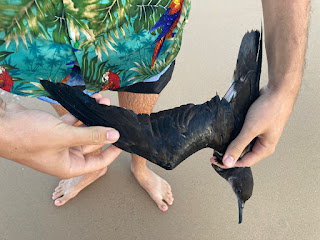
  While this does mean that birding is put on the backburner, it never stops entirely. On the night of the 10th February we planned to have a relaxing beach walk with Herminio and his girlfriend, and then go for a meal. However, as we walked along the beach we spotted a Shearwater sat nearly in the surf . This is my first Brazilian seabird, so we headed down for a closer look. 

  Through binoculars it was clearly a Puffinus sp. being a medium-sized seabird with a dark mantle and head, contrasting with white chin, breast and belly. Our suspicions were that the bird was probably a Manxie, and this was confirmed with the views we were then able to obtain. The bird flew a short distance at one point as it approached the shore, but only flew a few metres further out to sea. The underwings in flight were clearly obviously white, with no hint of any dusky colouration. As we watched the bird it became increasingly clear that it was not well, so I headed into the surf to retrieve the bird. 

  As was expected, it was easily possible to collect it a few metres from shore, however it was not docile, attempting to bite and constantly struggling to escape my grip. We brought the bird to shore to allow for some quick photos and to check for injury. There did not appear to be anything wrong with the bird physically so I took it back out into the waves, throwing it over the breakers so it could hopefully make its way out to sea, which it started to do as the evening drew on. By darkness it was further out to sea than it had been initially, so hopefully in the darkness it would be able to reorient itself and head back into the Atlantic. 

  Not quite how I expected to see my first Brazilian shearwater...

-Manx Shearwater

Species List: 
Maceio: Feral Pigeon, Manx Shearwater, Ringed Kingfisher, Crested Caracara, Great Kiskadee,

Tuesday, 8 February 2022

Brazil; ESEC Murici - Day 11

  Our eleven-day visit to Murici reached its conclusion today, as we departed this wonderful site that we have called home. Our task for the morning was very simple, to simply pack up the camp and organise everything for a smooth exit. That said, the car would not arrive for us until just after midday, so we had a little time in the morning to spend birding.

  We used this time to try and find the very very elusive Alagoas Black-throated Trogon. Although I had seen it poorly yesterday, Lia had still not managed and so this was our task for the morning. We tried to find the bird from the previous day but it was silent and so, with a heavy heart after half an hour we gave up and began wandering back. Just a few hundred meters back along the track we heard the distinctive five-note ‘hoot’ of a trogon calling, and it sounded close. As stealthily as we could, we snuck through the forest and there, finally was a clear view of this recently described endemic, restricted just to this forest fragment. Both of us saw the bird clearly and significantly better photos were taken. What a way to end our time here.

  There was nothing else outside of the ordinary, although we found a small group of White-shouldered Antshrike feeding by the side of the trail, allowing us to see our first males of this species. And as left in the car, we flushed a Laughing Falcon from one of the fence posts adjacent to the forest.

  Although it was sad to leave the forest, I must say that it was lovely to be back with a real bed, a shower, clean drinking water, and no creepy insects…

-Anole sp.
-Alagoas Black-throated Trogon
-White-shouldered Antshrike

Species List:
ESEC Murici: Scaled Pigeon, Black Vulture, Turkey Vulture, Black-throated Trogon, Channel-billed Toucan, Laughing Falcon, Golden-tailed Parrotlet, White-shouldered Antshrike, Silvery-flanked Antwren, Rusty-winged Antwren, East Amazonian Fire-eye, Scalloped Antbird, Black-cheeked Gnateater, Ceara Woodcreeper, Plain Xenops, Blue-backed Manakin, Red-headed Manakin, Screaming Piha, Brown-winged Schiffornis, White-throated Spadebill, Ochre-bellied Flycatcher, White-bellied Tody-Tyrant, Ochre-lored Flatbill, Yellow-bellied Elaenia, Bright-rumped Attila, Greyish Mourner, Chivi Vireo, Southern Rough-winged Swallow, Trilling Gnatwren, Moustached Wren, Pale-breasted Thrush, Violaceous Euphonia, Flame-crested Tanager, Palm Tanager, Burnished-buff Tanager, Opal-rumped Tanager, Blue Dacnis, Red-legged Honeycreeper, Buff-throated Saltator,

Monday, 7 February 2022

Brazil; ESEC Murici - Day 10

  We had a much more relaxed itinerary planned for today, heading to the area where we had previously heard but failed to see the apparently very sneaky Alagoas Black-throated Trogon. We had a few camera traps to collect on the way, but in the end, it simply became a task of trying to find this damn bird. And, as seems to almost always be the case here, it remained silent and we recorded nothing. As we waited, Herminio suggested he would check another territory he knew of, one that had been very silent during our stay in the reserve. We waited a little longer but it wasn’t long before the radio crackled to life as he informed us that the bird he went to investigate was showing right on the trail. We covered the distance to his position incredibly quickly, guided by the Trogon itself as it sang in the canopy, but once we arrived the bird did not show again, only calling from high in the forest. We searched but to no avail and soon it stopped singing. It was at that point that somehow, I spotted the bird very low down motionless in the forest. A few quick photos were taken but by the time Lia arrived, he had already departed and we did not see it again.

  Having finally buried that hatchet, we spent the afternoon birding at the forest edge where we had been a couple of days previous. Here we were hoping for a hawk, but that did not happen and the raptor variety was limited to just Black Vulture and Turkey Vulture. While we stayed here and watched there were a few birds of note. A male Black-eared Fairy paid a quick visit, two Yellowish Pipit dropped in and a flock of three Peach-fronted Parakeets flew over, an uncommon species for this site. On the walk to the border, we had good, if not brilliant views of Pernambuco Foliage Gleaner, which was nice after a few days of not seeing this bird.

  At night we tried again for the endemic Screech Owl, but we had no joy at all. 

-Common Morpho
-Anole sp.
-Alagoas Black-throated Trogon
-Pernambuco Foliage-Gleaner
-Striped Lava Lizard


Species List:
ESEC Murici: Scaled Pigeon, Squirrel Cuckoo, Short-tailed Nighthawk, Lesser Swallow-tailed Swift, Black Jacobin, Reddish Hermit, Black-eared Fairy, Long-tailed Woodnymph, Black Vulture, Turkey Vulture, Black Hawk-Eagle, Short-tailed Hawk, Black-throated Trogon, Black-necked Aracari, Channel-billed Toucan, Collared Forest Falcon, Crested Caracara, Yellow-headed Caracara, Peach-fronted Parakeet, Red-shouldered Macaw, Plain Antvireo, Silvery-flanked Antwren, Rusty-winged Antwren, Scaled Antbird, Scalloped Antbird, Black-cheeked Gnateater, Ceara Woodcreeper, Plain Xenops, Pernambuco Foliage-gleaner, Blue-backed Manakin, Red-headed Manakin, Screaming Piha, Brown-winged Schiffornis, White-throated Spadebill, Ochre-bellied Flycatcher, White-bellied Tody-Tyrant, Yellow-bellied Elaenia, Bright-rumped Attila, Greyish Mourner, Piratic Flycatcher, Tropical Kingbird, Trilling Gnatwren, Moustached Wren, Yellowish Pipit, Violaceous Euphonia, Yellow-green Grosbeak, Palm Tanager, Green Honeycreeper, Bananaquit,