Saturday, 5 March 2022

Brazil; Northeast Trip -- Day 8

  This would be our second and final day in Pedra D’Anta, but the much-improved weather certainly helped us to have what was, in the end, an excellent day’s birding in which we recorded a very tidy 81 species, as well as a few bonus birds when we departed the site itself.

  As had been agreed with our guide the previous day, we arrived on-site at 06:00 and went straight to the sites canopy tower. It was pretty lively at first, with lots of commoner species and a few unexpected bonus birds to go with. Our first bonus was a distant speck that photos revealed to be a Buff-throated Purpletuft, a tiny cotinga that resides in the canopy, with a very small population surviving in the NE. Although on this occasion our views were distant, half an hour later two possible flew over us, inciting us to try a little playback. The results were outstanding, with a Purpletuft perched just above us in clear and exposed branches, sat very relaxed allowing us the best views we have ever had of this bird. Although not a lifer, or an endemic, it was the clear highlight of the day.

  We also had a nice bonus bird with White-lored Tyrannulet, another species rare in the NE forest fragments, but otherwise widespread in Brazil. Our views were distant and poor, but our guide informed us that its probably the first time the species has been photographed at the reserve, so that’s something at least.

  After around 90 minutes we finally got the bird we wanted when two Alagoas Tyrannulets came to the trees right in front of the tower. They then proceeded to give outstanding views allowing us to appreciate what is a very smart Tyrannulet all things considered. Shortly after an Orange-bellied Antwren also arrived, although it did not show half as well, but certainly better than the stomach and tail views we were restricted to in Murici.

  With all our outstanding targets wrapped up, we had another quick look at the Pinto’s Spinetail, which showed much better than the previous day, and then spent the rest of the day in the hummingbird garden. While there were no new species, it was lively and always buzzing with activity, so never a dull moment. Perhaps the highlight was the largest Tegu I have yet seen in Brazil, but it was too quick and scuttled off before I managed to grab a photo.

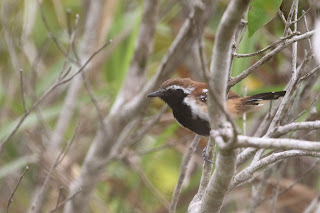
  On our way out of the reserve, we checked an area of scrub for Rusty-backed Antwren. After a little persuasion, we had a pair show incredibly well, especially the female, the male was a little more elusive. This species has always passed us by in other locations where it was supposed to occur, so it was good to finally connect with one.

-White-lored Tyrannulet
-Orange-bellied Antwren
-Buff-throated Purpletuft
-Alagoas Tyrannulet
-Pinto's Spinetail
-Sombre Hummingbird
-Blue-chinned Sapphire
-Rusty-backed Antwren


Species List:
RPPN Pedra D'Antas: Scaled Pigeon, Ruddy Ground Dove, White-tipped Dove, Smooth-billed Ani, Squirrel Cuckoo, Black Jacobin, Rufous-breasted Hermit, Reddish Hermit, Planalto Hermit, Black-eared Fairy, Black-throated Mango, Long-tailed Woodnymph, Swallow-tailed Hummingbird, Sombre Hummingbird, Versicolored Emerald, Glittering-throated Emerald, Blue-chinned Sapphire, Black Vulture, Turkey Vulture, Roadside Hawk, Mantled Hawk, Short-tailed Hawk, Zone-tailed Hawk, Caatinga Puffbird, Rufous-tailed Jacamar, Little Woodpecker, Cobalt-rumped Parrotlet, Red-shouldered Macaw, Great Antshrike, Variable Antshrike, Plain Antvireo, Silvery-flanked Antwren, Black-capped Antwren, Rusty-winged Antwren, Orange-bellied Antwren, East Amazonian Fire-eye, Scalloped Antbird, Olivaceous Woodcreeper, Straight-billed Woodcreeper, Rufous-fronted Thornbird, Pinto's Spinetail, Sooty-fronted Spinetail, Blue-backed Manakin, White-bearded Manakin, Buff-throated Purpletuft, White-throated Spadebill, Sepia-capped Flycatcher, Alagoas Tyrannulet, Smoky-fronted Tody-Flycatcher, Common Tody-Flycatcher, Yellow-olive Flatbill, White-lored Tyrannulet, Yellow-bellied Elaenia, Planalto Tyrannulet, Guianan Tyrannulet, Bright-rumped Attila, Boat-billed Flycatcher, Social Flycatcher, Piratic Flycatcher, Variegated Flycatcher, Rufous-browed Peppershrike, Southern Rough-winged Swallow, Trilling Gnatwren, House Wren, Moustached Wren, Pale-breasted Thrush, Violaceous Euphonia, Pectoral Sparrow, Flame-crested Tanager, White-lined Tanager, Brazilian Tanager, Sayaca Tanager, Palm Tanager, Burnished-buff Tanager, Seven-colored Tanager, Red-necked Tanager, Blue Dacnis, Red-legged Honeycreeper, Guira Tanager, Bananaquit, Buff-throated Saltator, 

Friday, 4 March 2022

Brazil; Northeast Trip -- Day 7

  Today was our first day at the forest reserve of Pedra D’Anta, now known as Serra da Urubu, which marked a return for us to the Atlantic Forests of the Northeast, as opposed to the Mangroves and other fragmented habitats we had been exploring over the last few weeks. This site is one reserve that makes up one of the largest forest fragments left in the Pernambuco Centre of Endemism, the other of course being ESEC Murici where we had spent ten days earlier in the year.

  We had a few species to target here but unfortunately, our birding was hampered somewhat by the weather and as such, we struggled to find many of the birds we wanted. Fortunately the key target we did manage to eventually find. Although known from a few fragments, the Pinto’s Spinetail is one of the trickier regional endemics due to few of its surviving populations existing in popular reserves. That was until a few years ago when a population was found here. It took some effort but in the end, we were able to see two different pairs of spinetails, although photos were difficult to manage.

  In addition, we had two more new species here, the Smokey-fronted Tody-Flycatcher and the typically uninspiring Guianan Tyrannulet. Fortunately, these showed much better than the spinetails and we were able to appreciate them a lot more. The Tody-Flycatcher in particular showed quite well, and at one point we were even able to watch them copulating.

  Without doubt the highlight of the day was the reserves hummingbird garden. In total, we recorded eleven different species, including the endangered and regionally endemic Long-tailed Woodnymph, with a couple of males that showed exceptionally well. There were also nice bonus species such as a Black-eared Fairy and a White-chinned Sapphire, both gorgeous males. But the sheer number of hummingbirds was what made it so impressive, with good numbers of Black Jacobin constantly buzzing around. There was also a quite lively tanager feeder with Red-legged Honeycreeper being a notable visitor, but by the afternoon they had scoffed all the bananas, and as such the activity there died down. There was a remarkable moment in the afternoon when we spotted maybe 10 Bananaquits all trying to feed on the same hummingbird feeder!  

-Guianan Tyrannulet
-White-chinned Sapphire
-Blue-chinned Sapphire
-Glittering-throated Emerald
-Pinto's Spinetail
-Smoky-fronted Tody-Tyrant
-Black-eared Fairy
-Long-tailed Woodnymph
-Black-throated Mango


Species List:
RPPN Pedra D’Anta: Ruddy Ground Dove, Smooth-billed Ani, Squirrel Cuckoo, Black Jacobin, Rufous-breasted Hermit, Reddish Hermit, Planalto Hermit, Black-eared Fairy, Black-throated Mango, Long-tailed Woodnymph, Swallow-tailed Hummingbird, Sombre Hummingbird, Versicolored Emerald, Glittering-throated Emerald, White-chinned Sapphire, Blue-chinned Sapphire, Black Vulture, Lesser Yellow-headed Vulture, Roadside Hawk, Rufous-tailed Jacamar, Lettered Aracari, Golden-spangled Piculet, Cobalt-rumped Parrotlet, Great Antshrike, Variable Antshrike, Silvery-flanked Antwren, Rusty-winged Antwren, Scalloped Antbird, Pinto's Spinetail, Sooty-fronted Spinetail, Blue-backed Manakin, White-bearded Manakin, Red-headed Manakin, Smoky-fronted Tody-Flycatcher, Common Tody-Flycatcher, Ochre-lored Flatbill, Yellow-bellied Elaenia, Guianan Tyrannulet, Boat-billed Flycatcher, Social Flycatcher, Piratic Flycatcher, Variegated Flycatcher, Tropical Kingbird, Rufous-browed Peppershrike, Trilling Gnatwren, Tropical Gnatcatcher, Moustached Wren, Pale-breasted Thrush, Rufous-bellied Thrush, Yellowish Pipit, Purple-throated Euphonia, Violaceous Euphonia, Pectoral Sparrow, White-lined Tanager, Brazilian Tanager, Palm Tanager, Burnished-buff Tanager, Red-necked Tanager, Blue Dacnis, Red-legged Honeycreeper, Guira Tanager, Wedge-tailed Grass Finch, Blue-black Grassquit, Bananaquit, Buff-throated Saltator,

Wednesday, 2 March 2022

Brazil; Northeast Trip -- Day 5

  The previous day we had driven north from Sergipe to Pernambuco, to the small town of TamandarĂ© where there were a couple of species for us to target in the nearby fragments on habitat. They could be tricky, but we had a full day reserved to try and spot them, so we were optimistic that we would see them both.

  First was the very rare Yellow-faced Siskin. Although widespread in the Northeast of Brazil, pressure from trappers means it is difficult to come by. The only reliable site is in a private forest fragment, but helpfully the birds preferred pine trees to feed in are right by the road, so this is where we set ourselves up for the morning. I was bracing for a good few hours stakeout but after around 40 minutes we spotted a male siskin distantly in the pines, but it flew off before we could get any photos or good views. Fortunately we would only have to wait another twenty minutes before either it or another male arrived. Although it was equally brief, this time we were able to grab a few record photos.

  The forest here was quite birdy, despite being next to the main road. We had brilliant views of Seven-coloured Tanager and Scaled Pigeon, and another lifer for me at least in the form of Grey-headed Flatbill, which is a very rare species in the Northeast region due to deforestation. In the end, it was a very enjoyable hours birding and that allowed us time to head to our next target species before the midday heat.

  Our next species was the equally range-restricted, but less threatened and easier to find within its range, Forbes Blackbird. Despite only being eight in the morning, the day was already hot and by the time we found the bird an hour later it was absolutely roasting. Lia spotted the birds feeding on the floor under some trees, before they moved out into the open allowing us for better views and even some photos. In the same area I lifered the stunning Lettered Aracari, which was preening in a Coconut Palm, as well as nice other species such as Red-shouldered Macaw and Black-capped Donacobius.

  We spent the rest of the day on the beach. We had a patch of forest we wanted to visit the evening but we found access too difficult due to the previous nights rainfall and as such made tracks down to the coast to another small coastal town where we would be going snorkelling the following day. 

-Grey-headed Flatbill
-Yellow-faced Siskin
-Lettered Aracari
-Red-shouldered Macaw
-Forbes Blackbird
-Smooth-billed Ani


Species List:
TamandarĂ©: Small-billed Tinamou, Scaled Pigeon, Scaled Dove, White-tipped Dove, Guira Cuckoo, Smooth-billed Ani, Squirrel Cuckoo, Black-throated Mango, Purple Gallinule, Southern Lapwing, Black Vulture, Turkey Vulture, Roadside Hawk, Caatinga Puffbird, Lettered Aracari, Green-barred Woodpecker, Crested Caracara, Golden-tailed Parrotlet, Cobalt-rumped Parrotlet, Peach-fronted Parakeet, Red-shouldered Macaw, Straight-billed Woodcreeper, Band-tailed Hornero, Common Tody-Flycatcher, Grey-crowned Flatbill, Southern Beardless Tyrannulet, Yellow-bellied Elaenia, Short-crested Flycatcher, Great Kiskadee, Boat-billed Flycatcher, Social Flycatcher, Variegated Flycatcher, Tropical Kingbird, Chivi Vireo, Black-capped Donacobius, Tropical Gnatcatcher, House Wren, Moustached Wren, Pale-breasted Thrush, Rufous-bellied Thrush, Common Waxbill, Violaceous Euphonia, Yellow-faced Siskin, Shiny Cowbird, Forbes's Blackbird, Tropical Parula, White-lined Tanager, Brazilian Tanager, Sayaca Tanager, Palm Tanager, Burnished-buff Tanager, Seven-colored Tanager, Red-necked Tanager, Blue Dacnis, Red-legged Honeycreeper, Bananaquit, Buff-throated Saltator, 

Tuesday, 1 March 2022

Brazil; Northeast Trip -- Day 4

  After the previous days developments in our itinerary, we once again spent the morning birding the small forest fragment at Santo Amaro das Brotas. And this turned into an excellent decision as we had a thoroughly enjoyable few hours birding, before spending the rest of the day driving north.

  Even having visited two times previously, this was morning was a brilliant birding experience. We did manage to find the Pectoral Antwren once again, and this time we were both able to see it well, with Lia being able to take some photos. We also managed to find some commoner species that we had not found on previous visits, such as Hook-billed Kite and Stripe-necked Tody-Tyrant. It was also good to have good views of the very endangered Coimbra Filho’s Titi monkey which we had seen on a previous visit, but this time we actually got good and prolonged views of multiple individuals.

  The undoubted highlight of the morning was finally seeing the endemic and endangered White-collared Kite, a species we have been searching for since we arrived in the Northeast of Brazil. Incredibly one flew low through the forest maybe only ten meters above my head, before perching in the lower canopy. Sadly in the ensuing excitement, the bird flushed before any photos could be taken, but an hour later we spotted the bird soaring above the forest, so we were able to get some photos to go with the incredible experience from earlier in the morning.

  And there was another raptor lifer for us here, when we spotted a Grey-lined Hawk. The previous day we had heard a raptor which we had eventually identified as this species, but without any observations, it was difficult to be certain. Today we managed to not only hear the bird, but see it, and see it well. With a little playback it flew low over us, allowing for exceptional views. It is a widespread species and nowhere near as rare as the White-collared Kite, but still a lifer for both of us.

-Coimbra Filho’s Titi
-Blue-chinned Sapphire
-Pectoral Antwren
-Grey-lined Hawk
-Hook-billed Kite
-White-collared Kite


Species List:
Santo Amaro das Brotas--Estrada das Antenas: Scaled Pigeon, Ruddy Ground Dove, Scaled Dove, White-tipped Dove, Smooth-billed Ani, Squirrel Cuckoo, Reddish Hermit, Blue-chinned Sapphire, Southern Lapwing, Western Cattle Egret, Striated Heron, Black Vulture, Turkey Vulture, Hook-billed Kite, White-collared Kite, Roadside Hawk, Grey-lined Hawk, Blue-crowned Trogon, Rufous-tailed Jacamar, Crested Caracara, Orange-winged Amazon, Cobalt-rumped Parrotlet, Planalto Slaty Antshrike, Silvery-flanked Antwren, Pectoral Antwren, Straight-billed Woodcreeper, White-bearded Manakin, Stripe-necked Tody-Tyrant, Ochre-lored Flatbill, Southern Beardless Tyrannulet, Short-crested Flycatcher, Tropical Kingbird, Rufous-browed Peppershrike, Chivi Vireo, Tropical Gnatcatcher, House Wren, Moustached Wren, Pale-breasted Thrush, Purple-throated Euphonia, Pectoral Sparrow, Tropical Parula, Palm Tanager, Guira Tanager, Blue-black Grassquit, Yellow-bellied Seedeater, Bananaquit, Common Marmoset, Coimbra Filho’s Titi,

Monday, 28 February 2022

Brazil; Northeast Trip -- Day 3

  Today was quite an exciting day in prospect, as we had arranged through some of our Brazilian birding contacts and a local fisherman to visit a small population of Grey-breasted Parakeet, an endangered species otherwise only known from a population in Ceara state. This new population was only discovered a few years ago but provides new hope for the species. To access the birds you need the help of the local fisherman, Nego, since they live deep in the mangrove forests and are only accessible by boat.

  We arrived at the docks early morning, where the ample muddy shoreline present was providing food to good numbers of waders. Grey Plover and Hudsonian Whimbrel were both new species for my Brazil list, and it was a lot of fun to watch the Turnstones and Spotted Sandpipers feeding as well, as it always is. But perhaps the highlight was the good numbers of Willet in the area, which is a new species for me. Sadly, despite finding possibly as many as ten during the morning, we never saw the bird fly, so couldn’t see the distinctive wing pattern. Also around the docks area was a Mangrove Rail, our first mangrove specialty species that we had also hoped to find here.

  The birding in the mangroves was excellent. There were good numbers of herons, including more Yellow-crowned Night-Heron, and more commoner waders. We had fantastic views of at least three Rufous Crab-Hawk and we were treated to a brief view of Little Wood Rail, another mangrove specialist that we had been targeting. The Grey-breasted Parakeets we eventually found in a more open area where they were feeding on Cecropia fruits. We often heard them but seeing them initially proved to be quite a challenge, not helped by the sun already being quite hot. We did get some excellent views of birds feeding in the shade, and in the end, probably spent about half an hour watching them.

  We had wrapped up our mangrove birding by mid-morning so made tracks to head north and try again for the Pectoral Antwren that we had missed on our way down. After nearly two hours it was looking like another blank when Lia heard the bird softly calling near the path, and with a bit of effort, we finally managed to spot the birds as they sang from within the bushes. Sadly Lia’s views were not as good as mine, so we decided to stick around and try again for them in the morning when hopefully they would be more active. 

-Willet
-Mangrove Rail
-Hudsonian Whimbrel
-Yellow-crowned Night Heron
-Grey-breasted Parakeet
-Rufous Crab Hawk
-Nymphidium mantus
-Pectoral Antwren

Species List:
Barra do Siribinha: Picazuro Pigeon, Ruddy Ground Dove, Scaled Dove, White-tipped Dove, Smooth-billed Ani, Squirrel Cuckoo, Mangrove Rail, Little Wood Rail, Grey Plover, Southern Lapwing, Collared Plover, Semipalmated Plover, Hudsonian Whimbrel, Ruddy Turnstone, Spotted Sandpiper, Greater Yellowlegs, Willet, Great Egret, Snowy Egret, Little Blue Heron, Western Cattle Egret, Striated Heron, Yellow-crowned Night Heron, Black Vulture, Turkey Vulture, Lesser Yellow-headed Vulture, Snail Kite, Rufous Crab Hawk, Roadside Hawk, Amazon Kingfisher, Green Kingfisher, Caatinga Puffbird, Lineated Woodpecker, Campo Flicker, Crested Caracara, Yellow-headed Caracara, Grey-breasted Parakeet, Peach-fronted Parakeet, Golden-capped Parakeet, Straight-billed Woodcreeper, Rufous Hornero, Caatinga Cacholote, Cattle Tyrant, Great Kiskadee, Boat-billed Flycatcher, Rufous-browed Peppershrike, Chalk-browed Mockingbird, House Sparrow, Red-rumped Cacique, Variable Oriole, Campo Troupial, Sayaca Tanager, Palm Tanager, Bicolored Conebill,
Santo Amaro das Brotas--Estrada das Antenas: Scaled Pigeon, White-tipped Dove, Smooth-billed Ani, Rufescent Tiger Heron, Black Vulture, Turkey Vulture, Lesser Yellow-headed Vulture, Roadside Hawk, Ferruginous Pygmy Owl, Rufous-tailed Jacamar, Crested Caracara, Orange-winged Amazon, Cobalt-rumped Parrotlet, Planalto Slaty Antshrike, Pectoral Antwren, Blue-backed Manakin, White-bearded Manakin, Ochre-lored Flatbill, Short-crested Flycatcher, Boat-billed Flycatcher, Social Flycatcher, Tropical Kingbird, Chivi Vireo, Tropical Gnatcatcher, Moustached Wren, Pale-breasted Thrush, Violaceous Euphonia, Pectoral Sparrow, Hooded Tanager, Palm Tanager, Blue Dacnis, Blue-black Grassquit, Bananaquit,