So today was our last full day in Dorset, and once more it was about 30 degrees, perfect weather for walking around the heathland. Since it was a Monday, there was a reasonable bus service and so made my way down to Hartland Moor. This is a large moor with hides and bogs, directly adjacent to Stoborough Heath that I went to on our first full day and had a really good day.
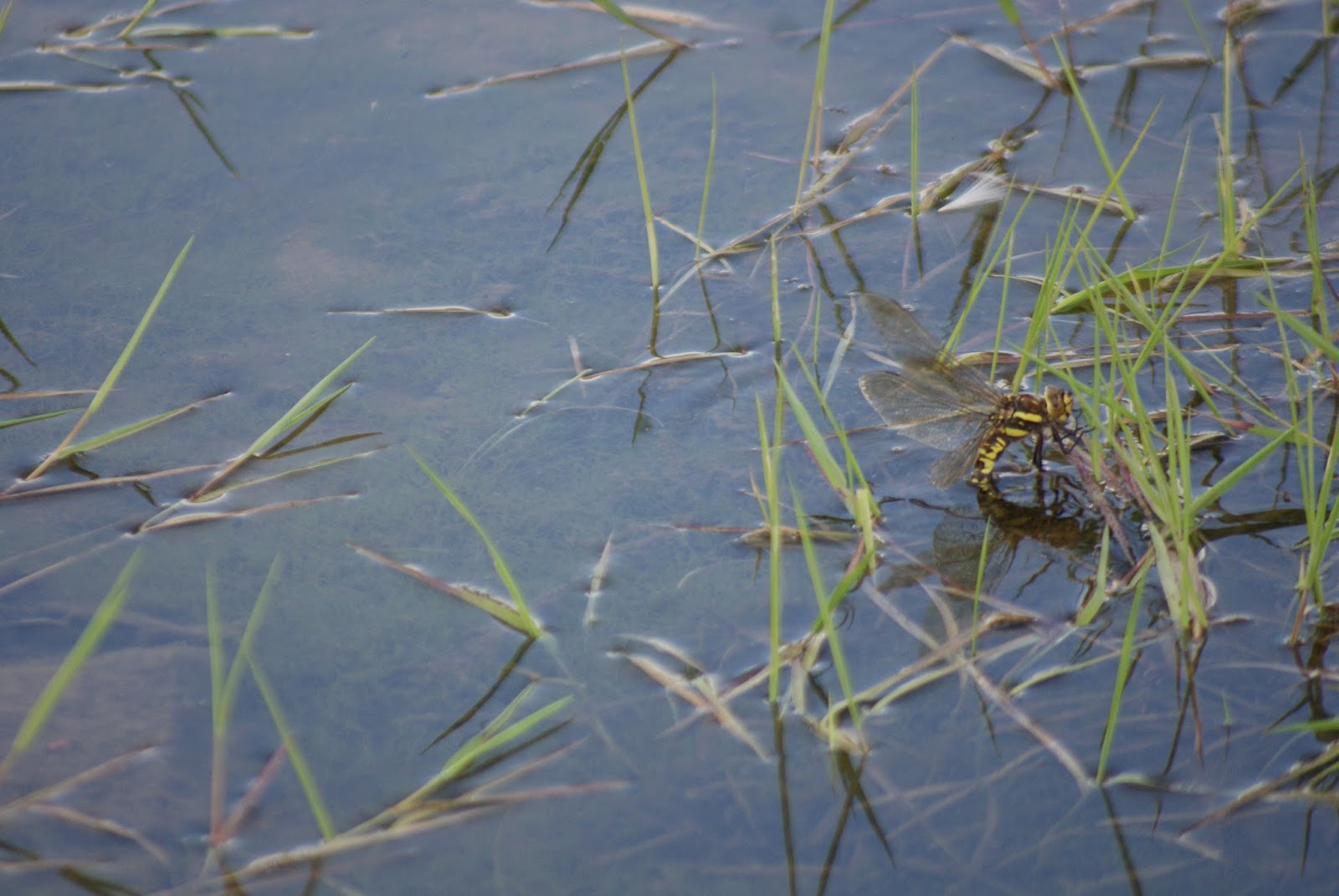
It involved a bit more walking to than Stoborough had done, and the hides were on the other side of the reserve, so when I made it there I devised a plan of action. The reserve was set around a small hill called The Great Knoll, so I decided to walk around this to get to the hide and then come back round the other side. I started in the boggy area, but quickly found a lack of path leaving me rather stranded. I found that I was surrounded by Four Spot Chasers and Keeled Skimmers as well as some Broad Bodied Chasers.
As I made my way through the bog to the various patches of trees. As I made my way I flushed some large woodpecker sized brown birds, which when I eventually caught up with them turned out to be Mistle Thrushes, a new species for the holiday.
-Mistle Thrush
But maybe some of the woodpecker sized birds were woodpecker sized because they were woodpeckers, as I found when I flushed a lovely adult Green Woodpecker
-Green Woodpecker
As I made my way through the bog, I noticed a random section of fence with a life raft on it, and I rightly assumed that this must be a view point to the bog with a section of dry land. I therefore headed to that spot by the driest route that I could see, which involved following the tree line and resulted in me spooking a Sika Deer, which once more jumped out and surprised me!
-Sika Deer
When I made it to the fence I saw that it looked over a large shallow pool where there were many dragonflies and damselflies. There was one Emperor Dragonfly which was relegating most other dragonflies to the banks, this included Keeled Skimmers.
-Keeled Skimmer
There were quite a few damselflies around too. Today was probably my last chance to record southern damselfly or it would elude me for another year. On this pool they were lacking. There were a few damselflies around, mainly Azure and Common Emerald Damselflies.
-Emerald Damselfly
From this 'fence' I could see another at the base of the Knoll, so I headed over in that direction for the most part on dry land. However going by dry land led me away from where I wanted to be. There was a ridge in front of me with a long thin pool between me and the ridge. On this pool there were Keeled Skimmers and Black Darters, which were a great addition to my dragonfly species for the holiday. They were more flighty that I would have expected from a darter and so my initial photo was not very good.
-Black Darter
I found a narrow part of the pool and jumped onto the ridge. From there I could see that over the ridge was a quite large pool with some areas of extensive aquatic vegetation. Here there were a lot more damselflies, including Large and Small Red Damselflies. It seems odd to think that until a week ago I had only ever seen one of this species and now I was taking it for granted.
-Small Red Damselflies
I wandered around the pool and there were some more flighty black darters but only Azure and Common Blue Damselflies, no southern. I therefore set off round the northern side of the Knoll on an actual footpath which was a relief. As I set off I noticed a Common Buzzard soaring overhead, presumably using the more than ample thermals.
-Common Buzzard
Around 300 meters round the knoll and I came to an area of open Birch woodland and Gorse and it was here that I spotted my daily allowance of that wonderful heathland bird the Dartford Warbler. There was a large group of them and I got some great views as they flew around me, and I even got some nice photos. However, it happened to be one of those times in life when it just goes wrong. I was watching the warblers when my phone went off. I had it on loud so that I could here it in my bag if it went off, since nobody texts me but if my family needed me they would be able to get me. It was my mum, reminding me to put on a hat. There are no words, especially when the hat was already on my head. Needless to say, once the photo went off I saw no more warblers.
-Dartford Warbler
I reached an area of more bog and here there was extensive cover of Round Leaved Sundews, some of which were even in flower, the first time I have seen this plant in flower. Please note though that the yellow flowers in the photo are not sundew flowers, they are the smaller white flowers.
-Round leaved sundews
I made my way round and found another pond, this time with more tree cover, though it was fairly quiet on the wildlife front. I made my way back to the path from this pond and there suddenly seemed to be birds everywhere; Stonechat, Dartford Warbler and Linnet, though they all flew off as soon as I noticed them.
-Linnet
I made my way round until I saw a path come off from the circular path round the Knoll. It seemed to be heading off towards where the hides were. Therefore I went along this path and found another pool, with deep wet sedge all around it. This pool had the usual dragonflies but once more one Azure Damselflies, though the most exciting thing at this point as a lovely bold male Stonechat singing from a gorse bush next to the pond, though it then moved on.
I then made my way down the path and onto the main path which the hides were on. It turned out to be a pretty pointless trip. I disturbed a handful of lizards but did not see what kind they were, and I also got reasonable views of Meadow Pipits but that was about it. I made it to the hide but it just looked over the heath and the footpath ran in front of it as well as behind. Needless to say, I did not see anything while I was in it.
The way back down the track provided a bit more, with good views of Linnets and a Golden Ringed Dragonfly hunting along the path. As with all these southern golden rings, if they landed they would not let you get close. As a result, my photo record with this species this holiday remained poor.
-Golden Ringed Dragonfly
I made my way cross country back to the pond where I had seen the stonechat. On my way there I found Small Red Damselfly at another small pond with the fence like structure and life ring. I took some more photos to increase my record library of this species. I had a look to see if there were any other Zygoptera ad found a Common Darter female.
-Small Red Damselfly
I continued to make my back to the pond next to the path. Once there I once more started to look to see what was about. It seemed to have quietened down rather than got busier and no matter how many damselflies I checked they were all Azure. I followed a Four Spot Chaser into the wet sedge meadow. Once I got there I lost the chaser, but spotted another damselfly landed in the sedge. Before I even checked I knew that it would indeed be a southern, and when I checked the photos I had taken to be double sure it was confirmed that I had indeed settled my score with this species and finally been able to tick Southern Damselfly. Once I started looking, following the one I had found around I found a couple of others, including a pair in their mating position. I gathered loads of photos to try and record every angle of the species for my library, but really I would have been content to just savor the moment of finally ticking this species after the disaster on Angelsey last year.


-Southern Damselfly
I was well choughed with finally finding one, and then finding more. I decided to leave them for now and explore the rest of the reserve and come back when I had finished, since I had noticed that I only had about an hour before I would need to leave for my bus.
I continued round the knoll as had been my plan and found another pool with the fence like structure in front of me. However, as I drew nearer I noticed that it was actually the same pond I had started my circuit at, and that left me feeling really confused. My 180 degree walk round the knoll had turned into a 300 degree walk. I therefore decided to climb the knoll to see if I could see anything on top, namely dartford warblers.
On my way up I found some metal tins for reptiles, though there were none under any this late in the day. The top was a bit of a disappointment, as I did not really see anything. On the way down though I found a female Keeled Skimmer that had taken on a Small Heath Butterfly and was sat there munching this butterfly was quite a size. However, the dragonfly was not keen to share its dinner with my camera and so my only photo, below was not that good.
-Female Keeled Skimmer feeding on Small Heath
Having finished quicker than I thought up on the top, I made my way back round to the southern damselflies but stopping off at the pond before reaching it. I walked down the ridge to see if I could find any Black Darters and was successful, but the wind had picked up and the perch it was sat on did not stay still so my photo was not really as good as I wanted it.
-Black Darter
There were also more Small Red Damselflies, though this time it was a slightly menalistic version, as some of its body was black, adding a little variety to my photo library.
-Small Red Damselfly
Once finished there, convinced I had seen all I could, I made my way back to where the Southern Damselflies had been. Luckily it did not take me long to track down one and continue my appreciation of this species. I also took some some more photos...
-Southern Damselfly
You will notice that on the bottom two photos the damselfly is having its lunch, which I only noticed afterwards when I looked back at my photos.
I then had to leave the damselflies to make sure I caught my bus. On the way out I called off at the boggy section to see if there was anything going on there. There were the usual dragonflies but then I spotted that one of those I had assumed to be an emperor was not actually and was a hawker. I spent as long as I dared trying to photograph it in flight but only managed one excusable photo for identification purposes. Those purposes showed that it was a Common Hawker, my first of the holiday, which added to my dragonfly list.
-Common Hawker
I did not have to run for my bus, only wait about 5 mins. The journey back was none eventful, as I decided to go by train from Wareham to Moreton rather than try and get a lift. Besides, I had found that buses here were as expensive as trains, so why not use the train.
Back at the caravan site I went for a shower to wash away my weariness. However, even that did not finish my wildlife day as soon as I came out of the shower I spotted a very pretty moth on the radiator. I headed home for the camera and then returned to take some photos for i.d. Turns out that this is a Buff Arches Moth, which I have not seen before.
-Buff Arches Moth
As I sat up to leave once I had photographed the moth I spotted another moth on the light, but this one needed no introducing, Common Footman its odd that a day flying moth would be sat on the light of a shower block, especially since the light was off, so it had obviously been there since the light was on. I moved the footman since I could not really get a good photo from where I was and where it was. I was a worried that as a day flying moth it might just fly off but no, I was able to move it outside and get some reasonable photos.
I am familiar with common footman, and it is one of my favorite moths, though I have only ever seen it once before, at Pottric Carr .
-Common Footman
I left the shower block two moth species richer than I had arrived. But it seemed a fitting way to end the day and our time in Dorset, since tomorrow we were leaving for Fareham. I had still one reserve on my visit list, and that would wait for tomorrow, when my family were at the tank museum.