Sunday, 6 February 2022

Brazil; ESEC Murici - Day 9

  The day started with a nice surprise when we found a stunning Boa Constrictor bathing behind our lodging. It was not the largest individual I have ever seen, being about a meter long, but was very docile and allowed for us to spend some time watching it. It was still there when we left for the field.

  This was a hard day in the field. We started early so that we could make the most of our day in the area where the territory of the Alagoas Antwren was. This was quite a trek from our base so we set off straight after breakfast. Helpfully, or not, there were few distractions along the way and we arrived in the area by mid-morning. No sooner had we reached the limit of where we wanted to be, than a mixed group of Silvery-flanked Antwren and Alagoas Antwren moved through. We certainly saw the male Alagoas, but the views were not good enough, for me at least, to recognize how many female-types were there. We followed this group for around an hour or so, but they were mobile and we frequently lost them before spotting them again. As before, the Alagoas Antwren was very mobile in the canopy, and I was not able to manage any good photos.

  We had planned to visit this area to check on the territory of the Alagoas Antwren, but also because by walking a little further we might be able to find the Black-tailed Leaftosser, a very rare inhabitant of the forest here. It was quite a trek, including a very steep descent down to a river valley. We were in position by late afternoon, and sure enough, we were able to see the bird in the area as Herminio had said. It was typically elusive and reclusive in dark areas, but we were able to get some good views of the birds feeding, largely by looking through the vines and spotted leaves being tossed.

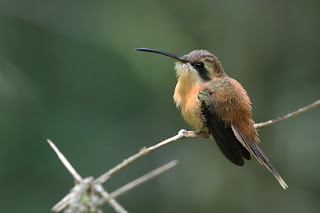
  It was quite a walk back, and it was already getting dark. We made a call at the banana farm and here we had good views of a few hummingbird species, notably Black-eared Fairy and Long-tailed Woodnymph before the darkness came. In the evening dusk, we had a nice silhouetted view of a Short-tailed Nighthawk fly over us, but that was all for nightbirds. 

-Boa Constrictor
-White-bellied Tody-Tyrant
-Alagoas Antwren
-Olivaceous Flatbill
-Black-tailed Leaftosser
-Marmosini sp.

Species List:
ESEC Murici: Scaled Pigeon, Short-tailed Nighthawk, Pauraque, Black Jacobin, Reddish Hermit, Planalto Hermit, Black-eared Fairy, Long-tailed Woodnymph, Black Vulture, Turkey Vulture, Black Hawk-Eagle, Short-tailed Hawk, Black-necked Aracari, Golden-spangled Piculet, Red-stained Woodpecker, Crested Caracara, Silvery-flanked Antwren, Alagoas Antwren, Rusty-winged Antwren, Scaled Antbird, East Amazonian Fire-eye, Black-cheeked Gnateater, Black-tailed Leaftosser, Ceara Woodcreeper, Plain Xenops, Blue-backed Manakin, Red-headed Manakin, Screaming Piha, Brown-winged Schiffornis, White-throated Spadebill, Ochre-bellied Flycatcher, White-bellied Tody-Tyrant, Olivaceous Flatbill, Bright-rumped Attila, Greyish Mourner, Social Flycatcher, Variegated Flycatcher, Tropical Kingbird, Southern Rough-winged Swallow, Trilling Gnatwren, Moustached Wren, Violaceous Euphonia, Yellow-green Grosbeak, Palm Tanager, Opal-rumped Tanager, Seven-colored Tanager, Green Honeycreeper, Buff-throated Saltator, 

Saturday, 5 February 2022

Brazil; ESEC Murici - Day 8

  Today was a much more relaxed day, with just a few things on the agenda. This suited us fine, as the previous night had taken its toll, and although we planned to rise at 05:30 as usual, we did not wake until 07:00. Despite this, there were still a few birds in the vicinity of the campsite, including Opal-rumped Tanager, which was a lifer for me. Otherwise, it was much the same, although I finally managed to see one of the Rusty-winged Antwren that have been calling every morning, there were incredible views of Reddish Hermit to be had in the clearing behind the camp.

  Our only task was to put camera traps on the nests that we had located on the 02nd. Due to the sensitive nature of the task, I did not travel to the nests with Herminio and Lia, but instead birded the nearby area. It was quite lively, with good views of Black-necked Aracari, but the absolute highlight was a large ant swarm and the birds that were with it. Most of them were East Amazonian Fire-Eye, like the previous day, however, there were also two Scaled Antbirds, which is a rare species here. They were far too interested in the ants to worry about me, so I was able to get fantastic views of both species.

  We were back in time for lunch at the campsite, meaning we had the full afternoon to ourselves. We decided to try again for the trogon that had so far eluded us, at the location we had heard it yesterday. Alas, we failed to hear or see the bird, and the whole forest was frustratingly quiet. On the way was another, smaller ant swarm and this also had a group of East Amazonian Fire-Eye following it, but that was probably the highlight of the afternoon.

-Reddish Hermit
-Mecistogaster sp.
-Scaled Antbird
-East Amazonian Fire-Eye

Species List:
ESEC Murici: Solitary Tinamou, Squirrel Cuckoo, Reddish Hermit, Black Vulture, Turkey Vulture, Black-necked Aracari, Red-shouldered Macaw, Plain Antvireo, Silvery-flanked Antwren, Rusty-winged Antwren, Scaled Antbird, East Amazonian Fire-eye, Scalloped Antbird, Black-cheeked Gnateater, Plain-winged Woodcreeper, Blue-backed Manakin, Red-headed Manakin, Screaming Piha, White-winged Cotinga, Brown-winged Schiffornis, Ochre-bellied Flycatcher, Euler's Flycatcher, Bright-rumped Attila, Greyish Mourner, Trilling Gnatwren, Purple-throated Euphonia, Violaceous Euphonia, Yellow-green Grosbeak, Flame-crested Tanager, Palm Tanager, Burnished-buff Tanager, Opal-rumped Tanager, Red-necked Tanager, Red-legged Honeycreeper, Bananaquit, Buff-throated Saltator,

Friday, 4 February 2022

Brazil; ESEC Murici - Day 7

  The previous evening we had agreed to an early start to try and check an area behind the camp for the Amazonian Barred Woodcreeper, one of the reserve's rarest inhabitants. Sadly we failed to get anything for our efforts. Upon return to the camp, the adjacent fruiting trees were very lively and there was a cracking male Green Honeycreeper, which is a rare bird for the site. There was also a very nice male Yellow-backed Tanager, which is just the second time I have seen this species.

  We spent the day in a new area looking for nests. Helpfully it was not far from the main trail but the terrain was hard work. Birdlife was limited, although the endemic trogon eluded us once again, calling distantly in the forest but going silent once we approached. There were a few birds to see, but most were common species such as the Red-headed Manakin, of which we were able to locate an active nest with two chicks, and a White-bellied Tody-Tyrant.

  On our way back we found an ant swarm crossing the trail, the first one I have seen here. There was not a great deal of diversity in the bird species following it, but it was excellent to watch the East Amazonian Fire-Eye as they fed. This swarm was still here when we headed out later in the early evening, and in addition to the Fire-Eye we managed to find two of the Amazonian Barred Woodcreeper. The birds called from deep in the forest, but with some playback they came, allowing us to get a photo of this rare resident.

  Our evening expedition was to a small river at the far end of the reserve which was home to a few frog species, some of which are highly endemic to Murici. Before that, however, we wanted to stop at a site on the border where we would be able to get fantastic views of the forest at sunset. The views were fantastic and we were able to enjoy a stunning orange sky while the time passed. It was dark when we left this open area, and night birds had already begun to appear, including two Pauraque and a Rufous Nightjar, although the latter we did not identify until the next day when analyzing photos. This was something of a shame, as its only the second time I’ve ever observed this bird, and the first time I have seen it properly.

  Our night in the forest was excellent, and that is an understatement. On our way down to the river, Herminio picked out a Pernambuco Dwarf Porcupine Coendou speratus sitting high in the canopy. This is the other species to occur at the reserve, the rarer and endemic species, and we were very lucky to see it. Then the frogs were fantastic, with more than five species at least, including all of the specificalities; Scinax muriciensis, Crossodactylus dantei and Boana freicaneca, two of which occur only in this reserve. Then, to really put the icing on the cake, we spotted a Kinkajou on our way back, which was moving high through the canopy, but frustratingly only showing occasionally.

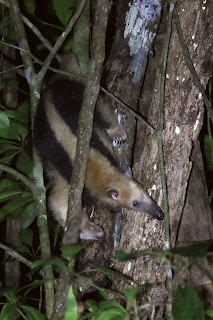
  But then, it really climaxed when we stopped for some signal. Although it was quite late, we stopped at the location for the internet, while Lia headed straight back to the camp. We had been there less than five minutes when Herminio spotted an absolutely incredible Southern Tamandua feeding in a rotting tree next to us. The animal was completely unfussed by our presence as it used its claws to rip into the branches while hanging on with its prehensile tail. After I had run off to collect Lia, we were able to watch it feeding for a good ten minutes before it slowly ambled up the trunk and into the canopy. Even after all the mammals, we have had the privilege of seeing in this reserve, this really was something else. 

-Amazonian Barred Woodcreeper
-Rufous Nightjar
-Eryphanis reevesii
-Southern Tamandua
-Pernambuco Dwarf Porcupine
-Kinkajou
-Frei Caneca Tree Frog
-Mata da Bananeira Snouted Tree Frog
-Subaúma Canebrake Tree Frog
-Crossodactylus dantei


Species List:
ESEC Murici: Short-tailed Nighthawk, Pauraque, Rufous Nightjar, Black Jacobin, Reddish Hermit, Black Hawk-Eagle, Black-throated Trogon, Crested Caracara, Yellow-headed Caracara, Laughing Falcon, Chestnut-backed Antshrike, White-shouldered Antshrike, Plain Antvireo, Silvery-flanked Antwren, Rusty-winged Antwren, East Amazonian Fire-eye, Scalloped Antbird, Black-cheeked Gnateater, Plain-winged Woodcreeper, Amazonian Barred Woodcreeper, Ceara Woodcreeper, Blue-backed Manakin, Red-headed Manakin, Screaming Piha, Brown-winged Schiffornis, White-throated Spadebill, Ochre-bellied Flycatcher, Sepia-capped Flycatcher, White-bellied Tody-Tyrant, Ochre-lored Flatbill, Yellow-bellied Elaenia, Planalto Tyrannulet, Greyish Mourner, Great Kiskadee, Tropical Kingbird, Trilling Gnatwren, Moustached Wren, Pale-breasted Thrush, Violaceous Euphonia, Yellow-green Grosbeak, Flame-crested Tanager, Palm Tanager, Red-legged Honeycreeper, Green Honeycreeper, Yellow-backed Tanager, Bananaquit, Kinkajou, Pernambuco Dwarf Porcupine, Southern Tamandua,

Thursday, 3 February 2022

Brazil; ESEC Murici - Day 6

  Today we headed to a new area of the forest, a deep river valley surrounded by the oldest area of the forest. We awoke at around 06:00 and after breakfast, we set off. It did not take us long to reach the area we were searching as along the way we saw just a few birds, perhaps the only bird of note being a Rufous-breasted Hermit that was apparently trying to feed on the ground. We came frustratingly close to seeing a Black-tailed Leaftosser but in the end, it was just too elusive and we failed to find the bird.

  There was not a lot of activity on the way back up from the river either, with a Piratic Flycatcher at the fruiting tree at the campsite being about the best of it. That’s about a wrap for today. Although we recorded many species, almost all were commoner forest inhabitants, and there was little in the way of new species for either of us. 

-Calycopis sp.
-Wied's Fathead Anole
-Entheini sp.
-Piratic Flycatcher

Species List:
ESEC Murici: Grey-fronted Dove, Squirrel Cuckoo, Short-tailed Nighthawk, Lesser Swallow-tailed Swift, Rufous-breasted Hermit, Planalto Hermit, Long-tailed Woodnymph, Black Vulture, Black Hawk-Eagle, Golden-spangled Piculet, Red-stained Woodpecker, Yellow-throated Woodpecker, Golden-tailed Parrotlet, Rusty-winged Antwren, Scalloped Antbird, Black-cheeked Gnateater, Plain-winged Woodcreeper, Plain Xenops, Pernambuco Foliage-gleaner, Blue-backed Manakin, Red-headed Manakin, Screaming Piha, Brown-winged Schiffornis, White-throated Spadebill, Ochre-bellied Flycatcher, White-bellied Tody-Tyrant, Ochre-lored Flatbill, Bright-rumped Attila, Greyish Mourner, Piratic Flycatcher, Chivi Vireo, Southern Rough-winged Swallow, Trilling Gnatwren, Pale-breasted Thrush, Violaceous Euphonia, Yellow-green Grosbeak, Flame-crested Tanager, Palm Tanager, Red-necked Tanager, Red-legged Honeycreeper, Buff-throated Saltator, 
Tuesday, 1 February 2022

Brazil; ESEC Murici - Day 5

  Today was, for all intents and purposes, a day off. Lia and I got up before first light so we could bird the trail before breakfast, and while there were many species, most were commoner forest inhabitants and there was nothing particularly different or notable. For the first time, I was able to observe the lek of the Blue-backed Manakin near the campsite, where two males would display on a perch with one replacing the other every second, while the other fluttered above the perch by about 30cm. After this one male departed and a female arrived. The remaining male jumped around various surrounding branches near the perched female, rapidly beating his wings, while the female bounced from side to side, but remaining on the same perch where the lek had been previously. It was pretty fantastic to observe.

  With the forest already warming up and bird activity slowing down, I decided to head to the forest border and look for raptors. This worked out nicely as there was a fantastic Mantled Hawk that flew low over the border right above me. There were also brilliant views of Lesser Yellow-headed Vulture among the commoner species. Whilst I was there I could hear Ash-throated Crake and Red-winged Tinamou in the adjacent fields, but I was unable to observe them.

  Since it had been so successful I decided to take the scope back to the border and spend the rest of the looking. Raptor-wise, the only addition was a nice Zone-tailed Hawk, although it was good to see the Mantled Hawk again in the evening. Perhaps the best bird was a White-winged Cotinga which I spotted perched on an emergent tree very distantly. Perched it was nothing special, but when it took flight you could see the striking white wings and they were really something. After dark, we returned to this area and had nice views of a Pauraque, our first nightjar at the forest. 

-White-bellied Tody-Tyrant
-Mantled Hawk
-Lesser Yellow-headed Vulture
-Lesser Swallow-tailed Swift
-Pauraque
-Nymphidium acherois
-White Witch Moth

Species List:
ESEC Murici: Solitary Tinamou, White-tipped Dove, Pauraque, Lesser Swallow-tailed Swift, Black Jacobin, Long-tailed Woodnymph, Ash-throated Crake, Black Vulture, Turkey Vulture, Lesser Yellow-headed Vulture, Roadside Hawk, Mantled Hawk, Zone-tailed Hawk, Golden-spangled Piculet, Red-stained Woodpecker, Crested Caracara, Red-shouldered Macaw, Rufous-winged Antshrike, Plain Antvireo, Rusty-winged Antwren, East Amazonian Fire-eye, Scalloped Antbird, Black-cheeked Gnateater, Ceara Woodcreeper, Plain Xenops, Pernambuco Foliage-gleaner, Blue-backed Manakin, Red-headed Manakin, Screaming Piha, White-winged Cotinga, Brown-winged Schiffornis, Ochre-bellied Flycatcher, White-bellied Tody-Tyrant, Yellow-bellied Elaenia, Bright-rumped Attila, Greyish Mourner, Great Kiskadee, Tropical Kingbird, Rufous-browed Peppershrike, Chivi Vireo, Southern Rough-winged Swallow, White-winged Swallow, Trilling Gnatwren, Moustached Wren, Pale-breasted Thrush, Violaceous Euphonia, Flame-crested Tanager, Palm Tanager, Blue Dacnis, Bananaquit, Buff-throated Saltator,

Monday, 31 January 2022

Brazil; ESEC Murici - Day 4

  Our initial plan was to wake early and set off early to be at our destination as early as possible. However, another rainstorm ended that plan, giving us an extra hour in bed. In the end we had just a single task on our itinerary, which was to visit the Blue-backed Manakin nest found by Lia the previous day, install a camera trap, and place to pipe over the base of the tree to provide some protection from arboreal predators.

  The morning walk to the river valley was quite relaxed, with little on the bird front. We had nice views of Red-legged Honeycreeper (although just a female), Greyish Mourner, Yellow-throated Woodpecker, and Scalloped Antbird. It was a lively walk all the same, with a few mixed-species flocks encountered along the way, although mostly composed of commoner species. For me, there was a single new species, the White-bellied Tody-Flycatcher which showed nicely but briefly. This briefness was frustratingly induced by me forgetting I had left the flash on the camera having just photographed a butterfly, allowing me just a single shot. 

  Once at the Manakin site our task was very quickly sorted, leaving us with the rest of the day basically free. Not far from the nest was a known lek of the Margaretta’s Great-billed Hermit, an endangered subspecies found only in a few sites across the Atlantic Forest. It is regarded as a full species in Brazil, but not yet by the IOC. At the lek site, we located two males holding territory, and they allowed us to approach reasonably close, although they would always remain in the shadow making photography difficult. At one point the two males clashed, rising into the air while they jousted, before disengaging and heading their own ways. This truly was a privilege of working at the site as opposed to just visiting, as the lek site is well off the main track and not viewable for visiting birders. We also took some time to look for an endemic frog, found just at a single river in the reserve; Crossodactylus dantei. Herminio found one which was very mobile and difficult to photograph, but we managed.

  The way back was also quite relaxed, with just a few birds along the way. Finally, I managed to see a Screaming Piha, although very obscured through the vegetation, as the photos I was able to manage clearly demonstrate. We arrived back at camp mid-afternoon, so Lia and I decided to head to the forest edge to try and look for raptors. There were many Black Vultures but the only species of note was a distant Mantled Hawk. There were a few other species here, including a rather showy Wedge-tailed Grassfinch and a pair of Lesser Swallow-tailed Swift that flew over. It was a really nice way to see out another long but brilliant day. 

-Margaretta’s Great-billed Hermit
-Haetera piera
-Porto Alegre Golden-eyed Tree Frog
-Crossodactylus dantei
-Wied's Fathead Anole

Species List:
ESEC Murici: Solitary Tinamou, Red-winged Tinamou, Grey-fronted Dove, Squirrel Cuckoo, Lesser Swallow-tailed Swift, Black Jacobin, Great-billed Hermit, Reddish Hermit, Planalto Hermit, Long-tailed Woodnymph, Black Vulture, Turkey Vulture, Mantled Hawk, Channel-billed Toucan, Golden-spangled Piculet, Red-stained Woodpecker, Yellow-throated Woodpecker, Crested Caracara, Red-shouldered Macaw, Silvery-flanked Antwren, Rusty-winged Antwren, Scaled Antbird, Orange-bellied Antwren, Scalloped Antbird, Black-cheeked Gnateater, Ceara Woodcreeper, Plain Xenops, Pernambuco Foliage-gleaner, Blue-backed Manakin, Red-headed Manakin, Screaming Piha, Brown-winged Schiffornis, White-throated Spadebill, Ochre-bellied Flycatcher, White-bellied Tody-Tyrant, Ochre-lored Flatbill, Yellow-bellied Elaenia, Euler's Flycatcher, Greyish Mourner, Great Kiskadee, Tropical Kingbird, Chivi Vireo, Trilling Gnatwren, Moustached Wren, Violaceous Euphonia, Yellow-green Grosbeak, Flame-crested Tanager, Palm Tanager, Burnished-buff Tanager, Blue Dacnis, Red-legged Honeycreeper, Wedge-tailed Grass Finch, Bananaquit,