
I have always said that you can tell if its going to be a good day by how it starts, and that usually means that I saw an unusual moth in the morning on the toilet block. And indeed, that is how today started, only this was something more than an unusual moth. In fact I would even go so far as to say that this is the moth I had always wanted, with the exception perhaps of Oleander Hawkmoth (like that's ever going to happen!!). I usually had a quick look round the toilets on my morning visit, as there was often some moth or another, not usually anything special, and today there was nothing at all so I left and as I was closing the door I spotted next to the door half under a clear notice board a small grey brown moth hiding. It was a Buff Tip Moth. I was overcome with euphoria and absolutely legged it back for the camera after spending a few mins appreciating it.
I returned with the camera and began snapping away. After some snaps I decided to move it to a more convenient position where I could get photos. The moth was completely docile and in a few seconds I had a buff tip moth on my finger. I then moved it around a few times before I had the right light and position and background for my photos and even then they could have been better, but what matter, when you have just seen one of your favorite moths.


-Buff Tip Moth
And so we got down to the business of the day. My family were going to the Isle of Portland so I decided I would go to Broadcroft Quarry Butterfly Reserve to see if I could give my butterfly list a kick start. Once I arrived I found myself not really knowing where I was going, and even as I write this I don't think I ever made it to the reserve, just to the fields adjacent to it. The site claimed adonis and chalk hill blue, but I saw neither. I did however see plenty of Common Blue Butterflies because as is the case with me, if I don't know what what im looking for the best thing to do is to take photos of all that it could be and analyse later. Therefore I have ample photos of common blue butterflies.

-Common Blue Butterfly
But there were more than just blue butterflies, as there were plenty of whites and browns, and even those that come between, like white browns-Marbled Whites, which seemed to be very abundant among the Gatekeepers, Meadow Browns and Large Whites

-Marbled White
And it was not just generic shaped butterflies as there were a good many skippers about too, though none of the lulworth variety, all either Large or Small Skippers

-Large Skipper

-Small Skipper
The field was very nice and was ideal what you would call butterfly habitat but there seemed to be a lack of anything else. I could hear whitethroats around me but failed to see any, and I also noticed a group of Ravens overhead. These were my first of the holiday and also of the year.

-Raven
There were meant to be 5 species of blue butterfly according to the websites. I had only seen 3 of the species mentioned, and only 2 of them I had seen on this holiday. The other besides common of course is Silver Studded Blue which is rare on limestone, and this is one of the few sites where it can be found as such. They were, however, very abundant here as they have been across the board this holiday.

-Silver Studded Blue
But it was not the butterflies that left their impression at this stage. I was wandering back to the road to make my way across to the field on the other side of the road when I glanced down and there was a Bee Orchid, another species I had been desperate to see. I was immediately struck by how tall the plant was, the flower being almost 30 cm off the ground. The flower was very dainty as it hung at the top of the tall stem. It was clear that the plant had been flowering before, but that those flowers had died and there was another unopened bud above the flower currently open. I took many photos because I was simply so excited by it and how dainty it was. Definitely one of the species of the holiday so far.
I was lucky that the plant was in the open and not obscured by any of the tall grasses in the area, or any of the brambles that had been clawing at my legs. I took photos from all angles because it was so lovely and I was so pleased at finally finding one.


-Bee Orchid
Indeed today seemed the day to look for flowers, as adjacent to the bee orchid I found another old favorite in Pyramidal Orchid, national flower of the isle of Wight

-Pyramidal Orchid
But the flowers did not steal the show for long, as I soon had a new butterfly species for me. I mentioned on Day 2 how I thought I had small/little blue but they turned out to be silver studded blues. Today I set that record straight as I was wandering through the grass I disturbed a small brown/grey butterfly that when it landed showed only limited spotting on the underside and little blue colour overall. I knew immediately this time that I had found a Little Blue Butterfly and I was very excited. Having given it the big up, it was a very tattered and old specimen, as all the spots were faded, the wings were damaged and even were these fixed its still not the most exciting example of a blue butterfly, mainly because its not really that blue. But having said that, it was nice to see that's true and was another new species for the holiday.


-Small Blue
Between photographing the little blue I had noticed that one of the singing Whitethroats had finally shown itself and had begun singing from the top of a bush, though it was some distance away as my camera see's it.

-Whitethroat
I then continued my way across the road as had been my original intention to see if I could find any more new species over that way. It really was more of the same, though without little blues, but I did encounter an equally scruffy butterfly in the form of Dingy Skipper, a species I have only ever seen once before, though that time it was in much better condition, as with this individual I could hardly make out any markings. It was still only the 2nd time of seeing this species and as such it did not lack any appeal because of its condition.


-Dingy Skipper
The remainder of the butterfly reserve was filled with regulars; Meadow Brown, Gatekeeper and Ringlet

-Ringlet
Once I had finished at the butterfly reserve I decided to wander into town and from there get a bus to Weymouth and visit Radipole Lake and Lodmoor, both RSPB. I made my way first to Radipole lake as it was nearest the bus stop and had the most recommendation.
As soon as I arrived my bird list began to grow, as I recorded, Cormorants, Feral Pigeon, Grey Heron and Tufted Duck, the latter I got extremely good views of.


-Tufted Duck

-Grey Heron
I wandered down the path, which had good growth of various plants and flowers on either side. On these I found some Scarlet Tiger Moths, to continue with the moth theme that we started on, which were advertised in the leaflet as being one of the specialties of the reserve.


-Scarlet Tiger Moth
I decided to make my way up to the top hide so that I had somewhere to have lunch. On my way up I passed through various reedbed habitats with some woodland too. Birdlife seemed to be quite limited, reduced to bearded tits mocking me from the reedbed with their too familiar chirping call.
On the side of the path I also found another Bee Orchid, but this one was bent over and the grass had grown up around it so my photos were not very good and did not add anything to the one I had seen earlier. They say you wait ages for a bus and then two come at once, and that was kind of what it was like with bee orchids, not that I'm complaining.
As I entered one of the wooded sections just passed the bee orchid I flushed a Comma from the hedgerows, but it landed on the path to sunbathe.

-Comma
At one point the path crossed over a bridge over a river which flowed pretty slowly. Here I spotted a female Banded Demoiselle which was the first really photograph-able one of the species I had found so far on the holiday.

-Banded Demoiselle
The only thing that happened on my walk up was that I flushed a Black Tailed Skimmer from its slumber on the path.
At the hide there really was not much going on. There were some Mallards in slumber on the far side and a Grey Heron fishing, as well as the regular Woodpigeons, but that aside it was really poor in my opinion. During lunch a couple of other birders came in and it was these that as I was leaving after lunch said that a kingfisher had come in. I made my way back up to the window and there was able to watch 2 Kingfishers as they flew across the pond, including hovering behavior and successful fish catching.
Once I had finished at the hide I had intended to go to the viewpoint to see if there was any better, but on the way I found that a family of very crabby Mute Swans had parked themselves on the path. When I approached they made themselves big and seriously hissed. I considered trying to get round by the side where their young were, but decided against it and instead went back.
I made my way back up the far side of the walkway but there was not much happening there, only a couple of Moorhen. On my way out I found another Scarlet Tiger Moth, but its wings were crippled. I took photos of it because it was displaying its vivid red underwings.

-Scarlet Tiger Moth
And that finished me at RSPB Radipole lake, and I was a bit dissapointed with it really, as there were so few birds. Next up was RSPB Lodmoor. It involved cutting across the town, but there was no wildlife going on there. At Lodmoor there were plenty of birds, but they were some way away. There was a good variety though, mainly waders and wildfowl. On the waders front there was Lapwing, Oystercatcher and to my surprise Common Sandpiper. There were Canada Geese, Graylag Geese and Shelduck on the wildfowl front, as well a a Grey Heron
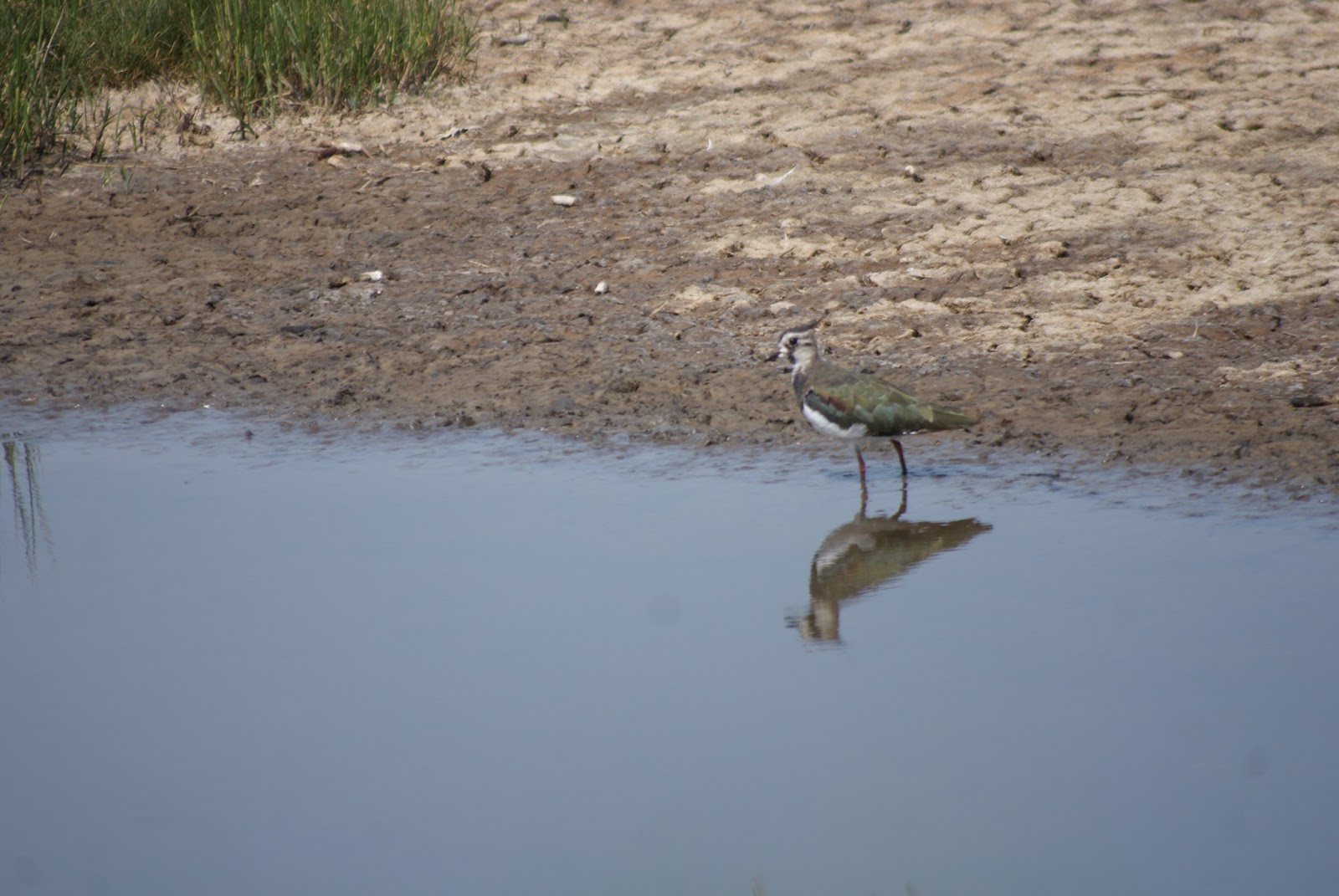
-Lapwing

-Shelduck and Grey Heron

-Common Sandpiper
I did the long walk side walk around the reserve, but I may as well have done the short walk, as the long walk really did not add anything to my reserves species list, except Whitethroat and Black Tailed Skimmer
On the road side of the walk I had a little more luck as it was here that I was able to overlook the scrapes. It was more of the same as what I had seen upon my entry, but I also flushed a pair of Bullfinches, which were my first of the holiday.
I eventually made my way round to the viewpoint eventually and it was here that I found my third and last really notable bird of the holiday with Greenshank. To me, Greenshank is one of those birds that you know you have seen before, but you don't remember where because I tended to overlook it and not really be bothered. I know I have seen a flock of around 7 at Calaverock WWT in Scotland before, but I don't recall any other time, so it was nice to get one on this holiday which was proving so void of birds.
This greenshank was quite distant but I could tell what it was. It allowed me to get some record shots, though they are really poor.


-Greenshank
My family picked me up from Lodmoor and then we went back to the caravan. Our juvenile robin was around back there. The only other thing of note was that during dinner my ankle was bitten rather brutally by a ladybird larva! I had no idea they were so savage!!


