Showing posts with label Bunting-Reed. Show all posts

Friday, 31 July 2020

Soil Hill; Isolation week 18

The weather this week was, at times, an absolute joke. Monday and Tuesday were both a write off for the Hill, but helpfully on the latter BS found a nice pair of adult Sanderlings on Fly Flatts so I went up to have a look. Despite the violently windy conditions, and with some excellent directions from Brian, I was able to get some scope views of the birds as they scuttled along the rapidly disappearing shoreline.
So what of the Hill. Despite being birdable on every other day during the week, the often blustery conditions made it a challenge to muster even the usual assortment of species. Add in the fact that its now nearing the end of summer and many species will be undergoing post-breeding moults, it was a fairly quiet affair all round. The farmers continued to cut fields in the area, so gull numbers continued to build up with Common Gull and Black-headed Gull regularly featuring in the recently scalped fields. Woodpigeons also increased rapidly this week, with well in excess of 100 birds in the bottom fields at times. In the bushes the birds were a challenge. The Sedge Warblers were seen on and off during the week, clearly expanding their range across the scrub at the bottom of the north slope, but the lack of access making it a challenge to view. Whitethroat and Reed Bunting are still present in good numbers, with Willow Warblers slowly increasing towards the end of the week. On the 29th a pair of Crossbill flew East over the Hill calling often but I was not actually able to spot them.
On the Friday the weather changed with a sudden burst of high pressure bringing with it warm and stable conditions. With it came a reasonable fall of Willow Warblers, somewhere between 10 – 15 moving around the sites various bushes. Lots of Whitethroats and Willow Warblers were also present, and a flock of five Cormorants flew south. But the undoubted highlight was a grounded Tree Pipit, which showed very well at times on the ground as well as perched atop some of the trees on the edge of the Summit. This is the first time I have seen this species on the deck here, and I was able to get some very nice photos of it. A flyover Siskin capped off the morning nicely. 
-Tree Pipit
-Cormorant
-Reed Bunting

Species List:
Soil Hill: Canada Goose, Mallard Common Pheasant, Feral Pigeon, Stock Dove, Common Wood Pigeon, Eurasian Collared Dove, Common Swift, Common Moorhen, Northern Lapwing, Eurasian Curlew, Black-headed Gull, Common Gull, European Herring Gull, Lesser Black-backed Gull, Great Cormorant, Grey Heron, Eurasian Sparrowhawk, Little Owl, Common Kestrel, Peregrine Falcon, Eurasian Magpie, Western Jackdaw, Rook, Carrion Crow, Eurasian Blue Tit, Great Tit, Eurasian Skylark, Sedge Warbler, Barn Swallow, Willow Warbler, Common Whitethroat, Eurasian Wren, Common Starling, Common Blackbird, European Robin, Dunnock, House Sparrow, Pied Wagtail, Meadow Pipit, Tree Pipit, European Greenfinch, Common Chaffinch, Common Linnet, Red Crossbill, European Goldfinch, Eurasian Siskin, Common Reed Bunting, Western Roe Deer, European Rabbit,
Fly Flatts: Canada Goose, Eurasian Oystercatcher, Common Ringed Plover, Sanderling, European Herring Gull, Lesser Black-backed Gull, Common Kestrel, Carrion Crow, Pied Wagtail, Meadow Pipit, Common Reed Bunting,

Friday, 24 July 2020

Soil Hill; Isolation week 17

This week was much slower than its predecessor with cloudy and windy weather dominating making it difficult to enjoy large numbers of birds on the hill and instead being restricted to occasional good birds. Having acquired work again, I stayed local and did not venture any further than Soil Hill.
The week started on the 19th when I had a nice flock of 12 Cormorants fly over the Hill heading north. On the same day there was a peculiar hybrid Greylag x Canada Goose but with white outer primaries, throwing some leucism in the mix. Monday the 20th was the day of the standout bird of the week when I spotted a Little Egret drifting over Bradshaw. It dropped down briefly on the pond behind Bradshaw Park but then quickly took off again and after drifting around for a few minutes headed south strongly. This small heron is still rare in Calderdale so I was pretty thrilled with that. A single Crossbill flew over on the 21st, calling loudly as usual and on the same day a very vocal Grasshopper Warbler was singing from the top of the summit.
Aside from that the species setup remained largely the same. A pair of Blackcap was in the North Slope Treeline, as was a pair of Bullfinch. The Sedge Warblers continued to linger but were far more elusive and were seen only infrequently. Good numbers of juvenile Reed Buntings have built up and there were a couple of Wheatears during the week as well. On the 24th the fields along Taylor Lane were cut and so there were good numbers of gulls and corvids to look at, although nothing particularly different of note. 
-Little Egret
-Canada x Greylag Goose hybrid
-Reed Buntings

Species List:
Soil Hill: Canada Goose, Mallard, Red-legged Partridge, Common Pheasant, Feral Pigeon, Stock Dove, Common Wood Pigeon, Common Swift, Common Moorhen, Eurasian Oystercatcher, Northern Lapwing, Eurasian Curlew, Black-headed Gull, Common Gull, European Herring Gull, Lesser Black-backed Gull, Great Cormorant, Little Egret, Eurasian Sparrowhawk, Little Owl, Long-eared Owl, Common Kestrel, Peregrine, Eurasian Magpie, Western Jackdaw, Rook, Carrion Crow, Coal Tit, Eurasian Skylark, Sedge Warbler, Common Grasshopper Warbler, Barn Swallow, Willow Warbler, Eurasian Blackcap, Common Whitethroat, Eurasian Wren, Common Starling, Mistle Thrush, Song Thrush, Common Blackbird, European Robin, Northern Wheatear, Dunnock, House Sparrow, Grey Wagtail, Pied Wagtail, Meadow Pipit, Common Chaffinch, Eurasian Bullfinch, European Greenfinch, Common Linnet, Red Crossbill, European Goldfinch, Common Reed Bunting,

Tuesday, 5 May 2020

Soil Hill; Isolation week 6

A mixed week with variable weather and mixed birding results. My work finally arrived on Monday so will finally be able to commence home office. That said, a Soil Hill visit every morning is still very much on the agenda.

02 May
Visit from 07.15. Total 42 species observed
Cold but clear and sunny with a nice selection of species but nothing outstanding. Highlights from the morning included three flyover Cormorants and a Greylag Goose. A Sand Martin also flew across the summit. 

03 May
Visit from 07.30. Total 42 species observed 
Overall sunny and pleasant morning but with scattered cloud cover. Generally similar makeup, regular assortment of species all on site. Three Wheatears were the highlight with another particularly showy male at the bottom of the north slope, as well as two females. A new Whitethroat territory at the top of the north slope treeline was also welcome, with the male singing from nice exposed perches. Two Sand Martins blogging was the best otherwise. Also first Swift of the year over Bradshaw.
-Reed Bunting
-Northern Wheatear
-Common Whitethroat

04 May
Visit from 07.00. Total 39 species observed.
Cold and overcast morning with low fog for the first hour. After being so close last week, it was nice to clinch a YELLOW WAGTAIL today, when one flew westward across the bottom of the hill. As before I heard the bird calling first and looked up to see it directly level with me at a reasonably low altitude. Despite the dull conditions the bird was glowing yellow, beyond doubt a male. Sadly it did not stop in the Lapwing field as I hoped, but carried on towards Ogden, calling all the way. I did not have my camera at the ready and since it was already level with me when I picked it up, there was no chance for photos.
Despite this excellent hill record, other birds were thin on the ground. A Jay flew over heading southwards and that was the only other notable from the day, although the male Stonechat and at least one Wheatear were still in place.
-Eurasian Jay

05 May
Visit from 06.45. Total 43 species observed. 
Another cold and generally overcast morning with a chilly east wind. Had a very pleasant morning with a stunning female Whinchat gracing the heather on the summit. Sadly it was extremely mobile, and no sooner did I pick it up than it flew to the North Slope top fenceline. Here I managed to grab some record shots before it flew down the slope with purpose. Despite thoroughly searching the slope I was unable to find it and can only assume that it moved on.
A pair of Grey Partridge on the north slope were only my second since my regular lockdown visits began. One Wheatear remained on the bottom fields but was distant and difficult to spot. Two House Martins that flew through were my first of the year as well, bringing my Soil Hill lockdown list up to a very respectable 83.
-Whinchat

06 May
Visit from 07.00. Total 42 species observed.
A bright and sunny morning with very little wind. Very pleasant birding with a few nice bits. First was a singing Chiffchaff in the copse opposite the site entrance track, it eventually moved closer and started to show but was flighty and passing cars frequently caused it to dive back into cover.
At the bottom of the hill there was two Wheatears and two Sand Martins, but the standout bird was a female White Wagtail. Helpfully it was with a male Pied Wagtail. Frustratingly I did not get a view of the rump, but in the field the bird overall was strikingly pale and after discussion with TDJ, KBL, JHF and SH from Spurn any doubts were safely removed. It flew off shortly after I found it, but I was unable to relocate it anywhere. 

'2nd calendar year Motacilla alba alba. The grey shading up the nape should rule out M.a. yarelli. The streaking effect seen on a couple of the photos is caused by the angle of the feathers, so you can almost see under them causing shadowing from this angle, otherwise you'd see the streaks come up towards the nape'

-Chiffchaff
-White Wagtail

Visit from 18.45. Total 38 species observed.
In the evening I decided to go back up to Soil Hill after reading that NK had a Sedge Warbler during his morning visit. It was a very pleasant evening and since the quarry workers had departed I was also able to have a look at the Stonechats, with both birds showing well. The Sedge Warbler was very elusive, but it showed well on brief occasions.
-European Stonechat
-Sedge Warbler

07 May
Visit from 07.00. Total 46 species observed.
It got warm quickly today, and by the time I left the Hill at 09.30 it was already hot and slowing down. Before that I managed a very nice haul of species with a few highlights. The Sedge Warbler was still present and far more vocal than it had been the previous evening. My first Soil Hill Swift also drifted over, bringing my Soil Hill year list up to 85. A Cuckoo was singing distantly towards Ogden, but there was never any chance I would be able to see it. There was still a single Wheatear, Stonechat and Sand Martin.

08 May
Visit from 07.00. Total 45 species observed.
It was a more overcast morning than the previous day, but had warmed up by the time I left. Another day with lots of species but little standout. The Sedge Warbler was still present and showing well. There was a lot of Sand Martin activity too, which will certainly be something to keep an eye on during the spring. Two Wheatears, four Swifts and a Goldcrest were the best of the rest.

Species List:
Soil Hill: Greylag Goose, Canada Goose, Mallard, Red-legged Partridge, Common Pheasant, Grey Partridge, Feral Pigeon, Stock Dove, Common Wood Pigeon, Common Cuckoo, Common Swift, Common Moorhen, Eurasian Oystercatcher, Northern Lapwing, Eurasian Curlew, Common Snipe, European Herring Gull, Lesser Black-backed Gull, Great Cormorant, Grey Heron, Eurasian Sparrowhawk, Little Owl, European Green Woodpecker, Common Kestrel, Eurasian Jay, Eurasian Magpie, Western Jackdaw, Rook, Carrion Crow, Eurasian Blue Tit, Great Tit, Eurasian Skylark, Sedge Warbler, Sand Martin, Barn Swallow, Common House Martin, Willow Warbler, Common Chiffchaff, Common Whitethroat, Goldcrest, Eurasian Wren, Common Starling, Song Thrush, Common Blackbird, European Robin, Whinchat, European Stonechat, Northern Wheatear, Dunnock, House Sparrow, Western Yellow Wagtail, White Wagtail, Pied Wagtail, Meadow Pipit, Common Chaffinch, European Greenfinch, Common Linnet, European Goldfinch, Common Reed Bunting, Weasle, Roe Deer, Orange Tip, Peacock, Small Tortoiseshell, 

Tuesday, 29 July 2014

Spurn Day 20

Today the virus began to really grab hold. As a consequence the birding has been limited. After I had awoken from my days slumber I eventually decided to go for a short walk along Canalside to see if any birds had dropped into the bushes. It was already mid-afternoon when I set off and as such did not expect to see much
The first bird I saw was a lovely Reed Bunting that was perched out in the open near the bottom of the walk. The only other time I have seen one here was a bird flushed that then immediately skulked again, so nothing worth reporting really. This time the view was obviously much better, so much so I have even included it in my blog.
-Reed Bunting
The tide was out and as such there were not many waders on show. There was a pair of well grown Cygnets on Canal Scrape and a few Sedge Warbler singing from the reeds. There were also a couple in the bushes, which gave better views but were still very skulky.
On my way back I found my highlight of the walk, which was a family of Whitethroat. I first noticed them as one of the juveniles had perched on a car window in a very unorthodox position. In fact I spotted 2 youngsters and an adult, which was tending to them and bringing them food. I grabbed a few photos to include on here, mainly because it had been a quiet walk but also because the young birds were quite cute.
-Whitethroat
And that was about it to be honest. Beacon Ponds was quiet for my shift, though there were impressive numbers of Dunlin on the beach. I also managed to sneak past them but once one took off they all followed suit, and then landed ahead of me on the beach, so I had to pass them again…

The Daily Oystercatcher
To be honest I can’t actually remember the Oyks actually doing anything today. I can’t recall if I saw them, though I probably did. They were probably just feeding or sleeping and so is not overly memorable.

Species List:
Canalside: Reed Bunting, Sedge Warbler, Whitethroat, Mallard, Mute Swan, Woodpigeon, Swallow, Sand Martin, Swift,
Beacon Ponds: Dunlin, Grey Plover, Oystercatcher, Cormorant, 

Wednesday, 9 April 2014

Bolton Abbey

So today my family decided to have their family day out at Bolton Abbey. I was not optimistic for finding anything for my yearlist, but I knew it would be a nice walk, and that I would see some lovely stuff. We wandered up the river and at the first loop I spotted a drake Mandarin, my first proper view of the year, though I have seen them before. 
-Mandarin
It was in this area that I began to notice the number of buzzards overhead. I got to watch many of them drifting over, though I only got silhouettes. I kept my eyes open for rarer raptors on passage but I could find none.
-Common Buzzard
But as I watched, I spotted another bird that was deffo not a buzzard due to the wing and tail shape being wrong. However, Having looked at the possibilities I thought it was an Osprey only the tailed looked too long. However, a quick plea on the Calderdale blog and reliable sources have agreed with this bird being an Osprey, so I will happily go along with that. So there we go then, another smashing bird seen today, and today's year-tick. It is also the first time I have ever seen Ospreys on passage. It is just unfortunate that I could get no better shots of what would have been a stunning bird.

--I re-analysed the photo and I am not happy with the Osprey school of thought and now think that it is a Marsh Harrier. The photo when tortured to bring out a wing features lacks the patterning of an Osprey but the dark patches match better to Marsh Harrier--
-Marsh Harrier
I spent quite a while watching the raptors, but then my attention was drawn back to the river, where an unusual plumaged form of a reed bunting. I think it was a young male coming back to summer male, so its possibly the first time I have seen one like this.
-Reed Bunting
At the same point there were a few waders going overhead, a trio of Oystercatchers and a Curlew, making for a nice addition to the day list. The Curlew flew right overhead, which gave me a great view, though I tried to take photos rather than watch it, which I would probably do If I had the time again.
-Curlew
A little further up again between watching the raptors there was a patch of scum in the water, where there was a pair of mandarin feeding. They looked really nice, and I managed to get pretty close to them, allowing me to get some decent shots for the year photo album.
-Mandarin Pair
The walk through the wood provided nothing much, but there was a Dipper and a Goosander on the river, as well as a buzzard on the hill behind. On the small birds in the wood there was very little, just a Long-Tailed Tit on one of the trees. There was also a Wren near the visitor center, as well as a Grey Wagtail.
-Wren
The way back passed without incident until the same area where it all happened on the way up. There I spotted the Mandarin pair on the grass grazing. I was not able to get very close but I was able to get some good views, and of such lovely birds.

-Mandarin Pair
So overall it was a really nice walk and saw some great stuff, the highlight being the mandarins which seemed to have increased so much since the last time I was there. The only thing left to do is to give a full run down of all the species seen today

Species List: Dunnock, Chaffinch, Common Gull, Blue Tit, Magpie, House Sparrow, Blackbird, Great Tit, Robin, Pheasant, Black-Headed Gull, Wren, Mallard, Common Buzzard, Grey Wagtail, Pied Wagtail, Woodpigeon, Feral Pigeon, Jackdaw, Rook, Bullfinch, Goldfinch, Goosander, Long-Tailed Tit, Song Thrush, Lesser Black-Backed Gull, Reed Bunting, Oystercatcher, Curlew, Chiffchaff, Sand Martin, Dipper, Willow Warbler, Swallow, Kestrel, Marsh Harrier,

Monday, 24 March 2014

Orgreave Again

The situation is getting quite desperate now, as in I am only 10 birds off my 100 before the end of march. With this in mind I decided to not type up today's notes and go back to Orgreave since I could do it on one bus journey.
I arrived at the site early afternoon, about half 1, and immediately began my hunt. The birds were pretty similar to last time, with the addition of redshank to the list. That was until half way round the western side I heard, and then followed until they landed, a flock of Linnets, my first of the year and reducing the required to 9 species. I was able to get reasonable views but they were not the finest linnets I have ever seen. They were a flock of 5 birds, but I only got bins on 2, a female and a male. Below is photographed the male, the female was partially behind the mound of earth
-Linnet
I continued round, and got some good views of goosander resting on the bank, along with gadwall, tufted duck and lapwings, making for a good day list. I then finally found the bird I was looking for; Wheatear. I spotted one a way off up the road and tried to get close but could not. That one then became 2, and soon they were everywhere, including one which was quite close and allowed me to get some pretty decent shots, at least that I am happy with. They are such stunning birds I was very excited to finally see one this year.
-Wheatear
I wandered up a ditch to try and get jack snipe, but failed and the then wandered back down by the river, but that was very quiet, only a long-tailed tit to show for it. 
I made my way back round to the first pool and found 3 Little Ringed Plovers, which was nice. I was pretty happy to see them again, as it seems to me that I hardly ever get good views of this species, and yet here is a site that seems to have them abundance. I did not manage any great photos, just more record shots.
-Little Ringed Plover
There were also plenty of Passerines around the lakes, mainly skylarks and Meadow Pipits, but there was also a bird that would have pushed the wheatears close for most stunning bird of the day in the form of a stunning male reed bunting. It really was a looker, truly fantastic. I was well impressed with the site again.
-Reed Bunting
So at the close of play I had spent a lovely afternoon birding and reduced the gap between my total and 100 by 2, meaning that in 7 days I am going to require 8 birds! Possible? Hopefully... 

Saturday, 1 March 2014

Old Moor Return

I had not been out birding for a little while just while the new semester settled down, but the weekend came round and I decided to just go for it. After much mental debate I decided to return to old moor to see what was around. This turned out to be a well founded decision.
 So, after a smooth public transport transition I made it Old Moor without any bother at all. I decided to head straight to the main hide as the sightings had suggested that there was a med gull around, as well as numerous raptors flying through, so I decided to skip the feeders initially and head straight there.
This was also a well founded decision as soon as a I arrived at the hide the birders in there alerted me to a bittern that had taken off and was being mobbed by some gulls over the mere. It was not the greatest or longest view of a bittern I have ever had, but still great to see as it fly low and dropped down into the reeds. I had heard that a bittern was around but had not expected to see it so was very pleased.
I then asked the other birders if the Med Gull was around, and they pointed out the location. Such as it was I had two very good year ticks within 20 mins of arrival. I found the Med Gull, no issue and was able to watch it swagger around and even seemingly display to some of the neighboring black headed gulls. I was well happy to have got this bird. What was even nicer was that it was in summer plumage. I had expected a 1st or 2nd winter bird but this was a full plumaged adult. This was only my 3rd ever time seeing this species so I was well pleased with this
-Mediterranean Gull
Sadly the record shots were not quite up to the view down the scope which was the only downside. After a bit I began exploring the rest of the mere and found plenty of lovely wildfowl, as well as a third year-tick for the day: Oystercatcher, feeding on the far bank. There were many more birds than last time too, so it was generally a very pleasing time watching them all.
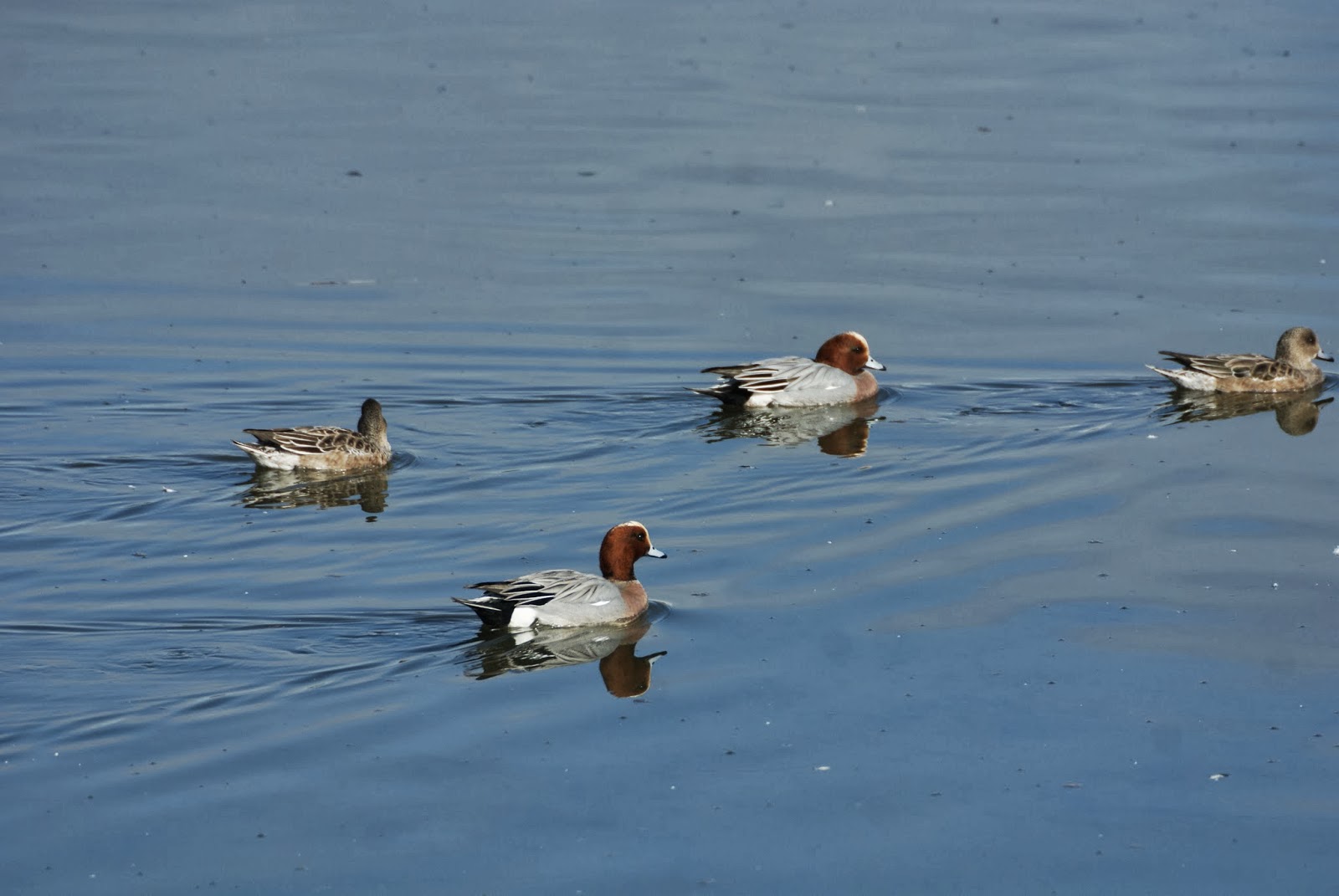
-Male wigeon
-Cormorant
-Wigeons
I scoured the rest of the reserve but found little that was not on the main hide, the highlights being the Goosander that were on the Wader Scrape.
After a bit I headed to the Tree Sparrow farm to see what was there, after all, last time I had brambling. This time there was not brambling, and there did seem to be fewer birds than last time, though there was a nice addition of Collard dove which I did not recall last time. There were the standard Yellowhammer too, always looking lovely and striking in the hedge.
-Yellowhammer
Next I went to the feeders behind the shop, last time there were no birds on these at all, but I had read that there were some lesser redpolls hanging around so I decided to try and hunt them down. I did not have to wait long before one bird came on the feeders at the back. This is only the 4th time I have ever seen Redpoll, so once more was well pleased with these. Sadly though the view was very short and it did not return besides its short stint of around 2 mins. In addition  there were Bullfinch, Goldfinch, Collard Dove and Woodpigeon all rather close and looking really nice.
-Lesser Redpoll
After this stint at the feeders I decided to head round to the reedbed section of the reserve to see what was going on. Not much different, though there was a stunning Great Crested Grebe and good Shoveler numbers, more than elsewhere on the reserve.
-Shoveler
While I was there something flushed all the gulls on the mere, I dunno what it was, but when I returned to the main hide to see if I could re-find the med gull it had sadly gone. One of the other birders though spotted a Dunlin fly across the mere, which was a year tick for me, so I decided to see if I could track it down.
I went to the Field Pool West Hide and had a look there, that's where it seemed to have gone. I did not have any luck initially, though I did find a Redshank, the first of the day and second of the year. After a bit longer though I did find the Dunlin and got some decent views of it feeding which was nice, and brought me up to 5 year-ticks for the day.
Finally I returned to the feeding station to see if the Redpoll had returned and was rewarded with not one but two redpolls and a lovely male Reed Bunting all on the feeders at the same time. So that was a wonderful end to a smashing day.
-Lesser Redpoll, Male Reed Bunting
And so finally I will end with a complete breakdown of all the species that I saw today in all their glory, and to tell you that as a result of today's remarkable birding my year-list is up to 80 species!

Day Total: Gadwall, Wigeon, Teal, Mute Swan, Goosander, Shoveler, Goldeneye, Tree Sparrow, Chaffinch, Greenfinch, Reed Bunting, Blackbird, Song Thrush, Magpie, Goldfinch, Black-Headed Gull, Lesser Black-Backed Gull, Mediterranean Gull, Lapwing, Bittern, Cormorant, Tufted Duck, Canada Goose, Blue Tit, Great Tit, Moorhen, Coot, Mallard, Pochard, Woodpigeon, Jackdaw, Stock Dove, Oystercatcher, Carrion Crow, Pheasant, Graylag Goose, Collard Dove, Yellowhammer, Long-Tailed Tit, Lesser Redpoll, Robin, Bullfinch, Great Crested Grebe, Wren, Dunnock, Common Gull, Redshank, Dunlin