Showing posts with label Egret-Little. Show all posts

Friday, 24 July 2020

Soil Hill; Isolation week 17

This week was much slower than its predecessor with cloudy and windy weather dominating making it difficult to enjoy large numbers of birds on the hill and instead being restricted to occasional good birds. Having acquired work again, I stayed local and did not venture any further than Soil Hill.
The week started on the 19th when I had a nice flock of 12 Cormorants fly over the Hill heading north. On the same day there was a peculiar hybrid Greylag x Canada Goose but with white outer primaries, throwing some leucism in the mix. Monday the 20th was the day of the standout bird of the week when I spotted a Little Egret drifting over Bradshaw. It dropped down briefly on the pond behind Bradshaw Park but then quickly took off again and after drifting around for a few minutes headed south strongly. This small heron is still rare in Calderdale so I was pretty thrilled with that. A single Crossbill flew over on the 21st, calling loudly as usual and on the same day a very vocal Grasshopper Warbler was singing from the top of the summit.
Aside from that the species setup remained largely the same. A pair of Blackcap was in the North Slope Treeline, as was a pair of Bullfinch. The Sedge Warblers continued to linger but were far more elusive and were seen only infrequently. Good numbers of juvenile Reed Buntings have built up and there were a couple of Wheatears during the week as well. On the 24th the fields along Taylor Lane were cut and so there were good numbers of gulls and corvids to look at, although nothing particularly different of note. 
-Little Egret
-Canada x Greylag Goose hybrid
-Reed Buntings

Species List:
Soil Hill: Canada Goose, Mallard, Red-legged Partridge, Common Pheasant, Feral Pigeon, Stock Dove, Common Wood Pigeon, Common Swift, Common Moorhen, Eurasian Oystercatcher, Northern Lapwing, Eurasian Curlew, Black-headed Gull, Common Gull, European Herring Gull, Lesser Black-backed Gull, Great Cormorant, Little Egret, Eurasian Sparrowhawk, Little Owl, Long-eared Owl, Common Kestrel, Peregrine, Eurasian Magpie, Western Jackdaw, Rook, Carrion Crow, Coal Tit, Eurasian Skylark, Sedge Warbler, Common Grasshopper Warbler, Barn Swallow, Willow Warbler, Eurasian Blackcap, Common Whitethroat, Eurasian Wren, Common Starling, Mistle Thrush, Song Thrush, Common Blackbird, European Robin, Northern Wheatear, Dunnock, House Sparrow, Grey Wagtail, Pied Wagtail, Meadow Pipit, Common Chaffinch, Eurasian Bullfinch, European Greenfinch, Common Linnet, Red Crossbill, European Goldfinch, Common Reed Bunting,

Monday, 21 March 2016

Saltholme RSPB and Hartlepool

So today I decided to take a short break from my patch at Soil Hill and go on a little adventure to the North-East to see if I could put to bed the demons of Penduline Tit and green-winged teal. Being in Halifax the public transport options are more limited but in the end I only lost an hour from Sheffield and I arrived at Saltholme RSPB at around quarter to eleven.
Within minuets of getting off the bus I had eyes on the Penduline Tits. They were distant but the sun was out and in the light they looked really smart. They would be up feeding on the Bull-rushes for about 10 minuets before they would drop for another 10 and then repeat. They showed really well when they were up though, if a little distant. I tried to get some decent photos but the distance made it difficult, still I managed some nice record shots...
-Penduline Tits
I was thrilled to have got them on the list having dipped them on their first day. Given their pattern of showing I decided to move on after an hour of watching them. I headed into the reserve in the hope of finally seeing a green-winged teal. I can safely say now that green-winged teal is my bogey bird, as once again I did not see it. This is the fifth time I have dipped this species...
I did however see plenty of common teal, including a large group of males which were displaying, something I can't remember seeing before and was really nice to watch. I also saw the female Smew again and had year-ticks of Black-tailed Godwit. The Smew was badly against the light so I was unable to get any decent photos. There was a nice Little Egret from the wildlife watchpoint though which I grabbed a couple of photos of to compensate.
-Smew
-Little Egret
By half 2 I decided to call it time on my hunt for the teal, which was not reported all day, and get on with my day. I got the bus off the reserve at half 2 and headed up to Hartlepool. The next stop for me was Ward Jackson Park to have a look at Hartlepool's resident population of Ring-necked Parakeets. I have no shame in this, its a species I have not really had the chance to photograph and have hardly seen at all to be fair.
As soon as I arrived at the park I could hear some calling but it took a while to pin them down, and then again to find one that was in a suitable position for a photo. When I eventually got a few in a photogenic position thought they were very obliging, and I was able to get a few nice photos in the late afternoon light.
-Ring-necked Parakeet
There were not many other birds in the park, but there was a very tame Gadwall on the pond, that was willingly coming to bread with the mallards. I had to suspect its origin but could see nothing so would have to assume that it is a wild bird that has become familiar with people. Either way it meant I could get some nice shots of it...
-Gadwall
By four I had wrapped up in the park. I could have gone home then but decided to endure the long trek to the headland to see the Shore Larks again. It was some walk there and by the time I arrived I never wanted to walk again.
The larks took some finding but this time I was able to pick them up on the deck rather than flushing them as before. They were more distant this time and I did not try to get too close. The light was much better this time, and in the early evening they looked fantastic. I mean they are Shore Larks, so they look fantastic anyway but when the conditions are right they really look the business. 
-Shore Lark
By the time I left the larks the sun was well on its way to setting. What a fantastic days birding, with a lifer and a host of other goodies. And all by public transport. All very nice indeed.

Species List:
Traveling: Common Buzzard, Jay, Little Owl, Grey Partridge, Stock Dove, Woodpigeon, Blackbird, Feral Pigeon, Herring Gull, Black-headed Gull, Magpie, Carrion Crow, Collard Dove, Red-legged Partridge, Pheasant, Skylark, Kestrel, Rook, Starling, Chaffinch, Jackdaw,
Saltholme RSPB: Penduline Tit, Smew, Blue Tit, Reed Bunting, Tree Sparrow, Wren, Tufted Duck, Mallard, Wigeon, Teal, Pochard, Canada Goose, Mute Swan, Moorhen, Black-headed Gull, Herring Gull, Little Egret, Great-crested Grebe, Magpie, Carrion Crow, Goldfinch, Greenfinch, Redshank, Meadow Pipit, Coot, Little Grebe, Shoveler, Shelduck, Lapwing, Gadwall, Common Snipe, Curlew, Pintail, Oystercatcher, Black-tailed Godwit, Greylag Goose, Stock Dove, Barnacle Goose, Chaffinch, Lesser Black-backed Gull,
Ward Jackson Park: Magpie, Treecreeper, Gadwall, Mallard, Moorhen, Coot, Tufted Duck, Canada Goose, Mute Swan, Chaffinch, Ring-necked Parakeet, Woodpigeon, Carrion Crow, Feral Pigeon, Herring Gull
Hartlepool Headland: Skylark, Shore Lark, Meadow Pipit, Ringed Plover, Oystercatcher, Carrion Crow, Herring Gull, Sparrowhawk, Woodpigeon, Feral Pigeon, Magpie

Tuesday, 22 September 2015

Orgreave Lakes

With nothing really on the cards to go any distance for I decided to take a trip down to the local patch for my first spot of birding for the new semester. Granted, it was a little quiet, but there were still a few nice bits and pieces.
Highlight of these was a Little Egret. One had been seen the previous week but had since moved on. I was pretty surprised then when I spotted it on the small island. It moved between the two lakes a bit whilst I was there, Still scarce in Sheffield, but no doubt one that will become far more abundant in future.
Another patch tick were 2 Siskins that flew over the trees alongside the river. That being said, they are so abundant this year that its hardly a surprise they turned up here as well. Other species on site were plenty of Pochard, a few Great Crested Grebe, a few large gulls and the usual suspects. A bit of a slow start to the year, but plenty to build on.
-Little Egret

Species List:
Orgreave Lakes: Grey Heron, Little Egret, Coot, Mute Swan, Great Crested Grebe, Pochard, Gadwall, Mallard, Tufted Duck, Graylag Goose, Canada Goose, Cormorant, Black-Headed Gull, Lesser Black-Backed Gull, Great Black-Backed Gull, Woodpigeon, Siskin, Long-Tailed Tit, Linnet, Goldfinch, Meadow Pipit, Skylark, Magpie, Carrion Crow,

Monday, 21 July 2014

Spurn Day 12 - LIFER ALERT

Sort of a continuation from yesterday; in the evening Paul was going to try to ring storm petrels and since I had never seen one I gave him a hand. However, nothing happened in yesterday’s half on the night with the exception of a few bats and a Toad. However on this side of the night stuff did start to happen and I picked up another lifer. Not a stormie or even anything alive but I saw my first Shooting Star. The first one I was not expecting and it was the brightest. I was surprised by just how bright it was, clearly adding illumination to the dark seascape as it whizzed overhead. There was a second too but this one was less bright. To say that I was thrilled would be an understatement! Paul even commented that I was easily pleased, which is true, and a good way to be I would say.
We now skip ahead to 5 in the morning as the shift began. It was another lovely morning only this time I was on the right side of it, so would be able to appreciate it all the way. There were no waders in when I arrived but still plenty of stuff around, including a personal record of 5 Little Egrets and both Oystercatcher families.
The morning began to pass with species coming and going. At around half 5 a Common Sandpiper dropped in, which I recognised by the call but only saw briefly. There were the usual assortment of regulars in, Arctic, Sandwich and Little Terns making up the bulk of the lagoon-side birds, plus the Ringed Plover and 5 Cormorants on the raft. At 6.00 I found a Red Knot feeding along the shoreline, but only one, and it soon moved onto the beach to feed.  At 6.10 I found a juvenile Little Gull preening itself on the side of the lagoon too, but again only one.
Things really began to kick off at 6.55. From behind me I heard a few terns call alarmingly and turned around to see a large black gull sized bird flying along the shoreline. It was an Arctic Skua, Dark morph. It moved along the beach very close to where I was sitting, the best view of one I have ever seen. The only downside was that the morning sun was behind it, so all I got of the bird was its silhouette. I was also surprised by how big it was, at least the size of a herring gull, but it has been 4 years since I last saw one. It was great to see, even though it’s my job to keep them away…
-Arctic Skua
The Skua did not stay long, only really passing through. It did cause absolute havoc in the colony, and the Sandwich Terns were probably part of the reason it did not stay for long. Its agility for a big bird while avoiding the terns was also striking, as was the size of terns in comparison to the Skua.
The tide had started to drift out over the morning so once the Skua had left and all had settled down I began to check out the birds on the beach. Most were Sandwich Terns with a few Arctic and Little thrown in. I continued scanning and stumbled across a small gull among the colony. I had a check of the key features and was left in no doubt that I had found myself a Kittywake sat on the beach. Now this may not sound much but this is a personal milestone for me. Ever since the Old Moor kittywake I have wondered if I would have been able to find and i.d a kittywake outside of its regular habitat. And now I had, with this individual on the beach. This self-found bird shows just how much I have improved even over this year.
-Kittywake
But the Gulls on the beach did not stop there. Another quick look and I found myself another unusual gull. Sadly it was quite distant but it was still pretty clear that I had found an adult Yellow-Legged Gull sat on the beach. This is not a species I see very often, though I have seen one at spurn already, but this one was self-found so all the more rewarding. Sadly I could not get any decent photos of it simply because of the distance, but they serve as record shots for this find.
-Yellow Legged Gull
I continued to scan the beach and the sea in case anything should drop in or drift by. I found a Black-Tailed Godwit feeding up near the far end of the beach and a young Gannet flew north at 7.20. The Terns were having a really bad day. Apparently the fox dropped in 4 times last night, then the Skua this morning. Add to that an adult and juvenile Kestrel that came in at 7.50 and a Grey Heron at 8.05 that sent them up. A Brown Hare then set them off, but these are easy enough for me to deal with.
It all settled down for a bit then, with birds coming and going but nothing major really. The next headlining bird to come along was a juvenile Marsh Harrier that drifted over from the north and circled the top area of the ponds. It then drifted west, largely avoiding the colony. It is a patch tick for me though, a nice addition.
-Marsh Harrier
Luckily the Harrier did not come in close enough for the terns to kick up a fuss. But their troubles did not stop there. At 10.50 the worst of them all came in. I saw the birds all go up but could not make out a threat, but this time it was really bad, as all the birds were calling and in the air. Then I saw it flying straight towards me. It was a male Sparrowhawk that had zoomed through the colony. It actually had the nerve to land in Area A, which meant I had to scare it off, a pity for such a spectacular bird. I did not see it get anything, but it went back south after I flushed it and I lost it, so it’s possible it may have done more damage out of sight. The Terns took an age to calm down, and were on edge for the whole afternoon, often going up for no reason.
The next bird that stood out from the regulars was something special, a self-found lifer. Out my 18 lifers this year only Corn Bunting was completely self-find, so this is pretty special, and long awited. As I watched the dunlin, a small group quite near to the hut I spotted one among them that was definitely not a dunlin, but for the first time it was pretty clear what it was. I had finally found myself a Curlew Sandpiper, at long last. Having seen one now I can safely overrule all the dubious birds during my time here.
It was a young bird, but molting so its plumage was quite blotchy. It really stood out from the Dunlins and was pretty much the spitting image of that in the book. It basically looked like a dunlin on stilts, with a slightly longer beak. I was very impressed by how different it actually looked in real life, having made it difficult for myself over the past few days. I tried to follow the bird as it fed to grab some photos for record purposes. I grabbed 2 in focus, but the bird I photographed and the bird’s plumage I saw looked completely different. It was not until I found a different photo from a different set that I figured it must just be the lighting
-Curlew Sandpiper (Middle Bird)
-Curlew Sandpiper (Central Bird)
I spotted the bird at 11.20 and by 11.40 the small flock of dunlin it was part of had taken off and gone to the beach. As a result when I went to lunch I kept an extra eye open for them. I failed to find any Dunlin but did flush 2 small waders. When I first saw them I considered if they were little stint, but were too red on the face and when they took of the distinct wing pattern showed clearly that they were Sanderling. I have never seen a summer plumage sanderling before so this was a plumage lifer for me, another addition to what was turning out to be a great day.
-Summer Plumaged Sanderling
By now it was getting quite hot, and me with 2 jackets on was beginning to feel a bit of a mug. However, the weather meant that Beacon Lane was alive with butterflies and dragonflies. On the small pond there was Ruddy Darter, both male and female, and Emperor, the latter was ovipositing too. On the butterfly front it was manly whites and browns, of the latter however I got a patch tick in Wall Brown. A species that used to be common back home, I hardly see them anymore, so I was well pleased when I found this individual, very fresh.
-Wall Brown
 On my walk back after lunch I found some more Sanderling on the beach. There were also Dunlin and the Ringed Plover. I had thankfully disposed of my excess clothing and so was feeling fresh for an afternoon perched on my dune watching the birds. If the morning was anything to go by I should be in for a good time.
The afternoon was significantly quieter than the morning, most things probably put down by the heat, as indeed was I. The haze over the pond was bad that I could not distinguish between Dunlin and Redshank in the wader roost. I did manage to distinguish the Black and Bar Tailed Godwits, 1 Black and 11 Bar, as well as count the number of Grey Plover, 13 with 1 summer plumaged ad.
At 2.30 the next treat came in, if only for about 10 seconds. I heard a peculiar call and turned round to see a pair of dark wader with distinctive white rumps drop in. They were Green Sandpiper, or so I take it, as they left almost immediately, before I could get the scope on them to look. I was scouring the bank where they had landed to get a better look, took my eye from the scope to get my bearing to see the birds flying off…
I enjoyed a quiet afternoon catching a few rays while counting terns and other birds. The Terns were still very put out due to the Sparrowhawk in the morning, but they had no real reason to worry despite their constant jittering. That’s until 4.15.
I heard the call of an alarmed tern at sea and looked to see an Arctic Skua mobbing a Sandwich Tern. It was quite far out but it was clear to see through the scope. It’s the first time I have ever seen a Skua undergo this characteristic mobbing behaviour. I have to be honest, its not pleasant to watch, though it is fascinating. This was quiet far out. The Tern got away this time, and the Skua began to approach the shore…
As a result I got the camera ready, but then lost the bird. In fact I lost both, as there two, but only one had been mobbing and only one was coming towards shore. I waited a couple of mins before deciding it must have moved off. I then heard the terns go mad, and spotted the Skua very close to the shore causing chaos. But as soon as I saw it, it began to move back out to sea, so not decent shots as such. It was still a great encounter and a behaviour tick to add to my collection.
-Arctic Skua Mobbing
-Arctic Skua
 The Skua left northwards I think, but I lost it again among the waves. It was almost time to head home too, having clocked up 50 species of bird during my shift today. The only other thing of note was a flock of Common Scoter that went north while I was watching the Skua. I did not follow them as I was busying trying to work out what kind of Skua I had (Poms or Arctic), but I reckon about 35 birds.
On the beach there were a few more Sanderling, this one though was a juvenile and so lacked the colouring on its head that the others I had seen had. I managed a pretty decent flight shot though as it took off.
-Sanderling
I arrived back at the warren at around half 5, absolutely worn out. I crashed onto the sofa for a good ten mins before I managed to muster the energy to cook dinner. 12 hour shifts on 4 hours sleep are not a good idea I have decided.
I had just put my chicken on when another birder, Rob, wandered in to get a jacket and said that there was a Bonxie on the sea. This required immediate attention. Off went the chicken, on went the boots. I made it up there, the bird still there, but it took me some time to actually find it. As we watched, Rob noticed that it was pecking something, which we worked out was an auk, probably a guillemot. The brute was giving it a fair old bash, but was too far out to get any pics.
That was the final bird of the day, clocking up my 3rd yeartick and second Skua of the day, what a finish. A finish well worthy of the day I would have said.

The Daily Oystercatcher
And of course our update from Spurns star birds. Both chicks with both adults were about when I arrived, feeding along the shoreline. There was also some wing-stretching from the chicks which is a promising sign. Sometimes they were feeding themselves, but other times they were pestering their parents. One chick seems to pester the parent significantly more than the other, and I have also noticed that one of the chicks seems to wander on its own a lot; an independent chick.
But this feature has been going for a few days and I have not yet introduced you to our stars. So this morning when they were fairly close and together I grabbed a few photos. Please note that there is also a Little Egret, one of the 5, photo-bombing this family portrait.
-Oystercatcher (With Photobombing Little Egret)

Species List:

Beacon Pools: Little Egret, Little Tern, Oystercatcher, Avocet, Common Sandpiper, Sandwich Tern, Arctic Tern, Ringed Plover, Cormorant, Mallard, Mute Swan, Woodpigeon, Swallow, Black-Headed Gull, Whimbrel, Lesser Black-Backed Gull, Knot, Little Gull, Skylark, Redshank, Arctic Skua, Kittywake, Greater Black-Backed Gull, Yellow Legged Gull, Gannet, Black-Tailed Godwit, Common Tern, Swift, Kestrel, Grey Heron, Sand Martin, Graylag Goose, Dunlin, Marsh Harrier, Carrion Crow, Sparrowhawk, Curlew Sandpiper, Linnet, Sanderling, Bar-Tailed Godwit, Pied Wagtail, Whitethroat, Grey Plover, Green Sandpiper, Magpie, House Martin, Feral Pigeon, Herring Gull, Common Scoter, Blackbird, House Sparrow, Starling, Grey Seal, Brown Hare, Southern Hawker, Emperor Dragonfly, Ruddy Darter, Common Blue-Tailed Damselfly, Small Tortoiseshell, Large White, Wall Brown, Meadow Brown, Gatekeeper,  Green-Veined White, Small Skipper, Ringlet, Red Admiral, Peacock, Small White,

Friday, 4 July 2014

Fairburn Ings

My time at uni is drawing near to an end for good for the summer. Since it is 'Le tour' this weekend I decided to make today my final major birding trip due to the number of road closures over the weekend. I decided to try a new site, for public transport at least, by going to Fairburn Ings RSPB. Its a site where I have had mixed fortunes before, dipping smew 3 years in a row, but I had not been for some time.
Reports showed that there were 2 spoonbills on site, that had been around for some time, which was the main reason I thought to go and have a look, but the glossy ibis that has been roving around west and South Yorkshire had recently made it is home. As a result I decided to head over that way to enjoy my last bit of proper first year birding.
Despite its steep train fare I did not have to get a bus, as I can walk to the site from Castleford, so that was a major bonus. Once out of the town you follow the canal for a short distance before going onto the RSPB land.
It was walking along the canal that I had Mallard, Swallow and Mute Swan on the canal and woodpigeon on the overhead cables over the hedge. Or so I thought. I don't really know what inspired me to check out this so obvious woodpigeon on the wires, but for some reason I gave it a thorough inspection. It was difficult from my range, and my head secretly wanted turtle dove, so I allowed myself all kinds of thoughts. When I managed to get a decent view through the bins I immediately noticed a lack of white round the neck. Woodpigeon no more. I still struggled to make anything out with my bins though, so got the camera and grabbed a record shot. I could not believe my eyes when I had a look, it was a Cuckoo, chilling on the wires. I got closer until I was right in front of it, the hedge providing a suitable hide. Its my first good shots of a Cuckoo landed, and it is also one of my best self finds. To find a Cuckoo at this time of year, on a site not reknown for its cuckoos, is something pretty special. I was well pleased with myself. I had a good look through the bins, before taking some shots and then going for the bins again. But it was between the transition of camera to bins that the bird moved off, as it was no longer there when I looked up again. I don't know where it went, but it made my day, and it was not even lunchtime.  
-Cuckoo
I continued onto the reserve, and decided to first call in at Lin Dyke Hide, as that was where the ibis and spoonbills were most frequently recorded. As I left the riverbank and headed up towards the hide I noticed 2 large white birds circling near the farm in the distance. Of course my first thought was swans, but through the bins I could see that they were not swans, they were in fact the Spoonbills that I had come to see. The scope was in my bag, and through the bins there was not much to make out except for their long neck and broad wings and tail. I grabbed a ton of record shots of the birds, since I had no idea what their next move would be, and good thing too, as they quickly dropped down below the tree line. They are my 17th lifer this year, and a bird I have long wanted to see. Sadly because of distance I could not make out the bills properly, but I had hope that over the course of the day I would find them again.
-Spoonbills
Now I was really buzzing and it was about to get even better. Not much further up than from where I saw the spoonbills I noticed a large bird fly towards me over the reeds to the right of the hide. It was clearly a heron and because the neck was tucked in from such a low flight I identified it as a bittern. A quick check with the bins showed I was right, but it also showed that the bird was coming towards me. I grabbed the camera due to the potential of some great shots, just in time for the bird to gain altitude and fly right over me. Great shots? you bet, it was without doubt the greatest view of a bittern I have ever had, beating even those birds that I have seen landed. I think it would only be right to let the pictures do the talking.
-Bittern
The bittern flew over the path and then was lost behind the trees. I had barely made it on site and already it was one of the best days birding this year, and that is saying something. I made it to the hide without further incident, but that's not saying much due to the short distance. I began looking for the ibis, or to see if the spoonbills had landed. The latter had not and the former was not to be seen. I did not want to ask other birders, as it removed some of the pride from any sighting, but from tactical eavesdropping I learned that it was in a pool just up the path.
From the hide there was good stuff to find, including many waterfowl; Common Teal, Shoveler, Gadwall and more Mute Swans. On the banks there were Lapwing, Redshank with a well grown chick and a few Little Egrets, which were showing really well. After some continued searching I found a few Little Ringed Plover on an island quite far out, and was going to announce them with pride, when I noticed a small bird right in front of the hide have a stretch. There had been a Little Ringed Plover with a well grown chick right in front of the hide all along, and nobody had noticed. They were even close enough to get some decent record shots.
-Little Ringed Plover
After my stay in the hide I decided to head up to check out the Ibis and see if it showing. I saw the small cluster of birders on the path, but could not see the bird due to the hedge. I saw the pool next and was shocked by how close it was to the path, as in really close. There were also about 10 Little Egrets on the pond, which being so close and so unfazed looked absolutely great, the best views I can ever recall having.
After a short while the ibis raised its head, it had been feeding at the back out of view. It was moving closer though, but keeping to the reeds and sedges, making it difficult to photo, or even see. This is of course the same bird that I twitched at Wombwell Ings, before exams and all that fun. That seems so long ago, and compared to how close the bird was currently seems completely independant of this encounter.
While I waited upon the ibis to yield a great view I noticed a pair of Whitethroat that had been moving around the hedge in front, probably disturbed by the small cluster of birders. I decided to back off to avoid causing them more harassment. Once back the birds started landing in very nice positions for a photo of Whitethroat for this year.
-Whitethroat
As I had mentioned before there were many Little Egrets all showing well. While photographing the Whitethroat I had noticed to my horror that my camera battery was very very low. Even so, I decided it was too good and opportunity to miss, so took a few photos of the egrets while they were in nice positions.
-Little Egret
But of course, the bird of the hour was the ibis. After waiting a little while it decided to finally come out and show itself in all its glory. It was a different perspective to the view I had got at Wombwell, here really highlighting the grey streaks on its head and the the green and purple sheen on the bird. It carried out all kinds of behavior, mainly feeding but also preening which was a different perspective of the bird.
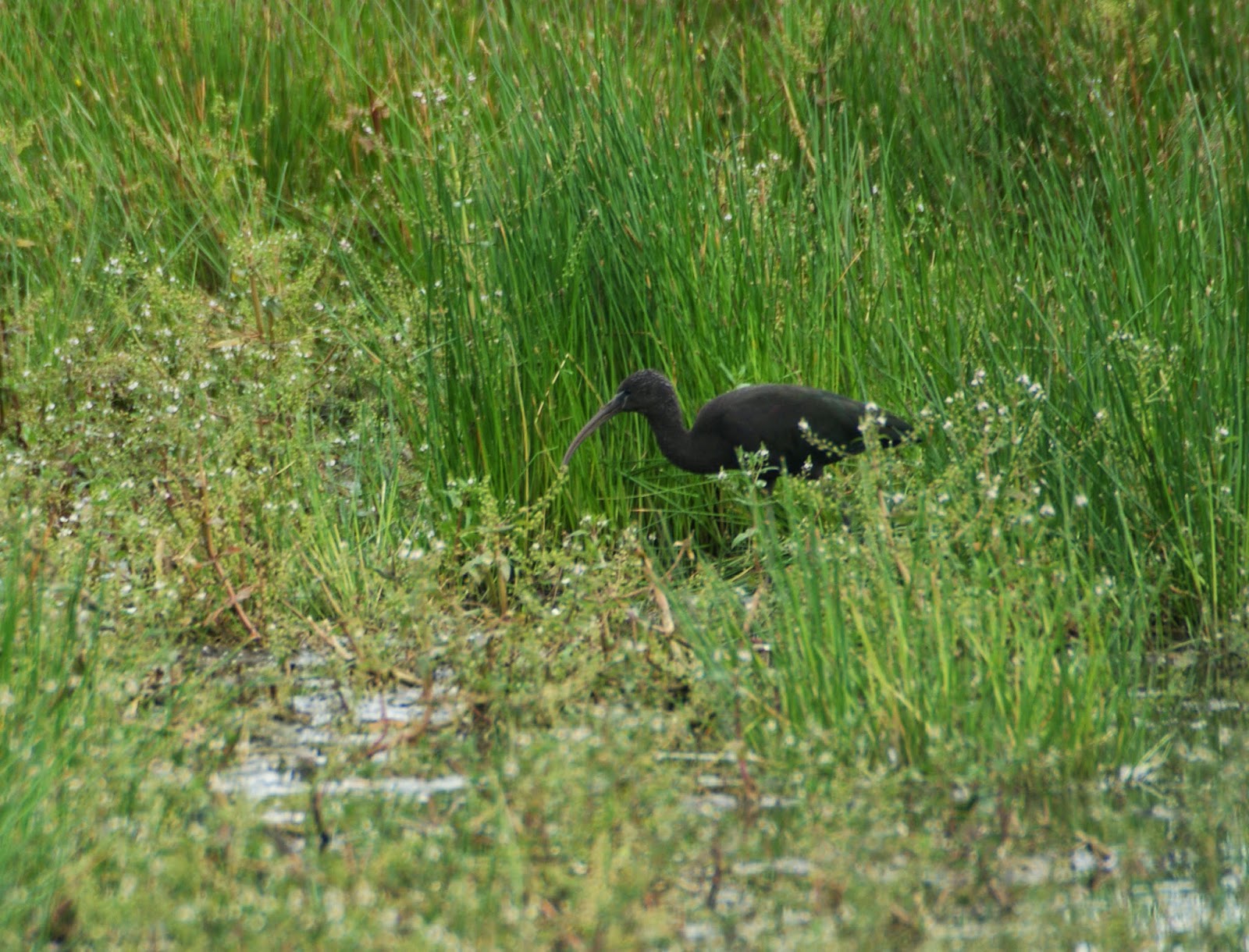
-Glossy Ibis
I got so many better pictures of the Ibis than before, the fourth awesome bird that I have seen already today. After a while I decided to move on to try and re-find the Spoonbills further up the reserve. I had initially decided to walk along the river, but the spoonbills had changed that and I decided to walk along the road to see if I could find them further up.
Before the road I added Willow Warbler to my day list, and Wren too, which was singing with great gusto from the hedge. Once on the road the birds naturally declined. Overlooking the Spoonbill Flash I did not get many additions as most of the birds could be seen from the hide. However, there were some ducks resting hidden next to the road which I failed to see due to me being distracted by a Sedge Warbler. One of the ducks was a Pochard female, which I took a couple of photos of due to it being so close.
-Female Pochard
I continued along the road, reaching the area that overlooks the moat. However, the spoonbills could not been seen. What did impress me were the number of Cormorants. They were everywhere, on the trees, on the bank, in the water even flying overhead. I was very surprised by how many there were.
I moved off and entered the car park area of the reserve. I first headed down to the main bay lookout point near the car park to see if there was anything there, as there has been some decent stuff in the past. Today it was very quiet though, mainly eclipse mallards. There was also a female Mandarin which was different, a lovely male reed bunting giving it Gusto from the reedbed and a couple of Common Terns hunting out over the bay.
After a short stay at the feeding station my next call was the Pickup Hide for lunch. On the feeding station there were Blue Tits, Great Tits and Tree Sparrows, nothing particularly unusual, nor were there any willow tits which I really wanted to see.
Fortunately at the Pickup Hide there was a Willow Tit, a very aggressive individual that was chasing all other birds on the feeders. Besides that there was not much about. The Sand Martin wall in front of the hide was quite busy, with a few birds drifting in and out at regular intervals. There were also about 5 Avocet on the bank, I am informed a pair with chicks. A Stock Dove also joined in at one point for a drink, but it was very quiet. I tried for some record shots of the Willow Tit but it was very dark and they did not come out well. Never mind.
-Willow Tit
-Tree Sparrow
Once I had moved on from Pickup I decided to take a look at the hide overlooking the main bay before returning to Lin Dyke via the river. In that hide there was not much, but there were good numbers of Great-Crested Grebes on the lake, most of which were sleeping. On the way to the hide I also picked up Chiff-Chaff and Long-Tailed Tit, the latter being a regular at the site.
Along the river it was very quiet. There good numbers of Cormorants in the river, and a Grey Heron on the bank. It was mainly the insects along the bank that were the highlight, with many species of butterfly; Ringlet, Gatekeeper, Small and Large Skipper, Red Admiral, as well as a couple of dragonfly species; a spectacular Four-Spot Chaser and a Black-Tailed Skimmer on the path.
-Four Spot Chaser
-Black-Tailed Skimmer
 I re-arrived at Lin Dyke hide intending to stay a little while and then go and re-find the ibis. However, not long into my stay at the hide and a birder came in and informed us that the ibis had moved on, apparently we should have seen it from the hide, but failed. So I spent all my remaining time in this hide waiting for something to appear.
And right on cue the Spoonbills decided to do another flyby, but this time I opted to watch them rather than photograph them. Even through the scope it was difficult to see that beak, but I certainly got a better view than I had got before, and I was glad I saw them again before I left for the train. Once they had gone down again I returned to try and see what else was about. The fore mentioned birder had spoken about Common Sandpiper, and right on cue a Common Sand came and landed on one of the pieces of wood on the lake, another great day tick. There was a tree in the middle of the flash, and while I watched this tree became frequently covered in Sand Martins, before something would cause them to flush and they would all leave. But the real stars again were the Little Ringed Plovers, which once more were right in front of me, but I was unable to spot them for a good half an hour. It then turned into a nightmare trying to describe their location to the other birds, who could not believe how well hidden they were, despite being out in the open.
-Little-Ringed Plover
It came to the time when I had to go for the train sadly, and I departed. On the way back I picked up another Grey Heron and a Pheasant but not much. It truly had been a great day, really enjoyable. And with another lifer, and catching up with that Glossy Ibis what more could a birder really ask for.

Species List:
Fairburn Ings RSPB: Spoonbill, Bittern, Little Egret, Grey Heron, Glossy Ibis, Starling, Dunnock, Chaffinch, Blue Tit, Magpie, Carrion Crow, House Sparrow, Blackbird, Blackcap, Great Tit, Robin, Common Pheasant, Black-Headed Gull, Wren, Mallard, Jackdaw, Mute Swan, Feral Pigeon, Woodpigeon, Mistle Thrush, Bullfinch, Goldfinch, Pied Wagtail, Kestrel, Collard Dove, Lapwing, Long-Tailed Tit, Tufted Duck, Cormorant, Moorhen, Coot, Great-Crested Grebe, Jay, Common Teal, Shoveler, Gadwall, Pochard, Redshank, Greenfinch, Tree Sparrow, Reed Bunting, Stock Dove, Willow Tit, Oystercatcher, Chiffchaff, House Martin, Little-Ringed Plover, Sand Martin, Willow Warbler, Scaup, Canada Goose, Graylag Goose, Avocet, Sedge Warbler, Common Sandpiper, Common Tern, Whitethroat, Swift, Cuckoo, Small Skipper, Large Skipper, Meadow Brown, Large White, Gatekeeper, Ringlet, Speckled Wood, Common Blue Damselfly, Common Blue-Tailed Damselfly, Brown Hawker, Black-Tailed Skimmer, Common Darter, Four-Spot Chaser, Common Toad,