My brother had an open day at Newcastle University and so my mum offered to go up to Seahouses afterwards for me to tick Eider, and have some fish and chips. This was a great plan, until there was a tern in my fortunes, a black and white tern of mega proportions. Yes, once again the Bridled Tern had returned to the Farne Islands, and this got me thinking that perhaps I would be able to make it to the Farnes via public transport and then get picked up.
I did some serious research into this, and found that it would be do-able, but would require us to reach Newcastle station for the train at 10.42, or else it would be a waste of time and I would miss all connections. I would require this train to Alnmouth, then a coast bus that was one every 3 hours to Seahouses and that would get me in at around half 1, giving me the option of 2 tours. In good faith I reserved a spot on the 2 o'clock tour, knowing that if I was going to make it, then this would be the one.
And so the day came, bright but overcast. We set off at around 8.00 in the morning, the time I usually get up when birding at uni, and made good speed all the way up to Newcastle. Here I must thank my dad for driving us there for me to get the train and Jesus for keeping the roads clear of traffic so it was possible. When I arrived I have a full half an hour of spare time prior to my train, so things were looking up.
All my other connections had plenty of time, the bus was a little late but no matter. A little wildlife intermission now, as we picked up Bullfinch and Roe Deer while driving up the motorway, I also added Kestrel and the Kittywakes on the Tyne bridge from the train, and Brown Hare, Rook, Curlew and another Roe Deer from the bus. Even should it all go wrong it had already been a pretty decent day.
I made it to Seahouses in good time, having had a pleasant journey on the bus through some lovely small villages along the coast. Upon arrival in Seahouses and checking my reservation I managed my first year-tick of the day, no problem: Eider. Sadly the males were all in eclipse, and the time was out, so I was unable to get great views at this point, but watched them over the wall behind the booking offices for the tours. Alongside the Eiders were Oystercatcher, Feral Pigeon and Herring Gull, so doing well already.
-Eclipse Eider
I had loitered around that area as our boat was soon due, and so it appeared. We got on a little later than 2.00, around 10 past, but I was surprised by how few twitchers there seemed to be, leaving me to wonder if the bird had gone overnight, and I had missed a trick. I should state here that a trip to the Farne Islands is great regardless of any Bridled Tern, and that it would be a great afternoon.
The first birds we encountered while on the boat were Guillemots that were fishing in small parties near the harbour. Thats year-tick number 2, quickly followed by number 3; Puffin, much to the delight of may passengers aboard the boat. Number 4 followed not too soon after in the form of Gannet, which glided among the waves or along the horizon in small flocks.
Having never been to a seabird colony at this time of year I was unsure of what to expect, if things would quieten down due to it been late, or if it would still be bustling. It was certainly a case of the latter, with the cliffs teeming with Guillemots and Kittywakes, the former making up the majority of the numbers.
-Guillemots
-Lots of Guillemots
As we pulled up for the first time near the inner Farne Islands, the tour guide pointed out Shags, number 5, and Cormorants roosting on the rocks. While Cormorant is a species I am well familiar with from inland, the shag is not, and I do not see them often. I was keen to try and get some photos, but was reluctant to pull out the camera for getting in peoples way. I managed a few shots of Shags, often on nests or perched on the cliffs, but it was difficult to focus due to the rhythmic bobbing of the boat.
-Shag Pair
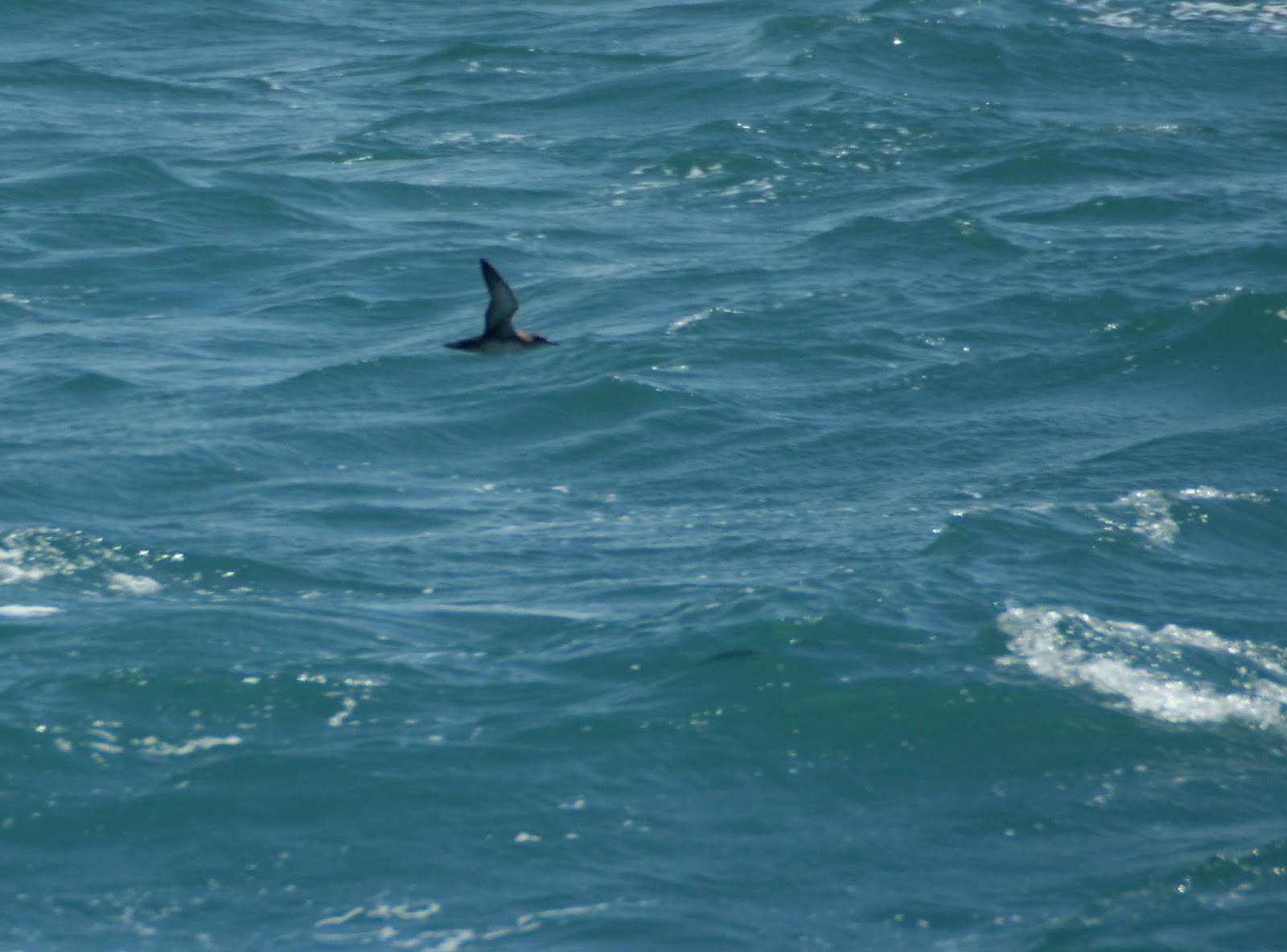
We then moved off to look at the Outer Farne Islands, and on the way across we were joined by more Gannets and a Fulmar, not a year tick but certainly an improvement on the sighting that was. This individual flew right over the boat, though I spotted it too late for any photos.
On the Outer Farnes there were rather a lot of Grey Seals, which caused quite a commotion among the boats occupants. I did not bother trying to get photos as everyone was standing and it would have just been in the way, but I was surprised by how close the seals were coming to the boat, obviously it is to be expected from inquisitive animals such as them, but regardless.
Anyway, having had great views of the seals the captain took us round to another island where there was more grass, and as a result there were good numbers of Common but especially Arctic Tern. But the real stars here were the Puffins, which were all lined up in a great mass along the top ridge of the rock, making for quite a spectacle. Despite the furor this created I decided to just get some photos, of a species that for all its character, I do seem to lack record photos of...
-Puffins
It was also on these Outer Farnes that we picked up our first Razorbills of the afternoon. I had noticed a lack of them among the guillemots, but the commentary explained they were not especially common here, and so it would seem. These were my 6th year-tick of the day, a nice addition but was unable to get any photos because they were sitting on the water on the wrong side of the boat. I spotted a few others perched on top of the rocks but I could not get any photos, the sea making it hard work.
And that concluded our tour, so we headed off into the Inner Farnes, to land on Inner Farne itself for and hour. As soon as we drew close I spotted the small group of obviously less dude birders perched atop the jetty staring out into the terns along the rocks, indicating clearly that this was the location of the bridled. But as soon as I got off the boat I was broke the devastating news that it had been lost as of 2 mins before where a large number of terns had gone up. But the birders remained hopeful of its return so I set up and began to look.
Upon landing on the island I got my 7th and for me most surprising year tick of the day when a female Red-Breasted Merganser flew past the jetty. I did not expect to see this species today, but it was a nice addition, having never seen one here before. It took me rather by surprise and I was unable to get any photos the view was so brief as it flew by, but the white wing patches made it pretty unmistakable. Along the shoreline there was also Ringed Plover, though I could only find the one, which was almost as aggressive as the terns were. At one point a young Black-Headed Gull managed to upset both the terns and the plover and so relentless were the attacks that the gull eventually just crashed into the water to sit it out. The terns in question were of course the Arctic Terns, but there were also good numbers of Sandwhich terns, though they were less bold. The boldness of the Arctics was something of a revelation, having been used to skittish birds most of my life, having these terns perch so close to me was something new. As we were waiting for the Bridled one perched on the mast near the jetty, an unnatural but convenient post for some record shots.

-Arctic Tern
It did not take long for the Bridled Tern to be found, perched on the other side of the jetty to where it had been before. I managed to locate it after looking through another gentleman's scope, finding it with my bins and then my scope. This is a bird I have long wanted to see, and it did not disappoint. As soon as I set eyes on it I took in its suave and elegant posture, as it perched among the rocks. It just oozed class, pure beauty, as solid and beautiful a British bird as you can get. I savored the view and then decided to grab some record shots before continuing my admiration. Good thing I did too, as no sooner had I rattled off about 20 record shots all the terns went up. I had put my camera away but through the bins I could follow the bird, as it came flew out over the bay, then back, then towards the jetty, and then right over us, and then over the far side of the jetty and then over the brow of the beach and was lost.
I can't describe the emotion felt as the bird flew over us, just for a split second it came with a couple of meters, so close that all its glory could be made out with the naked eye, Before having to watch it drift away beyond my sight. After it had gone over us I grabbed the camera but from that point on the bird had its back to us and I only managed a couple of shots before it went.
That was it, all day travelling, all that money for 5 mins watching one of the greatest birds I can imagine. Despite spending the rest of my time on the island looking, we were unable to relocate it, the bird had probably gone off fishing as it is prone to doing. But regardless, it had provided me with possibly one of the best 5 minuets of my life.
So I mentioned I got some photos, poor as they are as the bird was initially distant, but unmistakable in its finery. They define record shots. I would have loved a photo was it flew over us, but it will never be.
-Bridled Tern
This is a species I have always wanted to see, and it definitely made the whole trip worthwhile, though it would have been regardless. Some number crunching, that was the 8th (and final) year-tick of the day, but undoubtedly the best. Its also my 15th Lifer this year, and my first Mega for 4 years (pied billed grebe).
Having been on a missive high from the bird, it descended into a lull now that it was lost and the search began again. I searched at first but then began to look for the other birds on the island, though in the same area. Despite the great numbers of Arctic Tern there were still a few Common Tern around, and one landed right besides the path with a sand-eel in its mouth. Inland I would never be able to get this close to this species, so this was a real treat to see it like this.
-Common Tern
Having never been to the Farnes at this time of year, I can say that I have never been attacked by its terns, a feature so readily advertised about the islands. While not wanting to upset the birds I decided to run the gauntlet to pay for my stay on the island, but also to see what it was really like.
It did not dissappoint. Like a true birding pro, I managed to pass most of the birds perched on the edge of the path without causing them to fly, but the first bird was very upset and very persistent about its attacking. It pecked my a good 5 times before considering me vanquished, leaving me very relieved to have my hood.
It is a sickening feeling to have Arctic Terns pecking my head, when I spent most of Easter chasing them round South Yorkshire thinking I would not get them this year. Those 2 birds at Orgreave I had considered all I would get, observing a pair flying up and down a small lake before moving off. Now I had the birds well within touching distance, and if I did not want to touch them, they certainly wanted to get you. As I managed to avoid disturbing the birds on the paths edge I settled down to grab some photos, to improve on the record shots I had taken at Orgreave.
It is also worth mentioning that you got great views of the Arctic Tern chicks along the path. Not wanting to disturb the birds I did not stay at any nest to photograph the chicks so I have no photos of them, but they were certainly a delight to see.
-Arctic Tern
Sadly my island experience was limited due to the fact that I spent most of it on the jetty awaiting the return of the Bridled Tern, but one can't be in all places at once, and I was not to know that it would not return. The hour flew by, and before I knew it the ferry had returned to take us all off home.
Our captain made a slow and steady return round the far side of Inner Farne to allow us to get a final view of the birds. This time I had a better seat on the boat so took a great deal more photos than previously, though very few came out well. I tried to add Kittywake photos to my effort for the March bird at Old Moor and managed a few reasonable shots.
-Kittywakes
A real plus was that on the way out, just we were leaving, our driver alerted us to a Razorbill with its chick near the side of the boat. I grabbed a couple of record shots before I was crowded out, as proof of the year-list sighting. It actually came out alright, showing the adult well and even the chick too
-Razorbill
The rest of the trip passed without incident. A couple of Gannets and a few Puffins were the swansong of what had been a great afternoon, really enjoyable. But it was not over yet. I knew my parents were coming to pick me up, but I did not know when or where. I made my way over to the Eiders to take some photos while I waited. There were only females near the shore, but they had good numbers of chicks, of different ages too. Its the first time I have ever seen Eider chicks and I have to say that they are pretty sweet. Their feet seem so out of proportion to their body, and they often were sent tumbling either by gravity or by the waves.
-Eiders with Chicks
I found my parents soon enough and we went for a walk along the harbor. Here we picked up Grey Heron fishing in the bay, as well as swallow and a small brown bird that was almost certainly a rock pipit, but it did not stop so I decided to not tick it until I can find one where it can be 100% confirmed.
And that was that, most of the journey home was in rain, and when it was not raining I was asleep, reflecting on what had been a pretty incredible day, one of the best I can recall having. There were so many birds, and its the first time I have been to a proper seabird colony with my camera and as a more mature birder. And then of course there is the obvious, but need I say more about that bird. In fact, the only thing really left to do is to give you today's species list...
Species List:
Traveling: Bullfinch, Buzzard, Rook, Kestrel, Kittywake, Feral Pigeon, Woodpigeon, Swift, House Martin, Curlew, Roe Deer, Brown Hare
Seahouses/Farne Islands NT: Eider, Herring Gull, Black-Headed Gull, Feral Pigeon, Oystercatcher, House Sparrow, Starling, Gannet, Kittywake, Shag, Puffin, Common Guillemot, Cormorant, Lesser Black-Backed Gull, Common Tern, Arctic Tern, Fulmar, Greater Black-Backed Gull, Razorbill, Sandwhich Tern, Red-Breasted Merganser, Ringed Plover, Bridled Tern, Mallard, Pied Wagtail, Curlew, Grey Heron, Swallow, House Martin, Carrion Crow, Blackbird, Grey Seal,