Showing posts with label Redshank-Spotted. Show all posts

Monday, 22 June 2015

Blacktoft Sands RSPB

First day back in Halifax and I decided to head off. Chosen site? Blacktoft to hopefully get better views of the Monties and see the ring-necked duck that had been showing on and off there for a week or so.
I only narrowly made all my connections, with the train prior breaking down and meaning I missed a connecting train. The subsequent train got me to Goole 2 mins before the bus arrive, leaving me with that time to find the bus stop. Somehow I made it, and was on site for 10.
The RND had not been seen yet, so I thought about how best to approach my day. I decided to go and see the Spotted Redshanks first, as they were in full summer plumage, which is a plumage I have never seen before. There were 3 all lined up looking amazing in black, but they spent all their time sleeping, which kind of took the gloss off it. They only moved occasionally when flushed by a Lapwing, so I could not really get a good record shot. Either way they looked superb, but it would have been nicer if they were doing something.
-Spotted Redshank
After a while watching the spotshanks I moved on to the hide I had visited prior to look for the harriers. They were not showing, and I did not stay in that hide for long. I next moved on to the hide where the RND had been favoring. That was also not showing but I stayed in here a bit longer. There was an upstairs to this hide giving me more of a vantage point over the marsh, and I soon picked out the female Montagu's Harrier flying over the reeds.
It was distant, though she came a bit closer as she moved from right to left, but never close, and all my record shots were distant and nothing spectacular. Having said that, it meant I got to finally look and appreciate the birds, unlike last times fleeting glimpse which I messed up with the camera. And I have some record shots. Despite the lack of duck I was well pleased with how the day was progressing.
-Female Montagu's Harrier
The female came by a few times in the end, never close but good views could be had through the scope. I had to wait until mid afternoon before I got a look at the male, who was very distant and did not come particularly close.
Its the first time I have seen a male harrier that's not been a Marsh Harrier (which were in abundance on site) and I was pretty ecstatic about seeing it. It would have been nicer if he had come closer but I was more than pleased to have seen him. At one point, both he and a Marsh Harrier were in the air together, and at another point I saw both the female and male Monties flying together. What a superb bird, outstanding.
-Male Montagu's Harrier
Despite the lack of signal I was desperately refreshing the birdguides app to try and make sure that if the duck did appear I did not miss it. I did not get any information on the duck, but got a pleasant surprise when I saw a male Red-Necked Phalarope had been seen from the Singleton Hide. So I headed there.
As I arrived the rain began to pelt down, and before long there was a thunderstorm going on. The Phalarope looked less than impressed but once the storm had moved on it began to look a little happier. This is the first male of this species I have seen and was a bonus for the day out. It did not come especially close so I only got record shots but its still a superb looking little bird.
-Male Red-Necked Phalarope

-Red-Necked Phalarope
I left the reserve at 5.00 feeling pretty pleased with a fine days birding. The other birds of note were a few distant Bearded Tits, but these were mere specks. The only downside was at 6.00, when waiting in Doncaster station I checked the news to see that the RND had been found again at 5.00 from the Singleton Hide, but you can't win them all.

Species List:
Blacktoft Sands RSPB: Swift, Tree Sparrow, Gadwall, Shoveler, Woodpigeon, Grey Heron, Lapwing, Little Grebe, Spotted Redshank, Black-Headed Gull, Mallard, Marsh Harrier, Coot, Little Egret, Reed Bunting, Tufted Duck, Magpie, Carrion Crow, Kestrel, House Martin, Swallow, Montagu's Harrier, Pochard, Starling, Shelduck, Pied Wagtail, Great Crested Grebe, Dunnock, Mute Swan, Linnet, Sedge Warbler, Wigeon, Goldfinch, Herring Gull, Avocet, Redshank, Sand Martin, Bearded Tit, Curlew, Chaffinch, Red-Necked Phalarope, Swallow, Moorhen, Whitethroat, Chiffchaff, Pheasant, Robin,

Wednesday, 16 April 2014

Norfolk Holiday Day 4

And so on the last full day in Norfolk I decided to return to Titchwell since it had given so much more than Cley had yesterday. Once more it took me the best part of the morning to get to the site, but once there the weather was lovely and hopefully there would be plenty of morning reports for me to go for. 
I arrived at the site and checked the list. Both the mornings oddities were at Patsy's Reedbed; Pink Footed Goose and Lesser Whitethroat, the latter would be a lifer for me. I therefore headed straight to there. I wandered up to the view point over the pool and immediately spotted the PFG, which was resting among the graylags on the near side of the pool. I watched it for about 10 mins before deciding it would be time to try and locate the Lesser Whitethroat. 
-Pink-Footed Goose
So having picked up a great tick in the PFG, and got my best ever photos of the species I headed on to where the whitethroat was. It had been reported in the hedge behind the the pool, not showing well but calling frequently. As I had been asking for info about the bird at the center one of the birders wandered by who had seen it. He asked if I knew what one sounded like, and said that it sounded like a yellowhammer but without the 'cheese' when I replied no.
And so I stood next to the hedge listening for a yellowhammer with no cheese. And after about a minuet I heard it. I followed its call for some time before I saw it shadowy figure moving through the hedge. That was the pattern for a good 20 mins, following the skulky bird through the hedge without getting a real good view, but frequently hearing its call. 
After the 20mins it had a quiet spell, before having a very loud spell and then deciding to up-sticks and head away from that hedge and a different one away on the far side of the field. I tried to get a record shot as it flew off, but I struggled and my only effort is shown below, the bird being near the bottom right corner. You can see the dark cap if you blow up the photo enough, but photos are not everything, and my record shot is enough, as it pretty much sums up my view of the bird, skulky and difficult to see.
But see it I did, making it my 4th lifer of the holidays, and that was exciting enough when I had only just started the mornings birding.
-Lesser Whitethroat
Since the whitethroat had left I turned to find that the PFG had left to my disappointment. As a result I decided to head off, and just as I was leaving I turned again and what should drop out of the reeds but a Bittern. I could not believe it, as it landed right on the edge of the reeds on the edge of the pool, allowing me a great view of the bird. 
It stayed at the edge for a little while before merging itself into the back of the reeds. I managed a few photos but struggle to find it through the scope. The bins were enough, though they were not necessarily needed for a great view.
-Bittern
As I waited to see if the bittern would come back out the PFG returned with a small group of Graylag's, and landed on the pool. It took a little while but it returned to the bank soon enough and I was able to pick up a few more photos with the light with me this time. So that's 3 pretty awesome bird species and I had not even been onto the main part of the reserve.
-Pink-Footed Goose
I began my walk up the Western Bank to the Parrinder Hides. On the way up along the edge of the woods where the reeds are I heard a very familiar call that I have been hearing all week. It was the stunning and shocking call of a Cettis Warbler. As I turned to see if I could find the source of the call I spotted a small reddish warbler fly out of the reeds and land lower down. I then got to follow the bird as it skulked through the bottom of the reeds before it flew off into the woodland. So that was my second Cettis Warbler of the Holiday, and only my 4th ever.
The hides were quite quiet by the high standards set last time, though there were still great numbers of wildfowl and waders. There were a few Little-Ringed Plover and Avocets, as well the usual suspects. I decided to head up to the coast and see what was around up that end. 
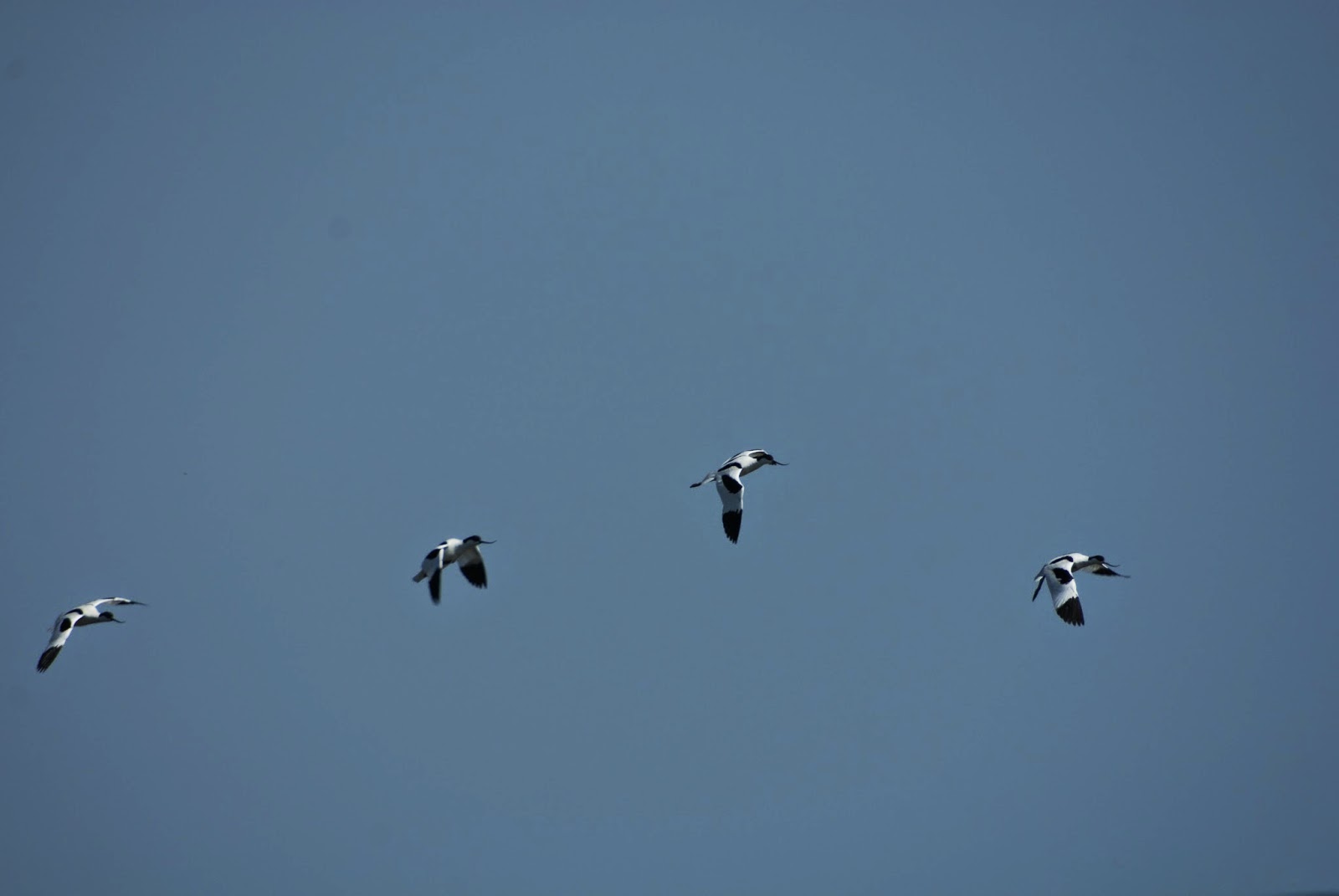
On the way up to the beach I was able to watch some lovely birds along the edge of Volunteer Marsh and Tidal Marsh. There were good numbers of Grey Plover and Brent Geese, but the highlights was a small group of Avocets over the tidal marsh which did a few Loop-de-Loops over the marsh before coming back down and landing on the island. Because they were in flight you can really appreciate the beauty and elegance of these birds.
-Avocet
Up on the coast I arrived just in time to see a flock of scoters with white wings come and land on the ocean quite near the shore. I had a look through the scope, and possibly because the sea was calm, or perhaps because they were closer I was actually able to fully appreciate the birds and even see the yellow on their bills and the white on the wing.
I still could not really count the number of each species in the flock, but I knew there were a large majority Velvet due to the number of white wings that I had seen when they landed. I grabbed some better record shots, which show that quite a few of the birds do indeed have white wings, but that some don't, a mixture flock.


-Common and Velvet Scoters
I was able to watch them for quite a while, though the started to drift out to sea, and then drift towards the western part of the beach until they ended up some was away. At that point I began to look around, see what else was about. Someone had decided to wander right down to the edge of the water, not a birder, someone on the beach, but in doing so they had sent up all the birds from the shoreline, Sanderlings, Dunlin and Bar-Tailed Godwit. The numbers of them can be difficult to tell if they are on the shoreline feeding, but when they were all in the air you can see the number of Sanderlings, far more than I had thought initially.
-Sanderling, Bar-Tailed Godwit and Dunlin
Also the near the waters edge was a small group of Common Scoter, 2 males and 2 females. The males however drifted off while the waders were up, but the females stuck around very close to the shore. I wanted to get close to the bird, since it was so close to the shore, but I decided against it in case I incurred the wrath of any other sea-watchers, though they would probably be watching the larger but drifting flock of other scoters. So in the end the photos were not what they could have been, but I did manage to get some decent photos of it.
-Female Common Scoter
Since the scoters had drifted away I decided to head down to the South Parrinder Hide to see if anything else had shown up through the day while I had not been there. I went in and began to scout around to see what was about. There was the usual stuff, until I took my eye away from the scope and spotted, on the bank right in front of the hide, the Spotted Redshank.
I'm always dubious in calling birds like this in case I am wrong, but exclaimed it more in surprise since I had been looking all over and here it was right in front of me. I got some great views and took plenty of photos, allowing me to fully appreciate the subtly beauty of the bird, as well as get to grips with all the key features: Spots, dark bill and the slight droop on the end of the bill.
Like I said, I got many photos, and who wouldn't with such an usual bird right in front of me looking so fine in the sunshine. Unlike last time, the sun was with me this time so all the spots on the birds back show up well in the photos, clearly showing the bird in all its glory.
-Spotted Redshank
Between my Spotted Shank watching a small family of Mallards swam across the front of the hide. You could tell the dude birders in that moment, as they became infatuated with the ducklings, while the other birders remained watching the Spotted Shank in front of the hide. I took a few quick photos of the Ducklings simply because its the first family I have seen this year, though of course there was the duckling on fly flatts, sadly though that one was dead. 
-Mallard Ducklings
-Spotted Redshank
After a while I decided to return to see if the scoters had come closer to the shore. They had not, the only birds of note being Sandwich Terns that drifted past the shore. However, on the way up I was able to get great views of a stunning Black-Tailed Godwit in summer plumage, on the small strip of water along the edge of the Volunteer Marsh. 
-Black-Tailed Godwit
After that short trip I called in again at the South Hide to see if the Spot shank was still there, but it had left, probably insulted by the number of 'birders' that seemed more keen on the ducklings that the shank. Time was running out for me so I decided to go and see if the Whitethroat had turned up. On the way there I stopped by to grab a few more photos of the Avocets, who even knows when I will next see one...
-Avocet
On the way I passed the Reedbed Pool, and on there was a pair of Red-Crested Pochard. The male and female were drifted from each other, the male drifted behind the reeds as I approached, but the female was sat quite close to the path. I managed a few photos of the bird, another record shot of this species. 
-Red Crested Pochard Female
I checked where the Whitethroat had been but it was not there, and neither was the PFG. In fact, the only thing that made that bit of the walk interesting was the fact that I stumbled across my first damselfly of the year, a fleeting glimpse of a Large Red Damselfly as it flew across the path. 
All in all, a great day, all four lifers of the holiday in one day, if that there was one addition today. And that will probably be the last birding action of the day. The only thing left to do is to give a full breakdown of all the species seen today...

Species List:
Titchwell Marsh: Pied Wagtail, Lesser Whitethroat, Pink-Footed Goose, Graylag Goose, Tufted Duck, Black-Headed Gull, Willow Warbler, Shelduck, Wren, Gadwall, Oystercatcher, Coot, Moorhen, Mallard, Bittern, Marsh Harrier, Woodpigeon, Robin, Cettis Warbler, Shoveler, Pochard, Teal, Avocet, Grey Plover, Redshank, Brent Goose, Herring Gull, Dunlin, Bar-Tailed Godwit, Ruff, Little Ringed Plover, Canada Goose, Lapwing, Lesser Black-Backed Gull, Linnet, Reed Bunting, Little Egret, Common Scoter, Velvet Scoter, Turnstone, Sandwich Tern, Sanderling, Jackdaw, Common Crow, Curlew, Spotted Redshank, Red-Crested Pochard, Chaffinch, Blackbird, Pheasant, Long-Tailed Tit, Swallow, Red-Legged Partridge, Large Red Damselfly, Speckled Wood, Large White, Peacock, Small Tortoiseshell,

Monday, 14 April 2014

Norfolk Holiday Day 2

The first full day in Norfolk commences. Given the lack of recent sightings on birdguides recently around Norfolk I decided to head to RSPB Titchwell today to see what was about, since there had been reports of a few things about in that region more than Cley. For some reason the bus had been broken up into 3 services rather than just the one, and as a result it took me short of 2 hours to get to Titchwell. On the journey I picked up Marsh Harrier, my first of the year, though doubtless it would not be the last.
I arrived at Titchwell just before 11 in the morning. I checked the sightings but they were limited already it seemed, but even as I stood looking at the list there came in a report of a Spotted Redshank on the Freshwater Marsh. Since I have a score to settle with this species I decided to head straight up there, just to finally see it. 
For some reason I called off at the Island Hide first, but it was quite quiet there, a few Teal, Shoveler and Avocets milling around but not much else. I did not stay long and progressed to the south Parrinder Hide. As I walked along the bank towards the hides I glanced over at the Volunteer Marsh and was rewarded with my first tick of the day, and only my second time ever with a stunning Grey Plover. It was sat quite close to the wall, so I was able to get some reasonable shots to record what was a very smart bird. 

-Grey Plover
I had a scout of the Volunteer Marsh but only picked up a few other bits, but year ticks all around; Bar and Black-Tailed Godwits were both year-ticks for me, and there continued to be plenty of Avocets around.
-Avocet
I decided I could wait no longer, and entered the South Parrinder Hide...
There were a few birders inside the hide, so I threw it out there 'is anything about'. The reply was something of a shock, since I had expected 'oh yes spotted redshank over there' but it actually came back, 'there is a little gull on the island'. Well there we go then, a little gull, another great bird and one that I had not really expected to see. It took a little while to find it though, because it was asleep. And it continued to be asleep for some time, so that were it not told to me and the colour of its legs I would have never have been able to tell.
Since the little gull was not doing a great deal I asked about the redshank and was duly directed to where it was, also asleep among a group of Black-Tailed Godwits. I took some photos of it asleep as given my history anything could happen with this species and I wanted something to remember it by should it do a runner again.
-Spotted Redshank, 3rd bird on the left, with Common Teal and Black-Tailed Godwit
I stuck around waiting for one of the two bird to awake. During my wait I managed to pick up plenty of other great species, including Little Ringed Plover, Ruff and Brent Geese, the latter of which had been grazing the salt marsh on the Western side of the West Bank walk, but a few had remained on the marsh. 
While I was scouting the marsh the Little Gull awoke. I grabbed a few record shots of it finally awake before setting about to have a good old look at one of my favourite gulls. It stuck around for a while, drifting in and out of sleep before after about 15 mins from it arousal it took off and left. I managed no photos of its flight, since I had been looking elsewhere at the time of it departure, but I still had a few decent ones from when it was resting.


-Little Gull
After a little while longer, the Redshank showing no signs of life, I decided to take a trip to the coast to see if any Scoters of either species were still about, either would be my second lifer of the holiday. On  the way I passed more Brent Geese as well as Little Egret on the saltmarsh.
The wind continued to be an issue and so it proved on the beach, where the sea was quite choppy. As a result, even when I finally found a flock of scoters on the sea I could only see them as black blobs dipping up and down on the surf. Most of them I could see were Common Scoters, and I could pick up no white on any individuals, though I could also pick up no other feature. 
That all changed when they decided to take off and do a loop-de-loop around the sea. Then I could clearly see through the scope that the first 3 birds to take off had very distinct white wings and as a result were Velvet Scoters, meaning I had just picked up 2 Lifers in a matter of minuets. As I watched them I decided to grab some record shots, and that really is all they are, black blobs in which some have white wings, but it is enough to show both species. 


-Common and Velvet Scoters
After a while watching the dark blobs I decided to go back for the redshank and come back later to see if they had come closer in shore. During my sea watch I had also watched the shoreline, where I had been delighted to find another year-tick in the form of Sanderling, as well as there being many other waders, such as Dunlin, Turnstone, Bar-Tailed Godwit and Oystercatcher
I wandered back down the Western Bank to the Parrinder Hides. Along the edge of the Volunteer Marsh there is a channel where waders often come and get very close to the path so you can get great views of them. Today's delight was a Black-Tailed Godwit which had wandered very close to the path feeding away and allowing me to get some pretty decent shots of it, to add to my library for the species.
-Black-Tailed Godwit
I first checked North Parrinder Hide as I had not been there yet, but it offered very little, only Curlew to add to the day's list. There continued to be good numbers of Grey Plover, but they had drifted further away from the hide and could only really be told now with the scope.
I moved on to South Parrinder Hide. I checked where the Redshank had been but it had moved on. I figured that it could not have gone far, and would still be with the godwits. I found the Godwits and on the edge of their group was a redshank. However I did not have the guts to call it whether it was spotted or not, and as it was asleep I struggled to get a really good view. 
After a while, the flock of 5 Godwits was joined by another 20 birds, and during their arrival the Redshank decided to up-sticks and move, resulting in me loosing it. I tried to find it again but failed, only after a while when another birder came in and found it did I spot it again. The other birder also identified it as the spotted, which is what I thought it was but now it was confirmed. 
I spent a while watching it, and it drifted closer and closer to the hide, until I was able to get some really good record shots. The only downside was that the sun was strong and it was behind the bird, meaning all my photos were very dark. I have tried to lighten them using photoshop but it has worked better on some that others. Either way its clear enough what it is, and that I have finally settled that score.


-Spotted Redshank
After a while I decided to go to Patsy's Reedbed pool where there were apparently red-crested pochards. On the way down I passed a small group staring intently into the saltmarsh so casually asked what was about. They directed my gaze to a bush, less than 5 meters from the path, and from that bush protruded the fanged face of a Chinese Water Deer, only my second ever.
It being so close I got great views of it, or at least its head, as it stared me down as I watched it. I was well pleased with this, spotting this unusual mammal in such an unexpected fashion.
-Chinese Water Deer
Continuing down the Western Bank, large numbers of Brent geese flew in, and quite close to the path, so I was able to get some more photos of these really rather stunning birds. I was quite pleased with my photo of these, as it appreciates their subtle beauty.
-Brent Geese
 I arrived at the pool to find no such birds, but while I was there a Bittern ascended from the reedbed, flew a few meters before returning to the reeds. The suddenness and unexpectedness made it one of the days highlights, and it is always lovely to see bitterns, no matter how fleeting the view.
And if I considered dipping the pochards a year tick missed, the fact that I was surrounded by at least 4 singing cettis warblers without seeing a single one would be adding more insult to the injury. But I moved on from it.
On the way back out I passed the visitor center and decided to call in and see what species were about that I could call in for. I found that the pochards had been reported from the western bank, but apart from that there was little else that I had missed. Since it was my intention to pass that area on my way to the coast I would have to keep and eye open for said pochards.
I checked the first pool on my left and there at the back I spotted a pair of Red-Crested Pochards, but they were so distant it was hardly a good view. No matter, as a little further on down the right hand side at the reedbed pool there was another pair slightly closer. Here I decided I would get my record shots of this species. They showed well, if not a little distant, and the male looked stunning in his adult plumage.
-Red-Crested Pochard
Also on the Reedbed Pool was a dabchick and a small group of standard Pochards. I continued along my way to the beach. Along the way I passed the deer again. It had moved out from the bush but was keeping a low profile among the taller plants, meaning I could not get a great photo.
I made it to the beach where I found that there were no scoters at all. I waited a short while, as that was all I could spare before my bus arrived, but there was no joy. The only thing of note out to sea was a Fulmar that flew past, my first of the year. However, along the shoreline there continued to be good numbers of waders, including Sanderling, which I have included a photo of simply because it is a species that I really do not see that often
-Sanderling
I decided that my last moments on the reserve could probably be spent better elsewhere, and so moved off. Along the edge of Volunteer Marsh where the waders show well there remained a Black-Tailed Godwit, but it had been joined by a Ruff that was almost in summer plumage, it was only lacking is mane. It was really close too, so that I could even see the scaled plumage on its back, a feature I have never seen before. So that was a lovely ending to the day.

-Black-Tailed Godwit

-Ruff
And that was that from titchwell. I also should mention that I had 3 species of butterfly today, Comma, Peacock and Large white, summer is obviously truly here now. I made it to my bus and made an earlier connection, and as a result decided to call off at Cley for an hour.
Cley was very quiet by its own high standards, possibly as a result of it being late in the day, but there was not much about. The highlight was a small group of Little Ringed Plover on the islands a small group of almost summer plumaged Ruff on the far island, but ultimately it was very quiet.
And so passed the first full day in Norfolk, 3 lifers for me, as well as a host of other smashing bird species. The tone has now been set, and the rest of the week has a lot to live up to.

Species List: 
Driving: Little Egret, Marsh Harrier, Shelduck, Graylag Goose, Starling, Lapwing, Kestrel, Song Thrush, Collard Dove, House Sparrow
RSPB Titchwell Marsh: Ruff, Brent Geese, Shelduck, Shoveler, Avocet, Little Ringed Plover, Little Gull, Spotted Redshank, Wren, Linnet, Redshank, Black-Tailed Godwit, Teal, Black-Headed Gull, Woodpigeon, Graylag Goose, Mallard, Little Egret, Grey Plover, Lesser Black-Backed Gull, Coot, Marsh Harrier, Lapwing, Pied Wagtail, Moorhen, Reed Bunting, Oystercatcher, Turnstone, Sanderling, Bar-Tailed Godwit, Common Scoter, Velvet Scoter, Greater Black-Backed Gull, Herring Gull, Dunlin, Curlew, Gadwall, Swallow, Chaffinch, Pheasant, Greenfinch, Robin, Dunnock, Tufted Duck, Bittern, Chiff-Chaff, Blackbird, Goldfinch, Red-Crested Pochard, Pochard, Little Grebe, Cormorant, Fulmar, Skylark, Chinese Water Deer, Cinnabar Moth, Comma, Peacock, Large White,
NWT Cley Marshes: Avocet, Shelduck, Ruff, Pied Wagtail, Teal, Shoveler, Gadwall, Graylag Goose, Black-Headed Gull, Common Gull, Lesser Black-Backed Gull, Lapwing, Little-Ringed Plover, Coot, Moorhen, Curlew, Marsh Harrier, Reed Bunting, Linnet, Mallard, Turnstone, Redshank, Canada Goose,