Showing posts with label Whitethroat-Lesser. Show all posts

Monday, 15 August 2022

Soil Hill birding; updates from the week 6th - 14th August

I was away working for the first few days of August, but the second week really brought home everything great about August on Soil Hill. Despite the heatwave, Lia and I managed to record over 40 species on nearly every morning before the oppressive weather set in. There were plenty of migrants scattered around in the various shrubby areas, including some of the more unusual ones, as well as my second patch tick of the year, bringing me up to 117 in total...

  • The undoubted highlight of the week was a Lesser Whitethroat that was in the Koi Farm Copse on the morning of the 10th August. As we walked up early doors a Sylvia warbler was ticking in the garden along Taylor Lane, but due to a Blackcap being present the previous day and the fact that we needed to check the bottom of the North Slope before the quarry opened, we made haste and didn’t investigate further. It was only when we saw this bird that it became clear. It showed incredibly well considering, which was awfully frustrating given my current camera predicament. Digiscoping through binoculars doesn’t work so well with Passerines. Huge thanks to JJL for use of his spare camera which allowed me to get some shots when we returned in the evening, when the bird continued to show well. I have searched for this species so long at this site, it was an incredible feeling to finally find one.

  • On the morning of the 9th a Short-eared Owl was hunting the fields along Ned Hill Track. It has been nearly two years since I last saw this species here, so it was much appreciated. Being a bigger bird I was able to get some digiscoped photos, although they are certainly lacking some quality.  

Migrants were really the stars of the week, as they usually are at this time of year. The warm weather brought out lots of activity with many birds flycatching and showing well in the early morning light. 
  • The first Spotted Flycatcher of the week was on the 10th when Lia found and identified the bird as we were waiting for the Lesser Whitethroat to appear. In the evening it showed very well on the wires above the Koi Farm Copse. The second of the week was in the North Slope Tree-Line on the 14th, and it too showed very well.

  •  The tall grass at the bottom of the North Slope has been a hubbub of activity, mainly Reed Buntings, Whitethroats and Goldfinches but also a few Warblers. At least one Grasshopper Warbler is lingering there, with another individual reeling at the top of the North Slope on the 14th, so at least two birds present on that date. There has also been two Sedge Warbler in the area, occasionally showing well but generally elusive. Both are juveniles, so could indicate that breeding did occur here, but I personally remain skeptical.  

  • As is typical for August, there was a good showing of Tree Pipit here. Often we heard an individual but it then did not call again and we did not see it, so would not commit to the ID. However, there were still enough individuals for which cooperated that during the week we managed to record eight different birds, some flying right overhead.   

  • We also had a brilliant showing of Willow Warblers. Every day had double figures with a new record count of 20 on the 8th, and counts of 17 on the 9th and 16 on the 6th. The yellow juveniles absolutely dazzled in the early morning sun.

  • There has been light passage with Swifts seen on most days, including 17 on the 14th. There have also been two dates with House Martins two on the 11th and 4 on the 14th.

Other birds included the first Common Snipe of the Autumn on the 13th, Great Spotted Woodpeckers on the 10th and 13th, the latter date being the first time I have recorded two different individuals on the same day here, and finally two Ravens distantly mobbing a Buzzard on the 15th

But perhaps the real 'best of the rest' was a covey of 10 Grey Partridge, clearly demonstrating successful breeding on the Hill this year. They were first seen on the 6th before then being seen on the subsequent four days. It really was a sight to behold.

-Lesser Whitethroat
-Short-eared Owl
-Spotted Flycatcher
-Sedge Warbler
-Tree Pipit recording by LNK

Species List:
Soil Hill: Canada Goose, Mallard, Grey Partridge, Common Pheasant, Red-legged Partridge, Feral Pigeon, Stock Dove, Common Wood Pigeon, Common Swift, Common Moorhen, Northern Lapwing, Eurasian Curlew, Common Snipe, Black-headed Gull, Common Gull, European Herring Gull, Lesser Black-backed Gull, Great Cormorant, Grey Heron, Eurasian Sparrowhawk, Common Buzzard, Little Owl, Short-eared Owl, Great Spotted Woodpecker, Common Kestrel, Eurasian Jay, Eurasian Magpie, Western Jackdaw, Rook, Carrion Crow, Northern Raven, Coal Tit, Eurasian Blue Tit, Great Tit, Eurasian Skylark, Sedge Warbler, Common Grasshopper Warbler, Barn Swallow, Common House Martin, Willow Warbler, Eurasian Blackcap, Lesser Whitethroat, Common Whitethroat, Goldcrest, Eurasian Wren, Common Starling, Mistle Thrush, Song Thrush, Common Blackbird, Spotted Flycatcher, European Robin, Northern Wheatear, Dunnock, House Sparrow, Grey Wagtail, White Wagtail, Meadow Pipit, Tree Pipit, Common Chaffinch, Eurasian Bullfinch, European Greenfinch, Common Linnet, European Goldfinch, Common Reed Bunting, Roe Deer, Weasel, European Rabbit,

Saturday, 7 May 2016

A few days at Spurn

Got a message from Tim on Thursday asking if I wanted to go for some LSWs. We did and failed but he convinced me to go to Spurn for a few days. I had to come back on the Saturday for a 21st but the conditions looked great and he was confident there would be plenty of birds.
Sadly it did not materialise like that. There were 3 good birds over the weekend, but only 1 of which I managed to connect with; Turtle Dove (Bee-eater and Serin the others). Another Turtle Dove however is always great and appreciated. 
There were good birds about. On the first day I got to see my Little Terns again after a long time apart and spurn-ticked Garganey with two on Holderness fields. An evening walk down the canal yielded Cuckoo, fantastic views of Hobby and Spurns first Spotted Flycatcher of the year. Other year-ticks included Lesser Whitethroat and Whimbrel. 
Day two I decided to do sammies early morning and missed Serin for my troubles. The only decent birds I got in return were Tree Pipit and Short Eared Owl. The day was hot and with no birds grounded it was hard work. A short walk down the point was made but the only notable sighting was a pair of Common Lizards possibly fighting, but looks like a male and female (?), on the road which were very preoccupied and easy to view.
Day three was shrouded in sea fret but a few birds had dropped in. Spotted Flycatchers had increased and I had my first Whinchat of the year. The Turtle Dove was also today, although the view was only brief sadly. Something of a Spurn mega on wetlands with a Canada Goose thats apparently set up for the last month or so...
-Little Tern
-Garganey
-Hobby
-Lesser Whitethroat
-Short-eared Owl
-Common Lizard
-Whinchat
-Spotted Flycatcher
-Canada Goose
-Brown Hare

Species List:
Spurn Bird Observatory: Blue Tit, Oystercatcher, Blackbird, Robin, House Sparrow, Collard Dove, Swallow, Dunnock, Carrion Crow, Whimbrel, Lesser Black-backed Gull, Starling, Mallard, Greylag Goose, Mute Swan, Avocet, Shelduck, Skylark, Pied Wagtail, Little Grebe, Ringed Plover, Little Tern, Garganey, Sandwich Tern, Little Egret, Common Tern, Black-headed Gull, Herring Gull, Black-tailed Godwit, Turnstone, Dunlin, Wigeon, Sand Martin, Gadwall, Yellow Wagtail, Meadow Pipit, Reed Bunting, Linnet, Bar-tailed Godwit, Kestrel, Lesser Whitethroat, Whitethroat, Spotted Flycatcher, Hobby, Cuckoo, Sedge Warbler, Reed Warbler, Reed Bunting, Starling, Short-eared Owl, Wheatear, Tree Pipit, Cormorant, Common Sandpiper, Grey Plover, Jackdaw, Whinchat, Canada Goose,

Friday, 12 June 2015

Spurn Weekend Day 1

So for my first full day at spurn before the NGBs arrived in the evening I had already decided to do the point providing there was not much moving. There was nothing moving as a thick fog had set in overnight. As a result I set off down the point with the intention of doing a proper count and hopefully getting plenty of stuff seen.
It was pretty quiet, with most of the birds seen being Common Whitethroats, of which I counted 36 singing birds, though there were undoubtedly more. At the point I was harassed by a crow overhead which would not stop calling while I was there, which probably did not help the number of birds. This crow played this way all weekend according to other birders that went down the point. There were plenty of Brown-Tailed Moth caterpillars which I had heard so much about but never seen, as well as a host of Garden Tiger moth caterpillars. The birding highlight was a Tree Pipit that went over my head calling. I did not recognise the call but a quick check of the Collins App left me in no doubt. I also found a Redpoll at Chalk Bank, as well as a Sedge Warbler.
-Common Whitethroat
-Sedge Warbler
By the time I had done at the point I decided to head off up to the ponds to have a proper look at my Little Terns for the year. Along Beacon Lane I re-encountered the Lesser Whitethroats that were still keeping a very low profile and proving very difficult to photograph.
-Lesser Whitethroat
I wandered round Holderness field. I kept checking the ponds to see what was there. I checked the phalarope pool, but the bird had not been seen for a week, so imagine my surprise when I saw it feeding. I radioed it out, but still could not believe I had refound it. Given the butterflies I had for a obvious bird that was only a refind, imagine how tense its going to be when I find something new and mega!! 
-Red-Necked Phalarope
After watching the phalarope for a while I head on my way. I had a look over wetlands with Mick, and we spotted Little Grebe (which was later put out as a red-necked) and a drake tuftie, both good birds for Spurn. Ponds was quiet, but there were a few Little Terns along the edge of the ponds and with the new Swaro I was finally able to get a proper good look at them, even though I had all of last summer.
Mick had told me about the Corn Buntings, that they were up at the top of the Easington lagoons. I had always planned to head up that way but this was good news to hear. The Lagoons were quiet courtesy of a some disruptive dog walkers. At the top of the lane, exactly where Mick had described I connected with only my second (third and fourth) Corn Bunting. 2 birds were in the corn in the field, but one was singing from the hawthorn next to the path giving me a proper good look and a chance for some nice shots of the yeartick.
-Corn Bunting
I could tell I was a little close to the birds singing perch so did not stay long. I decided to walk back down the beach to find anything there. I was rewarded with a Fulmar flying down the beach super close, probably as a result of the fog. There was also an adult Guillemot in the shoreline breakers. It seemed fine and had probably been disorientated by the fog.
-Common Guillemot
Since it was only early afternoon and I had already done the point and the lagoons I decided to do all of Spurn for the first time since I had been here, so I headed over to Sammies via Long Bank. There was not a great deal there, not even for the day list, but it was in the mid afternoon lull in the middle of the day, so its not a massive surprise.
I finished off the walk down Canal Bank where I added Coot to the day list, but not a lot else and I was knackered so after that went back to the Warren for a little sit down. Overall a smashing day with Corn Bunting the star species being only my second ever, best ever view and Year and Spurn tick, its got it all really.

Species List:
Spurn Point: Mistle Thrush, Swallow, Whitethroat, Dunnock, Linnet, Little Tern, Meadow Pipit, Sandwich Tern, Shelduck, Gannet, Guillemot, Reed Bunting, Starling, Great Tit, Woodpigeon, Wren, Carrion Crow, Tree Pipit, Kestrel, Lesser Black-Backed Gull, Herring Gull, Sparrowhawk, Lesser Redpoll, Sedge Warbler,
Numpties and Beacon Lane: Woodpigeon, Meadow Pipit, Linnet, Swallow, House Martin, Common Gull, Skylark, Magpie, Starling, Mallard, House Sparrow, Blue Tit, Blackbird, Greenfinch, Whitethroat, Great Tit, Chaffinch, Blue Tit, Dunnock, Lesser Whitethroat,
Holderness Field, Beacon Ponds and Kilnsea Wetlands: House Martin, Magpie, Black-Headed Gull, Mallard, Reed Bunting, Great Tit, Whitethroat, Avocet, Woodpigeon, Swallow, Starling, Linnet, Red-Necked Phalarope, Skylark, Pied Wagtail, Shelduck, Gadwall, Oystercatcher, Tufted Duck, Mute Swan, Little Tern, Little Egret, Redshank, Knot, Ringed Plover, Grey Plover, Dunlin, Sedge Warbler, Grey Heron, Bar-Tailed Godwit, Corn Bunting, Blackbird, Herring Gull, Fulmar, Guillemot, Sandwich Tern, 
Sammies Point and Canal Bank: Feral Pigeon, Woodpigeon, Shelduck, Mallard, Starling, Swallow, Carrion Crow, Skylark, Linnet, House Martin, Meadow Pipit, Stock Dove, Little Egret, Reed Warbler, Sedge Warbler, Whitethroat, Reed Bunting, Chaffinch, Goldfinch, Blackbird, Black-Headed Gull, Oystercatcher, Sanderling, Sand Martin, Avocet, Ringed Plover, Common Gull, Coot, Great Tit, Coot,

Wednesday, 27 August 2014

Spurn Day 49

Today was a bit of a come down from yesterday, but it was still pretty incredible. There were fewer scarce migrants, though the icky was ringed at 06.05 and a wryneck was seen in the afternoon, but I saw neither.

I started up at Seawatching but it was dead, and I decided to go for a walk round the canal instead. I was due up a Kierons to finish the report at 10.00 so could not do a long walk, but headed off to see what I could find. Along the canal I found a Sedge Warbler, Willow Warblers, Whitethroat and Lesser Whitethroat. And finally, finally, I managed to get a proper record shot of Lesser Whitethroat. It was a little distant but given my previous attempt was no more than a brown smudge I will honestly take absolutely anything, and it’s pretty clear despite the distance. It’s also the first time I have clearly seen one in the full rather than flying away or skulking through the bushes.
-Lesser Whitethroat
I then had a quick look in Kew but the icky was not there, so I headed along to see Kieron and finish the report. That finished off my morning but the report was all but done. After that I headed back for lunch and to rest before the afternoon.
First thing in the afternoon I headed up to Clubleys to have a look. There were a few Emperor Dragonflies and Common Darters around, but the most surprising thing was when 2 Green Sandpipers were flushed from over the hill and flew over the scrape making a right din. I tried to grab a few record shots of the encounter but they did not come out to well.
-Green Sandpiper
I then headed down to ‘bush bash’ canal hedge, and in doing so found a few Pied Flycatcher and Willow Warbler. It was then that I received a message about a wryneck at Sammies, and as such I speeded straight there without further ado. I did pick up a few Whinchat and Wheatear along the way; they were both sat along the fence posts.
I arrived at the spot to hear that the wryneck had been lost, but it had been photographed while sunbathing. I’m not a cynic by nature but if it was sunbathing why did it feel the need to move? I am wondering if the photographer may have flushed it getting to close, but who is to say, and I am not. It did not show again but during my time at Sammies I found some good birds; Pied Flycatcher, Garden Warbler and a Redstart, which was a Spurn tick for me. It was a young bird flycatching from the edge of the bush, but it was ample compensation for the wryneck dip. I also had a very nice Ruff on the estuary which was quite close to the bank.
-Ruff
I returned to a more central position in case anything turned up. I had a look in the car park of the pub, where I got great views of Pied Flycatcher and another Garden Warbler. The Pied Flycatcher showed very well even on the floor.
I returned to the warren to have some dinner before the seawatch. Seawatching was dead, with only 238 terns flying south, with a few Oystercatchers and one Arctic Skua. The highlight of the evening session was when I went down to make coffees and Paul collard me saying he had a Pied Flycatcher to ring. I finished off the coffees and then went to watch him ringing it. I asked for a few photos but they were too flighty to hold properly, so I could only get a headshot. It certainly gives a different perspective on the birds I have been seeing for the last few days.
-Pied Flycatcher

Species List:
Mooching about: Collard Dove, Lesser Whitethroat, Whitethroat, Sedge Warbler, Reed Warbler, Snipe, Coot, Mallard, Wren, Dunnock, Little Egret, Redshank, Dunlin, Ringed Plover, Turnstone, Pied Flycatcher, Willow Warbler, Woodpigeon, Great Tit, Blue Tit, Garden Warbler, Whinchat,
Sammies: Mediterranean Gull, Common Gull, Black-Headed Gull, Ruff, Common Redstart, Pied Flycatcher, Whinchat, Wheatear, Garden Warbler, Willow Warbler
Seawatching: Gannet, Arctic Skua, Sandwich Tern, Common Tern, Oystercatcher, 

Monday, 4 August 2014

Spurn Day 26

Despite being back on days, today was a quiet day on the ponds. There was very few wader movement, though I may have missed some when I went for lunch, but if I doubt they came and left with the space of 2 hours.
But there was a Black-Tailed Godwit on the ponds, which is a species that seems to have been lacking in recent visits. Other waders included 5 Sanderling, a few Dunlin, the Oyks and a Common Sandpiper that dropped in during the early morning.
The highlight of the day was when an Arctic Skua flew over the colony. Sadly it did not come close to the hut, but left by the south side of the pond. I grabbed a photo of it and it is effectively the only thing photographed all day, which was a reflection of how quiet it was.
-Arctic Skua
There was an incredible passage of Hirundines though, with sometimes over a hundred birds going south in the space of a minuet. It was certainly impressive, I can only imagine what it was like down at the watch-point. There were impressive numbers of Swallows all skimming the ponds at the same time, so its been an impressive day hirundine wise that's for sure.
On the way back form the ponds I got another view of one of my bogey species. Yesterday I have a sneaky feeling I may have seen a Lesser Whitethroat along Beacon Lane, but as usual the views were too fleeting to be confident. Today the same thing happened but I managed a fleeting view enough to tell me that I had indeed seen my second ever Lesser Whitethroat. Sadly as soon as I saw the bird it dived into the bush and I spotted a small grey brown bird fly out the back. But that seems pretty standard for this species.
Having been picked up by that after dinner I headed up to the Sea-watching point. There was a good group there, so there was a chance that if something mega turned up it would be seen. It did not, but there was decent passage of Common and Sandwich terns with a few Arctics thrown in for good measure. Its my first real experience of tern passage, and I have to say that my old issue of Common or Arctic is showing me up a bit, not what I really wanted.

The Daily Oystercatcher
I have seen more flying today, flying in groups, singly, you name it. When the family all fly together you can clearly tell which are the youngsters as they have to flap twice as much as the adults. But besides that I can see they are becoming more competent flyers, and will soon be on their way off the pond I feel.

Species List: 
Beacon Ponds: Black-Headed Gull, Shelduck, Mute Swan, Oystercatcher, Dunlin, Common Sandpiper, Redshank, Meadow Pipit, Swallow, Sandwich Tern, Woodpigeon, Mallard, Linnet, Little Egret, Little Tern, Reed Bunting, Yellow Wagtail, Sand Martin, Feral Pigeon, Graylag Goose, Swift, Arctic Tern, Arctic Skua, Grey Heron, Cormorant, Black-Tailed Godwit, Pied Wagtail, House Martin, House Sparrow, Sanderling, Lesser Black-Backed Gull, Avocet, Blackbird, Mallard, Lesser Whitethroat, Dunnock, Whitethroat, Chaffinch, Great Tit, Magpie, Wall Brown, Meadow Brown, Gatekeeper, Speckled Wood, Red Admiral, Large White, Small White, Small Tortoiseshell, Peacock, Ruddy Darter, Emperor, Migrant Hawker, 
Seawatch: Gannet, Oystercatcher, Sandwich Tern, Common Scoter, Arctic Tern, Little Gull, Turnstone, Swallow, Sand Martin, Common Gull, Lesser Black-Backed Gull, Arctic Skua, Whimbrel, Grey Seal,

Wednesday, 16 April 2014

Norfolk Holiday Day 4

And so on the last full day in Norfolk I decided to return to Titchwell since it had given so much more than Cley had yesterday. Once more it took me the best part of the morning to get to the site, but once there the weather was lovely and hopefully there would be plenty of morning reports for me to go for. 
I arrived at the site and checked the list. Both the mornings oddities were at Patsy's Reedbed; Pink Footed Goose and Lesser Whitethroat, the latter would be a lifer for me. I therefore headed straight to there. I wandered up to the view point over the pool and immediately spotted the PFG, which was resting among the graylags on the near side of the pool. I watched it for about 10 mins before deciding it would be time to try and locate the Lesser Whitethroat. 
-Pink-Footed Goose
So having picked up a great tick in the PFG, and got my best ever photos of the species I headed on to where the whitethroat was. It had been reported in the hedge behind the the pool, not showing well but calling frequently. As I had been asking for info about the bird at the center one of the birders wandered by who had seen it. He asked if I knew what one sounded like, and said that it sounded like a yellowhammer but without the 'cheese' when I replied no.
And so I stood next to the hedge listening for a yellowhammer with no cheese. And after about a minuet I heard it. I followed its call for some time before I saw it shadowy figure moving through the hedge. That was the pattern for a good 20 mins, following the skulky bird through the hedge without getting a real good view, but frequently hearing its call. 
After the 20mins it had a quiet spell, before having a very loud spell and then deciding to up-sticks and head away from that hedge and a different one away on the far side of the field. I tried to get a record shot as it flew off, but I struggled and my only effort is shown below, the bird being near the bottom right corner. You can see the dark cap if you blow up the photo enough, but photos are not everything, and my record shot is enough, as it pretty much sums up my view of the bird, skulky and difficult to see.
But see it I did, making it my 4th lifer of the holidays, and that was exciting enough when I had only just started the mornings birding.
-Lesser Whitethroat
Since the whitethroat had left I turned to find that the PFG had left to my disappointment. As a result I decided to head off, and just as I was leaving I turned again and what should drop out of the reeds but a Bittern. I could not believe it, as it landed right on the edge of the reeds on the edge of the pool, allowing me a great view of the bird. 
It stayed at the edge for a little while before merging itself into the back of the reeds. I managed a few photos but struggle to find it through the scope. The bins were enough, though they were not necessarily needed for a great view.
-Bittern
As I waited to see if the bittern would come back out the PFG returned with a small group of Graylag's, and landed on the pool. It took a little while but it returned to the bank soon enough and I was able to pick up a few more photos with the light with me this time. So that's 3 pretty awesome bird species and I had not even been onto the main part of the reserve.
-Pink-Footed Goose
I began my walk up the Western Bank to the Parrinder Hides. On the way up along the edge of the woods where the reeds are I heard a very familiar call that I have been hearing all week. It was the stunning and shocking call of a Cettis Warbler. As I turned to see if I could find the source of the call I spotted a small reddish warbler fly out of the reeds and land lower down. I then got to follow the bird as it skulked through the bottom of the reeds before it flew off into the woodland. So that was my second Cettis Warbler of the Holiday, and only my 4th ever.
The hides were quite quiet by the high standards set last time, though there were still great numbers of wildfowl and waders. There were a few Little-Ringed Plover and Avocets, as well the usual suspects. I decided to head up to the coast and see what was around up that end. 
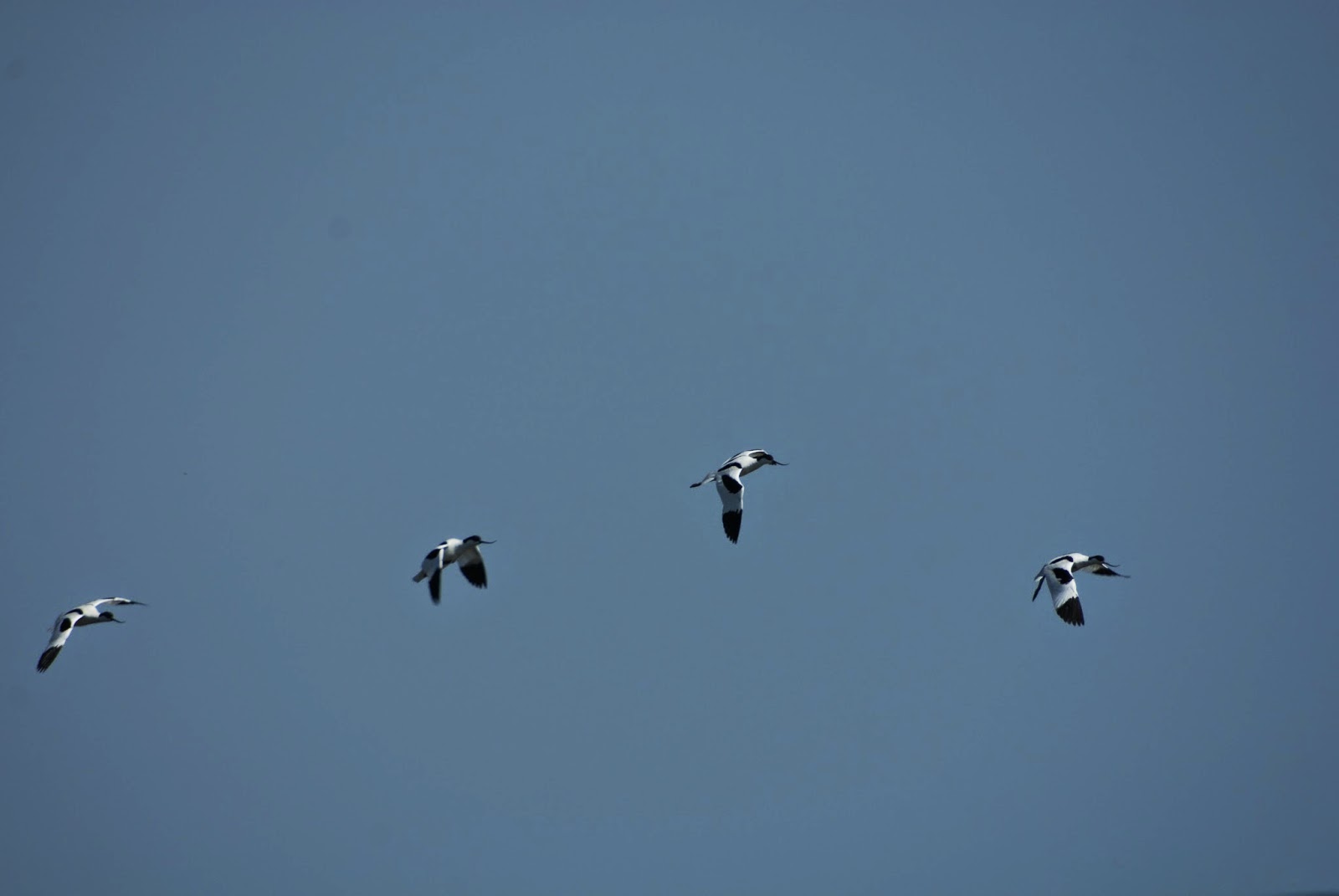
On the way up to the beach I was able to watch some lovely birds along the edge of Volunteer Marsh and Tidal Marsh. There were good numbers of Grey Plover and Brent Geese, but the highlights was a small group of Avocets over the tidal marsh which did a few Loop-de-Loops over the marsh before coming back down and landing on the island. Because they were in flight you can really appreciate the beauty and elegance of these birds.
-Avocet
Up on the coast I arrived just in time to see a flock of scoters with white wings come and land on the ocean quite near the shore. I had a look through the scope, and possibly because the sea was calm, or perhaps because they were closer I was actually able to fully appreciate the birds and even see the yellow on their bills and the white on the wing.
I still could not really count the number of each species in the flock, but I knew there were a large majority Velvet due to the number of white wings that I had seen when they landed. I grabbed some better record shots, which show that quite a few of the birds do indeed have white wings, but that some don't, a mixture flock.


-Common and Velvet Scoters
I was able to watch them for quite a while, though the started to drift out to sea, and then drift towards the western part of the beach until they ended up some was away. At that point I began to look around, see what else was about. Someone had decided to wander right down to the edge of the water, not a birder, someone on the beach, but in doing so they had sent up all the birds from the shoreline, Sanderlings, Dunlin and Bar-Tailed Godwit. The numbers of them can be difficult to tell if they are on the shoreline feeding, but when they were all in the air you can see the number of Sanderlings, far more than I had thought initially.
-Sanderling, Bar-Tailed Godwit and Dunlin
Also the near the waters edge was a small group of Common Scoter, 2 males and 2 females. The males however drifted off while the waders were up, but the females stuck around very close to the shore. I wanted to get close to the bird, since it was so close to the shore, but I decided against it in case I incurred the wrath of any other sea-watchers, though they would probably be watching the larger but drifting flock of other scoters. So in the end the photos were not what they could have been, but I did manage to get some decent photos of it.
-Female Common Scoter
Since the scoters had drifted away I decided to head down to the South Parrinder Hide to see if anything else had shown up through the day while I had not been there. I went in and began to scout around to see what was about. There was the usual stuff, until I took my eye away from the scope and spotted, on the bank right in front of the hide, the Spotted Redshank.
I'm always dubious in calling birds like this in case I am wrong, but exclaimed it more in surprise since I had been looking all over and here it was right in front of me. I got some great views and took plenty of photos, allowing me to fully appreciate the subtly beauty of the bird, as well as get to grips with all the key features: Spots, dark bill and the slight droop on the end of the bill.
Like I said, I got many photos, and who wouldn't with such an usual bird right in front of me looking so fine in the sunshine. Unlike last time, the sun was with me this time so all the spots on the birds back show up well in the photos, clearly showing the bird in all its glory.
-Spotted Redshank
Between my Spotted Shank watching a small family of Mallards swam across the front of the hide. You could tell the dude birders in that moment, as they became infatuated with the ducklings, while the other birders remained watching the Spotted Shank in front of the hide. I took a few quick photos of the Ducklings simply because its the first family I have seen this year, though of course there was the duckling on fly flatts, sadly though that one was dead. 
-Mallard Ducklings
-Spotted Redshank
After a while I decided to return to see if the scoters had come closer to the shore. They had not, the only birds of note being Sandwich Terns that drifted past the shore. However, on the way up I was able to get great views of a stunning Black-Tailed Godwit in summer plumage, on the small strip of water along the edge of the Volunteer Marsh. 
-Black-Tailed Godwit
After that short trip I called in again at the South Hide to see if the Spot shank was still there, but it had left, probably insulted by the number of 'birders' that seemed more keen on the ducklings that the shank. Time was running out for me so I decided to go and see if the Whitethroat had turned up. On the way there I stopped by to grab a few more photos of the Avocets, who even knows when I will next see one...
-Avocet
On the way I passed the Reedbed Pool, and on there was a pair of Red-Crested Pochard. The male and female were drifted from each other, the male drifted behind the reeds as I approached, but the female was sat quite close to the path. I managed a few photos of the bird, another record shot of this species. 
-Red Crested Pochard Female
I checked where the Whitethroat had been but it was not there, and neither was the PFG. In fact, the only thing that made that bit of the walk interesting was the fact that I stumbled across my first damselfly of the year, a fleeting glimpse of a Large Red Damselfly as it flew across the path. 
All in all, a great day, all four lifers of the holiday in one day, if that there was one addition today. And that will probably be the last birding action of the day. The only thing left to do is to give a full breakdown of all the species seen today...

Species List:
Titchwell Marsh: Pied Wagtail, Lesser Whitethroat, Pink-Footed Goose, Graylag Goose, Tufted Duck, Black-Headed Gull, Willow Warbler, Shelduck, Wren, Gadwall, Oystercatcher, Coot, Moorhen, Mallard, Bittern, Marsh Harrier, Woodpigeon, Robin, Cettis Warbler, Shoveler, Pochard, Teal, Avocet, Grey Plover, Redshank, Brent Goose, Herring Gull, Dunlin, Bar-Tailed Godwit, Ruff, Little Ringed Plover, Canada Goose, Lapwing, Lesser Black-Backed Gull, Linnet, Reed Bunting, Little Egret, Common Scoter, Velvet Scoter, Turnstone, Sandwich Tern, Sanderling, Jackdaw, Common Crow, Curlew, Spotted Redshank, Red-Crested Pochard, Chaffinch, Blackbird, Pheasant, Long-Tailed Tit, Swallow, Red-Legged Partridge, Large Red Damselfly, Speckled Wood, Large White, Peacock, Small Tortoiseshell,