My time at uni is drawing near to an end for good for the summer. Since it is 'Le tour' this weekend I decided to make today my final major birding trip due to the number of road closures over the weekend. I decided to try a new site, for public transport at least, by going to Fairburn Ings RSPB. Its a site where I have had mixed fortunes before, dipping smew 3 years in a row, but I had not been for some time.
Reports showed that there were 2 spoonbills on site, that had been around for some time, which was the main reason I thought to go and have a look, but the glossy ibis that has been roving around west and South Yorkshire had recently made it is home. As a result I decided to head over that way to enjoy my last bit of proper first year birding.
Despite its steep train fare I did not have to get a bus, as I can walk to the site from Castleford, so that was a major bonus. Once out of the town you follow the canal for a short distance before going onto the RSPB land.
It was walking along the canal that I had Mallard, Swallow and Mute Swan on the canal and woodpigeon on the overhead cables over the hedge. Or so I thought. I don't really know what inspired me to check out this so obvious woodpigeon on the wires, but for some reason I gave it a thorough inspection. It was difficult from my range, and my head secretly wanted turtle dove, so I allowed myself all kinds of thoughts. When I managed to get a decent view through the bins I immediately noticed a lack of white round the neck. Woodpigeon no more. I still struggled to make anything out with my bins though, so got the camera and grabbed a record shot. I could not believe my eyes when I had a look, it was a Cuckoo, chilling on the wires. I got closer until I was right in front of it, the hedge providing a suitable hide. Its my first good shots of a Cuckoo landed, and it is also one of my best self finds. To find a Cuckoo at this time of year, on a site not reknown for its cuckoos, is something pretty special. I was well pleased with myself. I had a good look through the bins, before taking some shots and then going for the bins again. But it was between the transition of camera to bins that the bird moved off, as it was no longer there when I looked up again. I don't know where it went, but it made my day, and it was not even lunchtime.


-Cuckoo
I continued onto the reserve, and decided to first call in at Lin Dyke Hide, as that was where the ibis and spoonbills were most frequently recorded. As I left the riverbank and headed up towards the hide I noticed 2 large white birds circling near the farm in the distance. Of course my first thought was swans, but through the bins I could see that they were not swans, they were in fact the Spoonbills that I had come to see. The scope was in my bag, and through the bins there was not much to make out except for their long neck and broad wings and tail. I grabbed a ton of record shots of the birds, since I had no idea what their next move would be, and good thing too, as they quickly dropped down below the tree line. They are my 17th lifer this year, and a bird I have long wanted to see. Sadly because of distance I could not make out the bills properly, but I had hope that over the course of the day I would find them again.
-Spoonbills
Now I was really buzzing and it was about to get even better. Not much further up than from where I saw the spoonbills I noticed a large bird fly towards me over the reeds to the right of the hide. It was clearly a heron and because the neck was tucked in from such a low flight I identified it as a bittern. A quick check with the bins showed I was right, but it also showed that the bird was coming towards me. I grabbed the camera due to the potential of some great shots, just in time for the bird to gain altitude and fly right over me. Great shots? you bet, it was without doubt the greatest view of a bittern I have ever had, beating even those birds that I have seen landed. I think it would only be right to let the pictures do the talking.
-Bittern
The bittern flew over the path and then was lost behind the trees. I had barely made it on site and already it was one of the best days birding this year, and that is saying something. I made it to the hide without further incident, but that's not saying much due to the short distance. I began looking for the ibis, or to see if the spoonbills had landed. The latter had not and the former was not to be seen. I did not want to ask other birders, as it removed some of the pride from any sighting, but from tactical eavesdropping I learned that it was in a pool just up the path.
From the hide there was good stuff to find, including many waterfowl; Common Teal, Shoveler, Gadwall and more Mute Swans. On the banks there were Lapwing, Redshank with a well grown chick and a few Little Egrets, which were showing really well. After some continued searching I found a few Little Ringed Plover on an island quite far out, and was going to announce them with pride, when I noticed a small bird right in front of the hide have a stretch. There had been a Little Ringed Plover with a well grown chick right in front of the hide all along, and nobody had noticed. They were even close enough to get some decent record shots.
-Little Ringed Plover
After my stay in the hide I decided to head up to check out the Ibis and see if it showing. I saw the small cluster of birders on the path, but could not see the bird due to the hedge. I saw the pool next and was shocked by how close it was to the path, as in really close. There were also about 10 Little Egrets on the pond, which being so close and so unfazed looked absolutely great, the best views I can ever recall having.
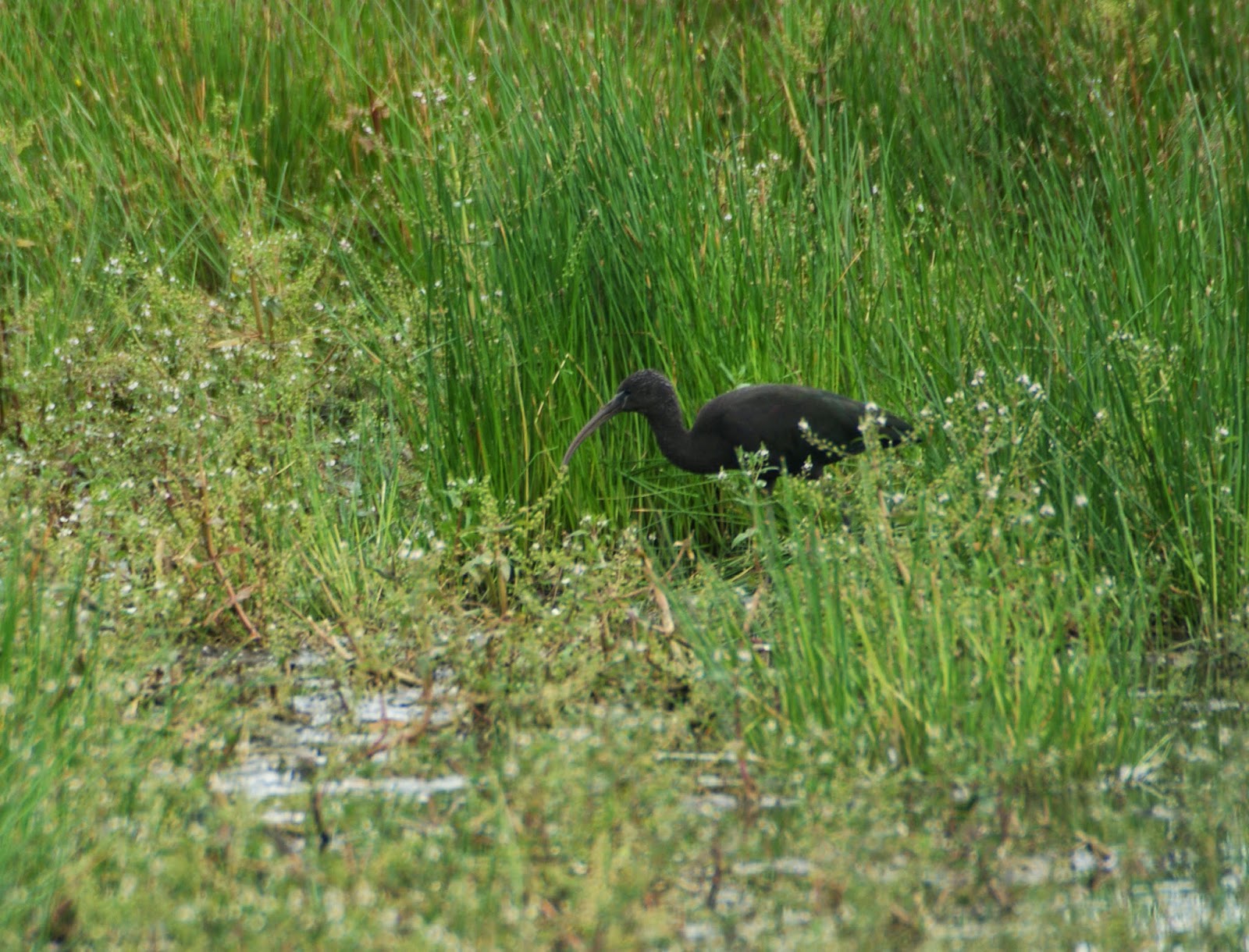
After a short while the ibis raised its head, it had been feeding at the back out of view. It was moving closer though, but keeping to the reeds and sedges, making it difficult to photo, or even see. This is of course the same bird that I twitched at Wombwell Ings, before exams and all that fun. That seems so long ago, and compared to how close the bird was currently seems completely independant of this encounter.
While I waited upon the ibis to yield a great view I noticed a pair of Whitethroat that had been moving around the hedge in front, probably disturbed by the small cluster of birders. I decided to back off to avoid causing them more harassment. Once back the birds started landing in very nice positions for a photo of Whitethroat for this year.
-Whitethroat
As I had mentioned before there were many Little Egrets all showing well. While photographing the Whitethroat I had noticed to my horror that my camera battery was very very low. Even so, I decided it was too good and opportunity to miss, so took a few photos of the egrets while they were in nice positions.
-Little Egret
But of course, the bird of the hour was the ibis. After waiting a little while it decided to finally come out and show itself in all its glory. It was a different perspective to the view I had got at Wombwell, here really highlighting the grey streaks on its head and the the green and purple sheen on the bird. It carried out all kinds of behavior, mainly feeding but also preening which was a different perspective of the bird.
-Glossy Ibis
I got so many better pictures of the Ibis than before, the fourth awesome bird that I have seen already today. After a while I decided to move on to try and re-find the Spoonbills further up the reserve. I had initially decided to walk along the river, but the spoonbills had changed that and I decided to walk along the road to see if I could find them further up.
Before the road I added Willow Warbler to my day list, and Wren too, which was singing with great gusto from the hedge. Once on the road the birds naturally declined. Overlooking the Spoonbill Flash I did not get many additions as most of the birds could be seen from the hide. However, there were some ducks resting hidden next to the road which I failed to see due to me being distracted by a Sedge Warbler. One of the ducks was a Pochard female, which I took a couple of photos of due to it being so close.
-Female Pochard
I continued along the road, reaching the area that overlooks the moat. However, the spoonbills could not been seen. What did impress me were the number of Cormorants. They were everywhere, on the trees, on the bank, in the water even flying overhead. I was very surprised by how many there were.
I moved off and entered the car park area of the reserve. I first headed down to the main bay lookout point near the car park to see if there was anything there, as there has been some decent stuff in the past. Today it was very quiet though, mainly eclipse mallards. There was also a female Mandarin which was different, a lovely male reed bunting giving it Gusto from the reedbed and a couple of Common Terns hunting out over the bay.
After a short stay at the feeding station my next call was the Pickup Hide for lunch. On the feeding station there were Blue Tits, Great Tits and Tree Sparrows, nothing particularly unusual, nor were there any willow tits which I really wanted to see.
Fortunately at the Pickup Hide there was a Willow Tit, a very aggressive individual that was chasing all other birds on the feeders. Besides that there was not much about. The Sand Martin wall in front of the hide was quite busy, with a few birds drifting in and out at regular intervals. There were also about 5 Avocet on the bank, I am informed a pair with chicks. A Stock Dove also joined in at one point for a drink, but it was very quiet. I tried for some record shots of the Willow Tit but it was very dark and they did not come out well. Never mind.
-Willow Tit
-Tree Sparrow
Once I had moved on from Pickup I decided to take a look at the hide overlooking the main bay before returning to Lin Dyke via the river. In that hide there was not much, but there were good numbers of Great-Crested Grebes on the lake, most of which were sleeping. On the way to the hide I also picked up Chiff-Chaff and Long-Tailed Tit, the latter being a regular at the site.
Along the river it was very quiet. There good numbers of Cormorants in the river, and a Grey Heron on the bank. It was mainly the insects along the bank that were the highlight, with many species of butterfly; Ringlet, Gatekeeper, Small and Large Skipper, Red Admiral, as well as a couple of dragonfly species; a spectacular Four-Spot Chaser and a Black-Tailed Skimmer on the path.
-Four Spot Chaser
-Black-Tailed Skimmer
I re-arrived at Lin Dyke hide intending to stay a little while and then go and re-find the ibis. However, not long into my stay at the hide and a birder came in and informed us that the ibis had moved on, apparently we should have seen it from the hide, but failed. So I spent all my remaining time in this hide waiting for something to appear.
And right on cue the Spoonbills decided to do another flyby, but this time I opted to watch them rather than photograph them. Even through the scope it was difficult to see that beak, but I certainly got a better view than I had got before, and I was glad I saw them again before I left for the train. Once they had gone down again I returned to try and see what else was about. The fore mentioned birder had spoken about Common Sandpiper, and right on cue a Common Sand came and landed on one of the pieces of wood on the lake, another great day tick. There was a tree in the middle of the flash, and while I watched this tree became frequently covered in Sand Martins, before something would cause them to flush and they would all leave. But the real stars again were the Little Ringed Plovers, which once more were right in front of me, but I was unable to spot them for a good half an hour. It then turned into a nightmare trying to describe their location to the other birds, who could not believe how well hidden they were, despite being out in the open.

-Little-Ringed Plover
It came to the time when I had to go for the train sadly, and I departed. On the way back I picked up another Grey Heron and a Pheasant but not much. It truly had been a great day, really enjoyable. And with another lifer, and catching up with that Glossy Ibis what more could a birder really ask for.
Species List:
Fairburn Ings RSPB: Spoonbill, Bittern, Little Egret, Grey Heron, Glossy Ibis, Starling, Dunnock, Chaffinch, Blue Tit, Magpie, Carrion Crow, House Sparrow, Blackbird, Blackcap, Great Tit, Robin, Common Pheasant, Black-Headed Gull, Wren, Mallard, Jackdaw, Mute Swan, Feral Pigeon, Woodpigeon, Mistle Thrush, Bullfinch, Goldfinch, Pied Wagtail, Kestrel, Collard Dove, Lapwing, Long-Tailed Tit, Tufted Duck, Cormorant, Moorhen, Coot, Great-Crested Grebe, Jay, Common Teal, Shoveler, Gadwall, Pochard, Redshank, Greenfinch, Tree Sparrow, Reed Bunting, Stock Dove, Willow Tit, Oystercatcher, Chiffchaff, House Martin, Little-Ringed Plover, Sand Martin, Willow Warbler, Scaup, Canada Goose, Graylag Goose, Avocet, Sedge Warbler, Common Sandpiper, Common Tern, Whitethroat, Swift, Cuckoo, Small Skipper, Large Skipper, Meadow Brown, Large White, Gatekeeper, Ringlet, Speckled Wood, Common Blue Damselfly, Common Blue-Tailed Damselfly, Brown Hawker, Black-Tailed Skimmer, Common Darter, Four-Spot Chaser, Common Toad,