Showing posts with label Chaser-Four-spot. Show all posts

Friday, 19 June 2020

Soil Hill; Isolation week 12

The weather became warm and humid during the week, normally with foggy start that restricted early morning birding but with pleasant conditions by mid-morning that would then give way to still, heavy and hot conditions.
As antcipated for the summer months, Soil Hill has continued to be fairly slow, but with a few interesting bits. A Bullfinch has been hanging around, seen twice, and there have been three flyover Siskins which were the first of the year. These Siskins coincide with a large national movement of the species. The Warblers on site continue to feed their young and there was a fledging of Stonechats which produced six offspring, all dotted along the walls. Insects have also been on the up, with good numbers of Large Red and Azure Damselflies still around, as well as Broad-bodied Chaser and Four-spotted Chaser adding to my Soil Hill dragonfly list.
In addition to my daily visits to Soil Hill, I also visited a few other local sites. I visited Gorple and Widdop Reservoirs for the first time, and there were a few nice bits there. At Gorple there was ample shoreline but only a handful of waders; 4 Redshank, 5 Common Sandpiper (Including chicks) and a Dunlin. A spotted Flycatcher was also present in one of the small plantations there. Widdop was fairly quiet but a couple of Little Ringed Plovers were excellent.
-Little Owl
-Azure Damselfly
-Four-spot Chaser (f. praenubila)
-Broad-bodied Chaser

Species List:
Gorple Reservoirs: Greylag Goose, Canada Goose, Mallard, Tufted Duck, Common Pheasant, Feral Pigeon, Stock Dove, Common Wood Pigeon, Eurasian Oystercatcher, Northern Lapwing, Little Ringed Plover, Eurasian Curlew, Dunlin, Common Sandpiper, Common Redshank, Black-headed Gull, Lesser Black-backed Gull, Common Kestrel, Western Jackdaw, Rook, Carrion Crow, Northern Raven, Eurasian Skylark, Barn Swallow, Willow Warbler, Eurasian Wren, Song Thrush, Common Blackbird, Spotted Flycatcher, European Robin, Northern Wheatear, Grey Wagtail, Pied Wagtail, Meadow Pipit, Common Chaffinch, Lesser Redpoll, European Goldfinch, Eurasian Siskin, Common Reed Bunting, 
Widdop Reservoir: Canada Goose, Mallard, Little Ringed Plover, Eurasian Curlew, Common Sandpiper, Common Buzzard, Common Kestrel, Barn Swallow, Willow Warbler, Eurasian Wren, Common Starling, Mistle Thrush, Common Blackbird, European Robin, Dunnock, Grey Wagtail, Pied Wagtail, Meadow Pipit, Common Chaffinch, European Goldfinch, Eurasian Siskin, Common Reed Bunting,
Soil Hill: Canada Goose, Mallard, Red-legged Partridge, Common Pheasant, Feral Pigeon, Stock Dove, Common Wood Pigeon, Eurasian Collared Dove, Common Swift, Common Moorhen, Eurasian Oystercatcher, Northern Lapwing, Eurasian Curlew, Common Snipe, Black-headed Gull, European Herring Gull, Lesser Black-backed Gull, Eurasian Sparrowhawk, Common Buzzard, Little Owl, Common Kestrel, Eurasian Magpie, Western Jackdaw, Rook, Carrion Crow, Coal Tit, Eurasian Blue Tit, Great Tit, Eurasian Skylark, Sedge Warbler, Sand Martin, Barn Swallow, Common House Martin, Willow Warbler, Common Chiffchaff, Eurasian Blackcap, Common Whitethroat, Goldcrest, Eurasian Wren, Common Starling, Mistle Thrush, Song Thrush, Common Blackbird, European Robin, European Stonechat, Dunnock, House Sparrow, Pied Wagtail, Meadow Pipit, Common Chaffinch, Eurasian Bullfinch, European Greenfinch, Common Linnet, European Goldfinch, Eurasian Siskin, Common Reed Bunting, Western Roe Deer, European Rabbit, Broad-bodied Chaser, Four-spotted Chaser, Azure Damselfly, Large Red Damselfly, Small Tortoiseshell, Peacock, Red Admiral, Painted Lady, Common Blue, Large Skipper,

Friday, 4 July 2014

Fairburn Ings

My time at uni is drawing near to an end for good for the summer. Since it is 'Le tour' this weekend I decided to make today my final major birding trip due to the number of road closures over the weekend. I decided to try a new site, for public transport at least, by going to Fairburn Ings RSPB. Its a site where I have had mixed fortunes before, dipping smew 3 years in a row, but I had not been for some time.
Reports showed that there were 2 spoonbills on site, that had been around for some time, which was the main reason I thought to go and have a look, but the glossy ibis that has been roving around west and South Yorkshire had recently made it is home. As a result I decided to head over that way to enjoy my last bit of proper first year birding.
Despite its steep train fare I did not have to get a bus, as I can walk to the site from Castleford, so that was a major bonus. Once out of the town you follow the canal for a short distance before going onto the RSPB land.
It was walking along the canal that I had Mallard, Swallow and Mute Swan on the canal and woodpigeon on the overhead cables over the hedge. Or so I thought. I don't really know what inspired me to check out this so obvious woodpigeon on the wires, but for some reason I gave it a thorough inspection. It was difficult from my range, and my head secretly wanted turtle dove, so I allowed myself all kinds of thoughts. When I managed to get a decent view through the bins I immediately noticed a lack of white round the neck. Woodpigeon no more. I still struggled to make anything out with my bins though, so got the camera and grabbed a record shot. I could not believe my eyes when I had a look, it was a Cuckoo, chilling on the wires. I got closer until I was right in front of it, the hedge providing a suitable hide. Its my first good shots of a Cuckoo landed, and it is also one of my best self finds. To find a Cuckoo at this time of year, on a site not reknown for its cuckoos, is something pretty special. I was well pleased with myself. I had a good look through the bins, before taking some shots and then going for the bins again. But it was between the transition of camera to bins that the bird moved off, as it was no longer there when I looked up again. I don't know where it went, but it made my day, and it was not even lunchtime.  
-Cuckoo
I continued onto the reserve, and decided to first call in at Lin Dyke Hide, as that was where the ibis and spoonbills were most frequently recorded. As I left the riverbank and headed up towards the hide I noticed 2 large white birds circling near the farm in the distance. Of course my first thought was swans, but through the bins I could see that they were not swans, they were in fact the Spoonbills that I had come to see. The scope was in my bag, and through the bins there was not much to make out except for their long neck and broad wings and tail. I grabbed a ton of record shots of the birds, since I had no idea what their next move would be, and good thing too, as they quickly dropped down below the tree line. They are my 17th lifer this year, and a bird I have long wanted to see. Sadly because of distance I could not make out the bills properly, but I had hope that over the course of the day I would find them again.
-Spoonbills
Now I was really buzzing and it was about to get even better. Not much further up than from where I saw the spoonbills I noticed a large bird fly towards me over the reeds to the right of the hide. It was clearly a heron and because the neck was tucked in from such a low flight I identified it as a bittern. A quick check with the bins showed I was right, but it also showed that the bird was coming towards me. I grabbed the camera due to the potential of some great shots, just in time for the bird to gain altitude and fly right over me. Great shots? you bet, it was without doubt the greatest view of a bittern I have ever had, beating even those birds that I have seen landed. I think it would only be right to let the pictures do the talking.
-Bittern
The bittern flew over the path and then was lost behind the trees. I had barely made it on site and already it was one of the best days birding this year, and that is saying something. I made it to the hide without further incident, but that's not saying much due to the short distance. I began looking for the ibis, or to see if the spoonbills had landed. The latter had not and the former was not to be seen. I did not want to ask other birders, as it removed some of the pride from any sighting, but from tactical eavesdropping I learned that it was in a pool just up the path.
From the hide there was good stuff to find, including many waterfowl; Common Teal, Shoveler, Gadwall and more Mute Swans. On the banks there were Lapwing, Redshank with a well grown chick and a few Little Egrets, which were showing really well. After some continued searching I found a few Little Ringed Plover on an island quite far out, and was going to announce them with pride, when I noticed a small bird right in front of the hide have a stretch. There had been a Little Ringed Plover with a well grown chick right in front of the hide all along, and nobody had noticed. They were even close enough to get some decent record shots.
-Little Ringed Plover
After my stay in the hide I decided to head up to check out the Ibis and see if it showing. I saw the small cluster of birders on the path, but could not see the bird due to the hedge. I saw the pool next and was shocked by how close it was to the path, as in really close. There were also about 10 Little Egrets on the pond, which being so close and so unfazed looked absolutely great, the best views I can ever recall having.
After a short while the ibis raised its head, it had been feeding at the back out of view. It was moving closer though, but keeping to the reeds and sedges, making it difficult to photo, or even see. This is of course the same bird that I twitched at Wombwell Ings, before exams and all that fun. That seems so long ago, and compared to how close the bird was currently seems completely independant of this encounter.
While I waited upon the ibis to yield a great view I noticed a pair of Whitethroat that had been moving around the hedge in front, probably disturbed by the small cluster of birders. I decided to back off to avoid causing them more harassment. Once back the birds started landing in very nice positions for a photo of Whitethroat for this year.
-Whitethroat
As I had mentioned before there were many Little Egrets all showing well. While photographing the Whitethroat I had noticed to my horror that my camera battery was very very low. Even so, I decided it was too good and opportunity to miss, so took a few photos of the egrets while they were in nice positions.
-Little Egret
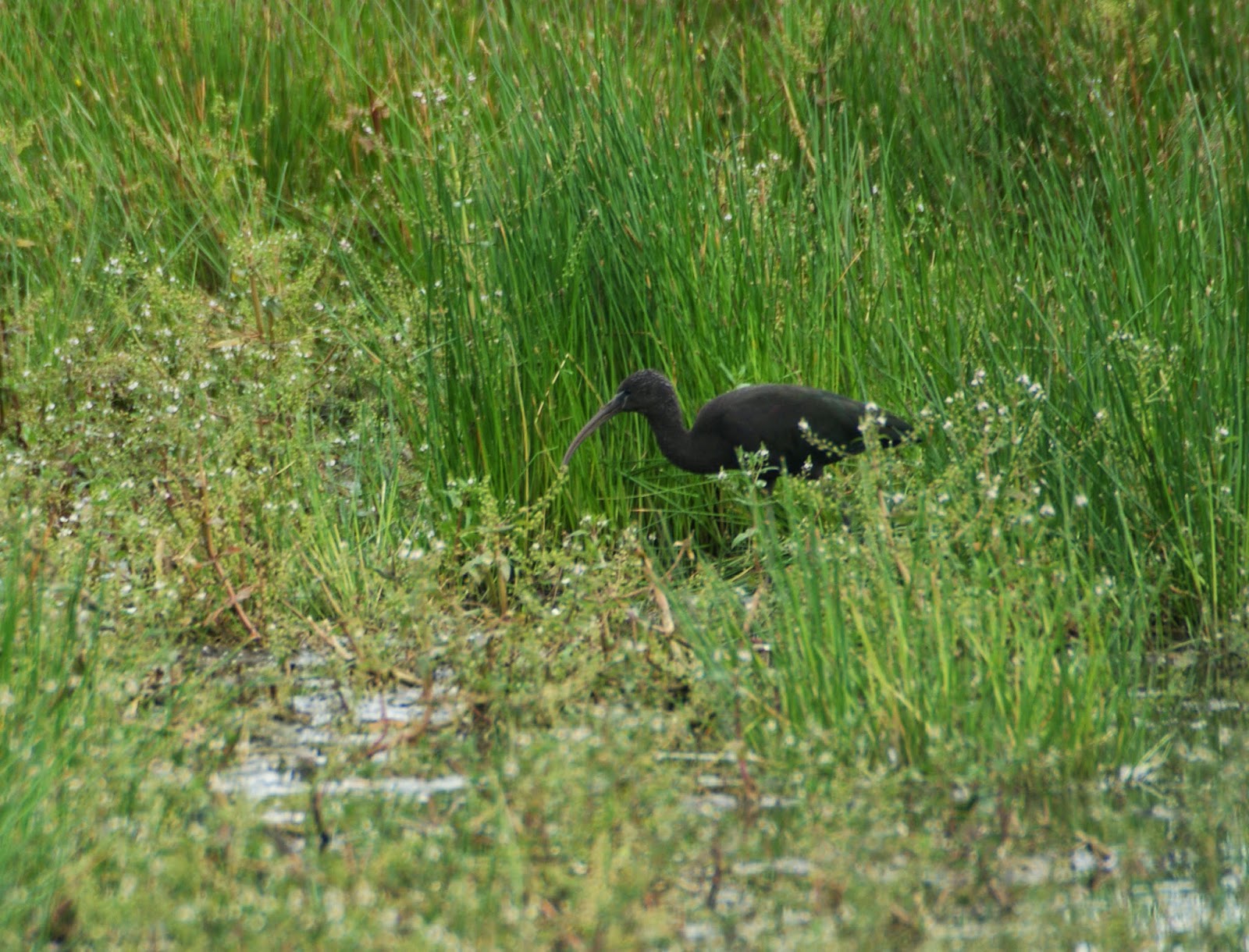
But of course, the bird of the hour was the ibis. After waiting a little while it decided to finally come out and show itself in all its glory. It was a different perspective to the view I had got at Wombwell, here really highlighting the grey streaks on its head and the the green and purple sheen on the bird. It carried out all kinds of behavior, mainly feeding but also preening which was a different perspective of the bird.
-Glossy Ibis
I got so many better pictures of the Ibis than before, the fourth awesome bird that I have seen already today. After a while I decided to move on to try and re-find the Spoonbills further up the reserve. I had initially decided to walk along the river, but the spoonbills had changed that and I decided to walk along the road to see if I could find them further up.
Before the road I added Willow Warbler to my day list, and Wren too, which was singing with great gusto from the hedge. Once on the road the birds naturally declined. Overlooking the Spoonbill Flash I did not get many additions as most of the birds could be seen from the hide. However, there were some ducks resting hidden next to the road which I failed to see due to me being distracted by a Sedge Warbler. One of the ducks was a Pochard female, which I took a couple of photos of due to it being so close.
-Female Pochard
I continued along the road, reaching the area that overlooks the moat. However, the spoonbills could not been seen. What did impress me were the number of Cormorants. They were everywhere, on the trees, on the bank, in the water even flying overhead. I was very surprised by how many there were.
I moved off and entered the car park area of the reserve. I first headed down to the main bay lookout point near the car park to see if there was anything there, as there has been some decent stuff in the past. Today it was very quiet though, mainly eclipse mallards. There was also a female Mandarin which was different, a lovely male reed bunting giving it Gusto from the reedbed and a couple of Common Terns hunting out over the bay.
After a short stay at the feeding station my next call was the Pickup Hide for lunch. On the feeding station there were Blue Tits, Great Tits and Tree Sparrows, nothing particularly unusual, nor were there any willow tits which I really wanted to see.
Fortunately at the Pickup Hide there was a Willow Tit, a very aggressive individual that was chasing all other birds on the feeders. Besides that there was not much about. The Sand Martin wall in front of the hide was quite busy, with a few birds drifting in and out at regular intervals. There were also about 5 Avocet on the bank, I am informed a pair with chicks. A Stock Dove also joined in at one point for a drink, but it was very quiet. I tried for some record shots of the Willow Tit but it was very dark and they did not come out well. Never mind.
-Willow Tit
-Tree Sparrow
Once I had moved on from Pickup I decided to take a look at the hide overlooking the main bay before returning to Lin Dyke via the river. In that hide there was not much, but there were good numbers of Great-Crested Grebes on the lake, most of which were sleeping. On the way to the hide I also picked up Chiff-Chaff and Long-Tailed Tit, the latter being a regular at the site.
Along the river it was very quiet. There good numbers of Cormorants in the river, and a Grey Heron on the bank. It was mainly the insects along the bank that were the highlight, with many species of butterfly; Ringlet, Gatekeeper, Small and Large Skipper, Red Admiral, as well as a couple of dragonfly species; a spectacular Four-Spot Chaser and a Black-Tailed Skimmer on the path.
-Four Spot Chaser
-Black-Tailed Skimmer
 I re-arrived at Lin Dyke hide intending to stay a little while and then go and re-find the ibis. However, not long into my stay at the hide and a birder came in and informed us that the ibis had moved on, apparently we should have seen it from the hide, but failed. So I spent all my remaining time in this hide waiting for something to appear.
And right on cue the Spoonbills decided to do another flyby, but this time I opted to watch them rather than photograph them. Even through the scope it was difficult to see that beak, but I certainly got a better view than I had got before, and I was glad I saw them again before I left for the train. Once they had gone down again I returned to try and see what else was about. The fore mentioned birder had spoken about Common Sandpiper, and right on cue a Common Sand came and landed on one of the pieces of wood on the lake, another great day tick. There was a tree in the middle of the flash, and while I watched this tree became frequently covered in Sand Martins, before something would cause them to flush and they would all leave. But the real stars again were the Little Ringed Plovers, which once more were right in front of me, but I was unable to spot them for a good half an hour. It then turned into a nightmare trying to describe their location to the other birds, who could not believe how well hidden they were, despite being out in the open.
-Little-Ringed Plover
It came to the time when I had to go for the train sadly, and I departed. On the way back I picked up another Grey Heron and a Pheasant but not much. It truly had been a great day, really enjoyable. And with another lifer, and catching up with that Glossy Ibis what more could a birder really ask for.

Species List:
Fairburn Ings RSPB: Spoonbill, Bittern, Little Egret, Grey Heron, Glossy Ibis, Starling, Dunnock, Chaffinch, Blue Tit, Magpie, Carrion Crow, House Sparrow, Blackbird, Blackcap, Great Tit, Robin, Common Pheasant, Black-Headed Gull, Wren, Mallard, Jackdaw, Mute Swan, Feral Pigeon, Woodpigeon, Mistle Thrush, Bullfinch, Goldfinch, Pied Wagtail, Kestrel, Collard Dove, Lapwing, Long-Tailed Tit, Tufted Duck, Cormorant, Moorhen, Coot, Great-Crested Grebe, Jay, Common Teal, Shoveler, Gadwall, Pochard, Redshank, Greenfinch, Tree Sparrow, Reed Bunting, Stock Dove, Willow Tit, Oystercatcher, Chiffchaff, House Martin, Little-Ringed Plover, Sand Martin, Willow Warbler, Scaup, Canada Goose, Graylag Goose, Avocet, Sedge Warbler, Common Sandpiper, Common Tern, Whitethroat, Swift, Cuckoo, Small Skipper, Large Skipper, Meadow Brown, Large White, Gatekeeper, Ringlet, Speckled Wood, Common Blue Damselfly, Common Blue-Tailed Damselfly, Brown Hawker, Black-Tailed Skimmer, Common Darter, Four-Spot Chaser, Common Toad,

Monday, 19 May 2014

Potteric Carr twitching Spotted Sandpiper

Yesterday at approximately 9.45 in the morning an adult summer plumage Spotted Sandpiper was found at Potteric Carr. Pretty special to say the least, but due to it being a Sunday and revision I decided not to go for it there and then, but to go after my 9.00 lecture on Monday.
I arrived at around 11 to the heartbreaking news that the bird had not been seen that morning, and since the reserve had opened early specially it seemed that the bird had cleared off, just my luck. I made my way straight to the main marsh to see what was around, on the way I encountered Song Thrush, a cuckoo calling but not seen and a Brimstone Butterfly looking lovely in what was glorious sunshine.
I arrived first at the hide where the  BNG's had been last time, but there was very little around today, a Whitethroat singing very visibly was probably the highlight. I made my way round the hide, not encountering an excessive amount but still plenty of nice things.
All the way round I had been surrounded by Damselflies, of the Common Blue, Common Blue-Tailed and Large Red varieties. However, south of the viewing screen there was a ditch and it was here that I encountered my first Dragonflies of the year in the form of a pair of Four-Spot Chasers. I tried to grab some photos but was unsuccessful.
The first hide where there was much of note was 'Roger Mitchell Hide'. Right outside the hide there were 4 lapwings and a flock of starlings feeding, so I was able to grab some pretty decent photos for the day, in case I encountered naught else.
-Lapwing
But there was else, as I checked the island in the middle of the lake I observed a wader on the end that I was not confident was a redshank, at which it initially appeared. I grabbed some photos but the bird was too far off for a clear diagnosis, however my hunch told me that it was almost certainly a Greenshank. Sadly though the bird flew off while I was not looking, leaving me with a few photos on which to base my analysis. 
I need not have worried as in the next hide, 'West Scrape Hide' there were two stunning Greenshanks feeding right in front of the hide. Almost certainly the same one that I had seen on the other marsh. They were happy feeding, back on forth in front of the hide. I managed to pick up some great shots of this species which I am not overly familiar with. However, the true significance of this find is that it is my 150th species this year. So that made up for the lack of Spot Sand, the big 150...
-Greenshank
After a while the Greenshank took off and landed on the far side of the lake, where they were difficult to see. I began looking round for other birds and spotted 3 redshank, a pair of shellduck and no less than 8 Ringed Plovers, a pair of which were sat right in front of the hide. Where the other 6 birds thought it would be a good idea to join them on the near island I got to watch a very territorial display from the original birds which was very nice to see. 
-Ringed Plover
West Scrape was where the spot sand was meant to be incidentally, but it was distinctly lacking in such species. After a while I decided to move on, as work would be waiting for me when I returned. I called in at 'Piper Marsh Hide' where the kingfishers were meant to be last time. And this time they were there, or at least one was, but it was some way off. Through the bins I got pretty decent views but the bird was very mobile, flying into trees and reeds so it was not often that it showed well except when it was in flight.
-Kingfisher
On the way out from the hide I spotted a very large and subtly colourful caterpillar on the path. I have done some research and reckon this is a Drinker Moth Caterpillar but I stand to be corrected should I be incorrect.
-Drinker Moth Caterpillar
 On the way round the 'Black Carr Field' I found one of the nicest surprises of the day when I spotted my first Long-Tailed Tit fledglings, or certainly the first I can ever remember seeing. Sadly I had to look up to it, but I was able to watch it being fed by the adult, but I did still get a pretty decent view so that I could see the brown face mask.
-Long-Tailed Tit fledgling
I decided to take a longer way round back to the entrance in case I could find a cuckoo. I could not, but did find Grey Heron and a very large Dragonfly Exuvia, of what I can't begin to imagine as there was no dragonfly species that large that emerge this early in the year. I would assume it was probably an early emerging emperor.
And thats that then. No Spot Sand but I managed to find my 150th species so I'm pleased. And the weather was good, and I was bitten and stung and covered in cobwebs and just generally beaten by nature, and the train copped it on the way home, but that's pretty standard really.

--150 SPECIES--


Species List:
Potteric Carr: Jackdaw, Dunnock, Great Tit, Black-Headed Gull, Jay, Blackbird, Carrion Crow, Canada Goose, Moorhen, Wren, Shelduck, Song Thrush, Swift, Coot, Tufted Duck, Mute Swan, Gadwall, Whitethroat, Mallard, Pochard, Willow Warbler, Great-Crested Grebe, Woodpigeon, Lapwing, Chaffinch, Goldfinch, Graylag Goose, Reed Bunting, Oystercatcher, Magpie, Starling, Lesser Black-Backed Gull, Cormorant, Greenshank, Shoveler, Redshank, Ringed Plover, Common Buzzard, Sand Martin, Chiff-Chaff, Kingfisher, Collard Dove, Long-Tailed Tit, Robin, Grey Heron, Blue Tit, Blackcap 
None Birds: Speckled Wood, Brimstone, Large White, Small White, Red Admiral, Peacock, Small Tortoiseshell, Orange Tip, Common Blue Tailed Damselfly, Common Blue Damselfly, Large Red Damselfly, Four-Spot Chaser

Thursday, 11 July 2013

Dorset Holiday-Day 5: Studland Heath NT

Another day where it was going to be an absolute scorcher. My family were going to Swanage so I got a lift to Studland NT which comes highly recommended by all the sources I had looked at. It is a dune filled heathland with large bodies of fresh water. Its most well known for its reptiles and winter birds but since I did not really rate my chances of finding either of these I decided to just go and see what was there. 
No sooner did I arrive than did I spot my first bird, a Kestrel flew over me. I was moving pretty cautiously with my eyes down looking for sand lizards when I spotted it moving over me. There might have been a nest nearby but I did not find it if there was.
-Kestrel
At first I did not really have a clue where I was going as many smaller paths crossed the main paths and so I followed these into the woods to get to the 'Little Sea' and see what was there. It did not help that my OS map did not have paths that corresponded to the actual paths, but no matter as I eventually found my way around. 
There were quite a few people around wielding nets in small groups and though I tried to avoid them I overheard them talking about dragonflies, so I assume that they must have been surveying dragonflies. As soon as I entered the small wooded section next to the little sea were I surrounded by dragonflies. There were quite a few Keeled Skimmers in the heather, and occasionally there would be a Black Tailed Skimmer too. I also found Common Darter, as well as one Southern Hawker, and that was all in one small space.
-Black Tailed Skimmer
-Common Darter
-Southern Hawker
I found a small path that went down to the side of the Little Sea and here I found a lot of damselflies. These were mainly Azure and Blue Tailed Damselflies. Since it was boggy I also found some Round Leaved Sundews, which had been a pretty regular feature of all the heathlands that I had visited.
-Round Leaved Sundews
I was though, a bit dissapointed by the little sea. I could see a hide opposite but there were no birds on it at all, except perhaps a few Black Headed Gulls. Making my way back onto the dunes I found another Black Tailed skimmer, only this one had just caught a Bluebottle, and seemed content to let me photograph it while it ate it. These are without doubt the best photos I have ever got of this species, but since the only one I have ever found that seemed keen to land. 
-Black Tailed Skimmer
I made my way along the edge of the woodland next to the Little Sea to see if there was an actual major path down to it with a good viewpoint. On my way I saw my first reptile of the day: Common Lizard. I had seen ample tracks in the sand, as well as seen fleeting glimpses, but this one slunk out of the heather and sat down on the path in front of me.
-Sand Lizard

--In mid 2015 I have encountered this photo again and after a quick google search its pretty clear this is in fact a female Sand Lizard, which was a reptile lifer at the time. The gold dots all along it should have given it away at the time, but I guess I just did not click. So here we have a Sand Lizard, reptile lifer at the time. Superb, just unfortunate that I did not recognise it at the time--

I then found a way down to the Little sea, or at least I thought it was the little sea, but it was closed it seemed, unless it went through the reeds at the northern end to join the LS. Either way this pond had more aquatic vegetation than the any of the LS so far had done, and there were more dragonflies here. I could only access it at this little site though, and here there were too many horseflies.
The dragonflies included the species already seen today and Four Spot Chaser. But there were others. There were three dragonflies slightly larger than darters that kept flying round holding territories very aggressively. It was only when they turned to me and I saw their vivid Green eyes that I realised that these were Downy Emeralds, though very late emeralds. Either way they were a new species and so I waited for one to land. And waited. And waited but they just did not seem keen, even despite the presence of an Emperor Dragonfly which was meant to relegate these smaller dragonflies to the waters edge.
-Four Spot Chaser
While I waited I looked at the birdlife on the pond, which was significantly better than it had been anywhere else on the reserve. There were Moorhens and Coots in the reeds, and opposite me there was a flock of Black Headed Gulls being shadowed by a Grey Heron.
-Grey Heron
The highlight of the birds was though a Little Grebe that was fishing at the far corner of the pond. I only just noticed it, as it was keeping its distance from me, but it was the only one I saw all holiday.
-Little Grebe
All this time the Emeralds had not landed, so I decided to have a mooch up the side of the pond and see if there were any others. I wont bore you with the account, but I found no others, and found that a sedge patch had built up between the waters edge and me so that I was unable to actually see the water. In this sedge patch though a lovely Reed Bunting came and landed next to me.
-Reed Bunting
With this in mind I decided to return to where I was. I was building a path of my own around the area with my to-and-fro-ing. The emeralds were still there but they were still not keen to land so I started trying to photograph them in flight. They came really close but moved too quick. I tried to focus on one point and wait for them to come but they kept being a little above or below the point of focus. 
What really struck me beside their eyes was that their tails seemed to be bent at one point. I don't know if this was an injury on the individuals I was watching or a regular thing with this species, but it struck me. Then, I was following one and it came and landed in a bird tree near me. It was a pain as I could not get a good angle on it and so my photos from that landing were poor. However, it soon took off and landed in the heather in front of me. It was not an ideal position, but allowed me to really get photos of their eyes, which were what had really struck me. 
-Downy Emerald
After a bit of Downy Emerald photographing it took off again and once more began to terrorise the other dragonflies that were there. And so that was the new dragonfly species I had been after, though it came from a source I had not expected it being so late in their flight season.
After I had watched the emerald I spotted that an Emperor Dragonfly had landed in front of me and was beginning to oviposite, so I took a few photos. It was looking at me while it was laying so the photos are more striking.
-Emperor Dragonfly
I left that section of the pond to continue exploring the dunes. I kept the woods to my left though and found that it quickly turned into a flooded forest, where the marsh came right up to the edge of the woods. Here the only dragonfly species that was in any real abundance were Black Tailed Skimmers. I found on that had caught a Blue Tailed Damselfly and was sat on a branch happily munching away.
-Black Tailed Skimmer
I soon found the main path again. I decided to cut across the woods via the path to the west side of the reserve to see what was ahead. The heat had become extreme and that was noticeable in the lack of butterflies around. There were a few Meadow Browns and Gatekeepers but otherwise it was very quiet.
Indeed, it was very quiet in all departments on the western side of the wood. I made my way towards the top car park to see what was about up there. The only thing I saw was a lizard scurry across the path, but too quick for anything other than to notice it. I found its tracks though, which was nice to find. It remained the same until I reached the northern section of the reserve near to the beach. Here the sand and heather was replaced by gorse and the birdlife greatly increased. It started when in a dried river bed I flushed a family of Pied Wagtails and a pair of Greenfinches
The gorse was well endowed with birds, heathland species such as Linnet, Stonechat, Skylark in song flight and Meadow Pipit. In fact, it was rather like Soil Hill in terms of its birdlife.
-Meadow Pipit
Having said that it was like soil hill, soil hill does not have any Dartford Warblers which were in abundance here. The only issue was that all I could see were their long red tails dissapearing into the gorse or them flying across the path. I headed to the car park to see what was there before I headed back to chase them, as it was very hot for chasing birds. 
On the way I spotted Sandwich Terns fishing on the beach but that was about it. The path from beach to car park was a boardwalk over a well reeded pool, but it was void of wildlife. As a result I headed back to the gorse to see if any dartford warblers would sit conveniently for me. After about 10 mins chasing them I finally found one hunting spiders in a dead gorse bush where I could see all its movements. From here I was finally able to get some record shots that actually look like Dartford Warblers. Not only that but I got a great view of the bird as it was feeding. Eventually after about 3 mins it took off again and dissapeared into more gorse.
-Dartford Warbler
I then returned to the path feeling very satisfied. Only to find once i got there another warbler, only this one was much bolder, it was a juvenile I think, and I was able to get quite close to it. It started hunting at the base of a gorse bush right in front of me and I watched it for some time before it slipped through a hole in the bush to the otherside and I lost it. 
-Dartford Warbler
I made my way back to the car park where I had begun by going down the Eastern side of the wood. There was not much going on, though there continued to be Skylarks singing and a Greater Spotted Woodpecker flew over me. In testament to this fact I have hereby included a photo of a tree...
-A Tree
In all honesty the remainder of the walk was quite limited in its wildlife appeal. As with Arne the day before the late afternoon sun seemed to come early and it had a twilight feeling at around 4 in the afternoon. All the wildlife seemed to have agreed and the only thing I saw on the way back was a lizard scurry across the path. I made my way to where the downy emeralds had been, but it was not a busy now, and there was only one emerald hunting, and it did not stop to land.
My mum text me saying meet up at the car park where I had been dropped off so I made my way that direction. It wasn't until I had joined up with them again that it really got interesting again. I joined my family on the beach and after a few mins of sharing what I had seen I noticed that some of the Black Headed Gulls were bulkier, their heads darker and their beaks darker. I had found some Mediterranean Gulls, only my second time ever, and this time I had a real camera. There were about 5 of them, though there could have been more, but I enjoyed watching them as they made their way up and down the beach hunting in the seaweed. 
-Mediterranean Gulls
Despite it become much quieter later on, this was without doubt the best day of the holiday so far. It was nice so see some unusual birds, and even then I got good views as well as some nice dragonflies and a new species.
So here ends day 5, again with sunburn and various scratches, but well worth it.